Providing Hints for Search Engines
| Fact: There is absolutely nothing you can do to guarantee that your site will appear in the top 10 search results for a particular word or phrase in any major search engine (short of buying ad space from the search site, that is). After all, if there were, why couldn't everyone else who wants to be number 1 on the list do it, too? What you can do is avoid being last on the list and give yourself as good a chance as anyone else of being first. Each search engine uses a different method for determining which pages are likely to be most relevant and should therefore be sorted to the top of a search result list. You don't need to get too hung up about the differences, though, because they all use some combination of the same basic criteria. The following list includes almost everything any search engine considers when trying to evaluate which pages best match one or more keywords. The first three of these criteria are used by almost every major search engine, and most of them also use at least one or two of the other criteria.
Clearly, the most important thing you can do to improve your position is to consider what word combinations your intended audience is most likely to enter. I'd recommend that you not concern yourself with common single-word searches; the lists they generate are usually so long that trying to make it to the top is like playing the lottery. Focus instead on uncommon words and two- or three-word combinations that are most likely to indicate relevance to your topic. Make sure that those terms and phrases occur several times on your page, and be certain to put the most important ones in the <title> tag and the first heading or introductory paragraph.
Of all the search engine evaluation criteria just listed, the use of <meta /> tags is probably the most poorly understood. Some people rave about <meta /> tags as if using them could instantly move you to the top of every search list. Other people dismiss <meta /> tags as ineffective and useless. Neither of these extremes is true. A <meta /> tag is a general-purpose tag you can put in the <head> portion of any document to specify some information about the page that doesn't belong in the <body> text. Most major search engines look at <meta /> tags to provide them with a short description of your page and some keywords to identify what your page is about. For example, your automatic cockroach flattener order form might include the following two tags: <meta name="description" content="Order form for the SuperSquish cockroach flattener." /> <meta name="keywords" content="cockroach,roaches,kill,squish,supersquish" />
The first tag in this example ensures that the search engine has an accurate description of the page to present on its search results list. The second <meta /> tag slightly increases your page's ranking on the list whenever any of your specified keywords are included in a search query. You should always include <meta /> tags with name="description" and name="keywords" attributes in any page that you want to be indexed by a search engine. Doing so may not have a dramatic effect on your position in search lists, and not all search engines look for <meta /> tags, but it can only help.
To give you a concrete example of how to improve search engine results, consider the page listed in Listing 23.1 and shown in Figure 23.1. This page should be fairly easy to find because it deals with a specific topic and includes several occurrences of some uncommon technical terms for which people interested in this subject would be likely to search. However, there are several things you could do to improve the chances of this page appearing high on a search engine results list. Listing 23.1. A Page That Will Present Some Problems During an Internet Site Search<?xml version="1.0" encoding="UTF-8"?> <!DOCTYPE html PUBLIC "-//W3C//DTD XHTML 1.1//EN" "http://www.w3.org/TR/xhtml11/DTD/xhtml11.dtd"> <html xmlns="http://www.w3.org/1999/xhtml" xml:lang="en"> <head> <title>Fractal Central</title> </head> <body style="background-image:url(fractalback.jpg); color:#003399"> <div style="text-align:center"> <img src="/books/4/158/1/html/2/fractalaccent.gif" alt="" /> </div> <div style="width:133px; float:left; padding:6px; text-align:center; border-width:4px; border-style:ridge"> Discover the latest software, books and more at our online store.<br /> <a href="orderform.html"><img src="/books/4/158/1/html/2/orderform.gif" alt="Order Form" style="border-style:none" /></a> </div> <div style="float:left; padding:6px"> <h2>A Comprehensive Guide to the<br /> Art and Science of Chaos and Complexity</h2> <p>What's that? You say you're hearing about "fractals" and "chaos" all over the place, but still aren't too sure what they are? How about a quick summary of some key concepts:</p> <ol> <li><p>Even the simplest systems become deeply complex and richly beautiful when a process is "iterated" over and over, using the results of each step as the starting point of the next. This is how Nature creates a magnificently detailed 300-foot redwood tree from a seed the size of your fingernail.</p></li> <li><p>Most "iterated systems" are easily simulated on computers, but only a few are predictable and controllable. Why? Because a tiny influence, like a "butterfly flapping its wings," can be strangely amplified to have major consequences such as completely changing tomorrow's weather in a distant part of the world.</p></li> <li><p>Fractals can be magnified forever without loss of detail, so mathematics that relies on straight lines is useless with them. However, they give us a new concept called "fractal dimension" which can measure the texture and complexity of anything from coastlines to storm clouds.</p></li> <li><p>While fractals win prizes at graphics shows, their chaotic patterns pop up in every branch of science. Physicists find beautiful artwork coming out of their plotters. "Strange attractors" with fractal turbulence appear in celestial mechanics. Biologists diagnose "dynamical diseases" when fractal rhythms fall out of sync. Even pure mathematicians go on tour with dazzling videos of their research.</p></li> </ol> <p>Think all these folks may be on to something?</p> </div> <div style="text-align:center"> <a href="http://netletter.com/nonsense/"><img src="/books/4/158/1/html/2/findout.gif" alt="Find Out More" style="border-style:none" /></a> </div> </body> </html> Figure 23.1. The first part of the page shown in Listing 23.1, as it appears in a web browser.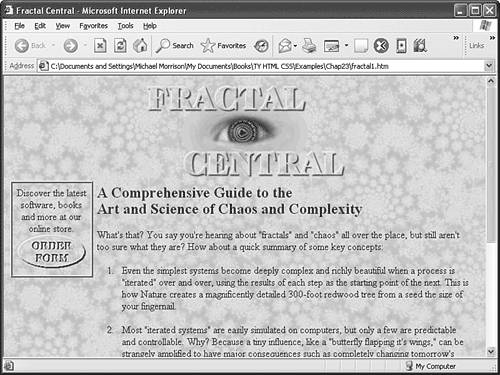 The contents of the page in Listing 23.2 and Figure 23.2 look to a human being almost the same as those of the page in Listing 23.1 and Figure 23.1. To search robots and search engines, however, these two pages appear quite different. The following list summarizes the changes and explains why I made each modification:
Figure 23.2. The first part of the page in Listing 23.2, as it appears in a web browser.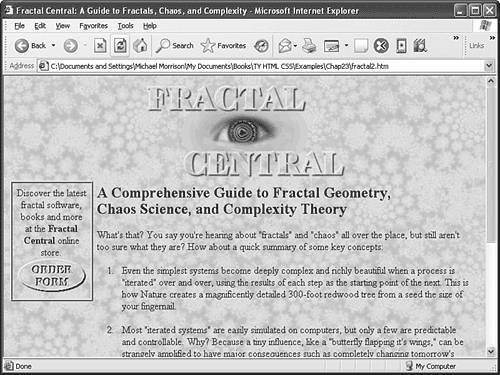 It is impossible to quantify how much more frequently people searching for information on fractals and chaos were able to find the page shown in Listing 23.2 versus the page shown in Listing 23.1, but it's a sure bet that none of the changes could do anything but improve the page's visibility to search engines. As is often the case, the improvements made for the benefit of the search spiders probably made the page's subject easier for humans to recognize and understand as well. This makes optimizing a page for search engines a win-win effort! Listing 23.2. An Improvement on the Page in Listing 23.1<?xml version="1.0" encoding="UTF-8"?> <!DOCTYPE html PUBLIC "-//W3C//DTD XHTML 1.1//EN" "http://www.w3.org/TR/xhtml11/DTD/xhtml11.dtd"> <html xmlns="http://www.w3.org/1999/xhtml" xml:lang="en"> <head> <title>Fractal Central: A Guide to Fractals, Chaos, and Complexity</title> <meta name="description" content="A comprehensive guide to fractal geometry, chaos science and complexity theory." /> <meta name="keywords" content="fractal, fractals, chaos science, chaos theory, fractal geometry, complexity, complexity theory" /> </head> <body style="background-image:url(fractalback.jpg); color:#003399"> <div style="text-align:center"> <img src="/books/4/158/1/html/2/fractalaccent.gif" alt="Fractal Central: A Guide to Fractals, Chaos, and Complexity" /> </div> <div style="width:133px; float:left; padding:6px; text-align:center; border-width:4px; border-style:ridge"> Discover the latest fractal software, books and more at the <span style="font-weight:bold">Fractal Central</span> online store.<br /> <a href="orderform.html"><img src="/books/4/158/1/html/2/orderform.gif" alt="Order Form" style="border-style:none" /></a> </div> <div style="float:left; padding:6px"> <h2>A Comprehensive Guide to Fractal Geometry,<br /> Chaos Science, and Complexity Theory</h2> <p>What's that? You say you're hearing about "fractals" and "chaos" all over the place, but still aren't too sure what they are? How about a quick summary of some key concepts:</p> <ol> <li><p>Even the simplest systems become deeply complex and richly beautiful when a process is "iterated" over and over, using the results of each step as the starting point of the next. This is how Nature creates a magnificently detailed 300-foot redwood tree from a seed the size of your fingernail.</p></li> <li><p>Most "iterated systems" are easily simulated on computers, but only a few are predictable and controllable. Why? Because a tiny influence, like a "butterfly flapping its wings," can be strangely amplified to have major consequences such as completely changing tomorrow's weather in a distant part of the world.</p></li> <li><p>Fractals can be magnified forever without loss of detail, so mathematics that relies on straight lines is useless with them. However, they give us a new concept called "fractal dimension" which can measure the texture and complexity of anything from coastlines to storm clouds.</p></li> <li><p>While fractals win prizes at graphics shows, their chaotic patterns pop up in every branch of science. Physicists find beautiful artwork coming out of their plotters. "Strange attractors" with fractal turbulence appear in celestial mechanics. Biologists diagnose "dynamical diseases" when fractal rhythms fall out of sync. Even pure mathematicians go on tour with dazzling videos of their research.</p></li> </ol> <p>Think all these folks may be on to something?</p> </div> <div style="text-align:center"> <a href="http://netletter.com/nonsense/"><img src="/books/4/158/1/html/2/findout.gif" alt="Find Out More" style="border-style:none" /></a> </div> </body> </html>
|

EAN: 2147483647
Pages: 345