Flylib.com

Books Software


Using the Outlook Menu Bar


Using the Outlook Menu Bar

graphics/01inf06.jpg

graphics/one_icon.jpg

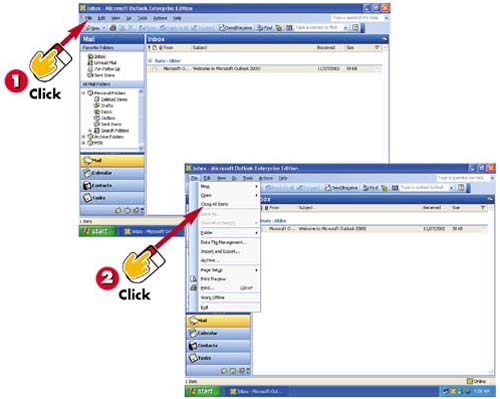
Click a menu name in the menu bar (in this case, File ).

graphics/tow_icon.jpg

The menu opens, displaying a list of available commands. Click a command to execute it, or click outside the menu to close the menu without making a selection.

INTRODUCTION

The Outlook menu bar lists the commands you can execute within Outlook. When you want to perform a particular action in Outlook, you select the appropriate command from the menu bar. For example, to print a message, you open the File menu and select the Print command. In this task, you'll explore Outlook's various menus .

TIP

Command Not Available?

If a command in a menu is colored gray, that command is unavailable. For example, the Paste command in the Edit menu is grayed out until you cut or copy text to be pasted.

graphics/01inf07.jpg

graphics/three_icon.jpg

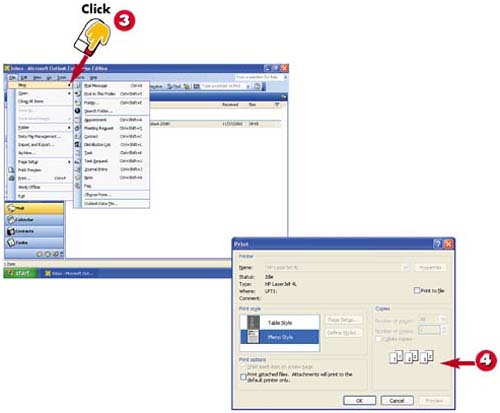
Clicking a command followed by a right-pointing arrow opens a submenu containing additional options. For example, click New to choose from the various new items you can create.

graphics/foure_icon.jpg

Clicking a command followed by an ellipsis opens a dialog box containing various options. For example, clicking Print opens the Print dialog box. Make your selections in the dialog box and click OK .

TIP

Expanding Menus

By default, when you click a menu name, Outlook displays a short version menu that contains only the commands you use frequently. To expand the menu to display all its commands, click the down-arrow button at the bottom of the menu. To configure Outlook to display the entire menu by default, open the Tools menu and choose Customize ; in the dialog box that opens, click the Options tab, click the Always Show Full Menus check box to put a check mark in it, and click the Close button.

Using the Outlook Toolbar

graphics/01inf08.jpg

graphics/one_icon.jpg

Click the button that represents the command you want to execute. For example, to send and receive e-mail messages, click the Send/Receive button.

graphics/tow_icon.jpg

If a button features a drop-down arrow, click the arrow to display additional commands, and then click the desired command. For example, to create a new message, click the New button and select Mail Message from the list that appears.

INTRODUCTION

In addition to using the Outlook menus to issue commands, you'll find buttons for commonly used commands on the Outlook toolbar.

TIP

Toolbars Reflect Selected Tool

The buttons and commands available on the toolbar change depending on what tool is selected ”Calendar, Mail, or what have you. For example, if you click the down arrow next to the New button while using the Mail tool, you'll see commands for creating new mail messages. If you click the same button while working with Calendar, however, you'll see commands for scheduling new appointments.


Changing the Outlook Window Layout

graphics/01inf09.jpg

graphics/one_icon.jpg

Click the View menu.

graphics/tow_icon.jpg

A list of the various items you can hide or display appears. If an item is checked, it is displayed; select the checked item to hide it.

graphics/three_icon.jpg

To hide or display toolbars , open the View menu and choose Toolbars . A submenu of available toolbars appears; select an unchecked toolbar to display it, or select a checked toolbar to hide it.

graphics/foure_icon.jpg

The change is made. Here you see the Outlook window with the Web toolbar displayed and the Outlook Bar hidden.

INTRODUCTION

If you prefer a more streamlined Outlook window, you can hide some of the toolbars and other screen elements. Alternatively, if you prefer to display more options in the Outlook window, you can display additional items onscreen.