Flylib.com

Books Software


Acquire the project team

Acquire the project team

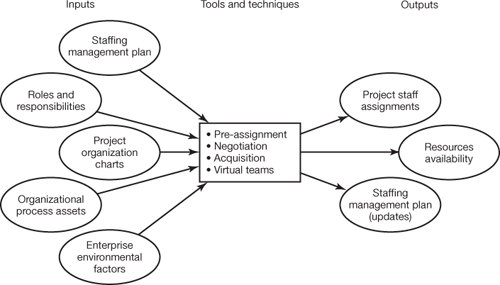
Figure 9.5 shows the process group for acquiring the project team. The inputs to this process are the organizational process assets, enterprise environmental factors and the three outputs from the human resources planning process: roles and responsibilities, project organization charts , and staffing management plan.

Figure 9.5. The acquire project team process

Adapted from PMBOK Guide (p.209)


There are four tools and techniques to use during this process. The first technique is pre-assignment. This is where project team members know in advance that they are to work on the project. This often occurs when specific individuals are committed to the project as part of a competitive pitch. The second technique is negotiation. Often the process of acquiring team members requires the project manager to compete for key personnel. Negotiation may occur between competing projects or with functional managers. It is often the project manager's influence within an organization that results in obtaining the required people. The third technique is acquisition. This technique is used when there is no internal resource to fulfil an aspect of the project. The project manager can choose to hire a new employee, engage consultants or sub-contract the work out. The final tool is the use of virtual teams .

PMI says

Virtual teams

'Virtual Teams. Groups of people with a shared goal, who fulfil their roles with little or no time spent meeting face-to-face. The availability of electronic communication, such as e-mail and video conferencing, has made such teams feasible .' PMBOK Guide (p.379)


Top of Page

Develop the project team

It is the project manager's responsibility to develop the project team. At the start of a project it is often the case that the team may not have worked together before. The project manager must ensure that the team develops into a group of individuals capable of delivering the project on time, on budget and on scope. The develop project team process is shown in Figure 9.6.

Figure 9.6. The develop project team process

Adapted from PMBOK Guide (p.212)


PMI says

Training

'Training. All activities designed to enhance the competencies of the project team members .' PMBOK Guide (p.213)


Training can be provided formally , such as obtaining certification, or informally, such as ad-hoc coaching sessions. The third technique is team-building activities. Team-building activities can vary enormously, ranging from a weekly team meeting to a team awayday. Project tasks can also be used for team building, such as the development of the work breakdown structure. The fourth tool is ground rules. It is imperative that the standards for acceptable behaviour are established at the start of the project. In fact the development of the ground rules can be a team-building exercise in the form of a workshop. The project manager must ensure that the team understand not only the rules but also the shared responsibility of enforcing them.

The fifth technique is the co-location of a team. This involves ensuring as many team members as possible are based, ideally , in the same room. If this is not possible, co-location on the same floor or in the same building will often suffice. If it is not possible to have the team in the same building, such as in a multi-country project, other methods must be thought of. One way to achieve this is by the creation of team pages on the organization's intranet. Another is the creation of virtual teams , making the most of novel technology, such as video conferencing and instant messaging.

The sixth and final tool is recognition and rewards. This technique identifies and provides incentives for desirable conduct throughout the project. It is important to reward only good behaviour; for example, working weekends to ensure a software product is ready for the publicized launch date is worth rewarding if the schedule was tight. It is not worth rewarding if the programmer was often absent without notice and was using the weekends to catch up on work. The PMI makes a clear distinction between win “lose and win “win rewards.

PMI says

Win “win versus win “lose

'Win “Lose rewards that only a limited number of project team members can achieve, such as team member of the month, can hurt team cohesiveness. Rewarding Win “Win behaviour that everyone can achieve, such as turning in progress reports on time, tends to increase support among team members.' PMBOK Guide


{% if main.adsdop %}{% include 'adsenceinline.tpl' %}{% endif %}

There is only one output from this process “ the team performance assessment. As the project team develops, their performance should increase. The performance assessment will evaluate the team's effectiveness by looking at various performance indicators, such as increased productivity, improved competencies, and reduced staff turnover .

Top of Page