Addressable Programming-Aircraft Station
Addressable Programming
A cable TV (CATV) industry term . A subscriber orders a movie or sports event. He does that calling a phone number ( generally an 800 number). A computer answers, grabs the calling number, confirms the request, then hangs up. The computer passes the request onto the cable company's computer, which checks the calling phone number against its accounting records. If the subscriber has good credit, the cable company sends a coded message down its cable network to the caller's set-top cable box/converter. The message temporarily enables that particular converter to descramble the channel offering the desired program.
Addressability
-
In computer graphics, the number of addressable points on a display surface or in storage.
-
In micrographics, the number of addressable points, within a specified film frame, written as follows : the number of addressable horizontal points by the number of addressable vertical points, for example, 3000 by 4000.
-
A cable TV term. The capability of controlling the operation of cable subscriber settop converters by sending commands from a central computer. Such addressability is absolutely required for a cable system to offer pay-per-view services.
Addressable Point
In computer graphics, any point of a device that can be addressed. See Addressability.
Addressed Call Mode
A mode that permits control signals and commands to establish and terminate calls in V.25bis. See also V.25 bis.
Addressee
The intended recipient of a message.
Addressing
Refers to the way that the operating system knows where to find a specific piece of information or software in the application memory. Every memory location has an address.
ADF
-
Automatic Document Feeder.
-
Adapter Description File.
ADH
-
Average Delay to Handle. Average time a caller to an automatic call distributor waits before being connected to an agent.
-
Automatic Data Handling.
Adherence
A term used in telephone call centers to connote whether the people working in the center are doing what they're meant to be doing. Are they at work? Are they on break? Are they answering the phone? Are they at lunch ? All these activities are scheduled by workforce management software. If they're in line, the workers are "in adherence." If not, they're "out of adherence." See Adherence Monitoring.
Adherence Monitoring
Adherence monitoring means comparing real-time data coming out of an ACD with forecast call volumes , forecast service levels and forecast work- force employment levels. The idea is to see if the people, the calls and the system are working as forecast. This a measure of how well your forecasting works. You need to know how well it works since it's your forecasting on which you base your employment. See Adherence.
Adjacency
Relationship formed between selected neighboring routers and end nodes for the purpose of exchanging routing information. Adjacency is based upon the use of a common media segment.
Adjacent Cell
A cellular radio term. Two cells are adjacent if it is possible for a Mobile End System (M-ES) to maintain continuous service while switching from one cell to the other.
Adjacent Channel Interference
When two or more carrier channels are placed too close together in the frequency spectrum, they interfere with each other and mess up each other's conversations.
Adjacent Colocation
Adjacent colocation is the same as physical colocation. See Colocation.
Adjacent MD-IS
A cellular radio term. Two Mobile Data Intermediate Systems (MDISs) are adjacent if each MD-IS controls one of a pair of adjacent cells.
Adjacent MTA
An MTA (Message Transfer Agent) that directly connects to another MTA. A Message Transfer Agent operated by a public service provider or PTT (Post, Telegraph, and Telephone administration), or a client MTA.
Adjacent Nodes
-
In SNA, nodes that are connected to a given node with no intervening nodes.
-
In DECnet and OSI, nodes that share a common network segment (in Ethernet, FDDI, or Token Ring networks).
Adjacency
A relationship formed between selected neighboring routers and end nodes for the purpose of exchanging routing information. Adjacency is based upon the use of a common media segment.
Adjacent Channel
A channel or frequency that is directly above or below a specific channel or frequency.
Adjacent nodes
-
In SNA, nodes that are connected to a given node with no intervening nodes.
-
In DECnet and OSI, nodes that share a common network segment (in Ethernet, FDDI, or Token Ring networks).
Adjacent Signaling Points
Two CCS/SS7 signaling points that are directly interconnected by signaling links.
Adjunct
-
Network system in the Advanced Intelligent Network Release 1 architecture that contains SLEE (Service Logic Execution Environment) functionality, and that communicates with an Advanced Intelligent Network Release 1 Switching System in processing AIN Release 1 calls. See also Adjunct Processor.
-
An auxiliary device connected to the ISDN set, such as a speakerphone, headset adapter, or an analog interface.
Adjunct Key System
A system installed behind a PBX or a Centrex. Such a key system provides the users with several more features than the PBX or Centrex. Not a common term today.
Adjunct Power
Power supplied to optional data or voice equipment in an equipment room, telecommunications closet, or work area, through separate power supplies .
Adjunct Processor
-
A computer outside a telephone switching system that "talks" to the switch and gives it switching commands. An adjunct processor might include a database of customers and their recent buying activities. If the database shows that a customer lives in Indiana, the call from the customer might be switched to the group of agents handling Indiana customers. Adjunct processors might also be concerned with energy management, building security etc.
-
An AIN (Advanced Intelligent Network) term for a decentralized SCP (Signal Control Point). An Adjunct Processor supports AIN services which are limited to one or more SSPs (Service Switching Points), which are SS7-equipped Central Office PSTN switches. Where multiple SSPs are supported, they typically comprise a regional network grouping. Adjunct Processors can include routing logic or call authorization security specific to a particular geographic area, providing switches with switching commands.
Adjunct Service Point
ASP. An intelligent-network feature that resides at the Intelligent peripheral equipment and responds to service logic interpreter requests for service processing.
Adjunct Switch Application Interface.
See ASAI.
Adjusted Ring Length
When a segment of Token Ring (in practice a dual ring) trunk cable fails, a function known as the Wrap connects the main path to the backup path . In the worse case ” the longest path ” would occur if the shortest trunk cable segment failed, so ARL is calculated during network design to ensure the network will always work.
ADK
Application Definable Keys.
ADM
Add/Drop Multiplexer. A multiplexer, such as a terminal multiplexer, capable of extracting and inserting lower-rate signals from a higher-rate multiplexed signal without completely demultiplexing the signal. Also a SONET/SDH term for a device which can either insert or drop DS1, DS2, and DS3 channels or SONET signals into/from a SONET bit stream. The ADM literally can reach up into the SONET pipe and extract a DS1-level signal, without going through the rigorous process of demultiplexing and remultiplexing which is required in the traditional T/E-carrier world. While the devices are much more complex than are TDMs, the process is much faster, induces no signal delay, creates no signal errors. The ADM also provides for dynamic bandwidth allocation, optical hubbing, and ring protection.
ADMD
Administration Management Domain. An X.400 Message Handling System public carrier. Examples include MCImail and ATTmail in the U.S., British Telecom's Gold400mail in the U.K. The ADMDs in all countries worldwide together provide the X.400 backbone.
Admin
Administration.
Adminisphere
The rarefied organizational layers beginning just above the rank and file. Decisions that fall from the adminisphere are often profoundly inappropriate or irrelevant to the problems they were designed to solve. This definition from Wired Magazine.
Administrable Service Provider
An SCSA definition. A service provider which supports administrable services (for example, SCSA Call Router).
Administration
-
The method of labeling, identifying and documenting an organization's voice/data communications cabling infrastructure.
-
A term used by the telephone industry to program features into a phone system. On a Northern Telecom Norstar system, administration includes making settings on
-
System speed dial;
-
Names on phones;
-
Time and date;
-
Restrictions;
-
Overrides;
-
Permissions;
-
Night Service and
-
Passwords.
-
Administration By Telephone
The capability for the system administrator to perform most routine system administrative functions remotely from any Touch Tone pad. Such functions include mailbox maintenance (e.g. create, delete, set password, set class of service, etc.) and disk maintenance.
Administration Directory Management Domain
A X.500 directory management domain run by a PTT (Posts, Telegraph, and Telephone administration) or other public network provider.
Administration Sub-system
Part of Lucent's premises distribution system that distributes hardware components for the addition or rearrangement of circuits.
Administrative Alerts
A Windows NT term. Administrative alerts relate to server and resource use; they warn about problems in areas such as security and access, user sessions, server shutdown because of power loss (when UPS is available), directory replication, and printing. When a computer generates an administrative alert, a message is sent to a predefined list of users and computers.
Administrative Assistant
Admin. The PC (Politically Correct) term these days for what we used to call a secretary. Some knucklehead in HR (Human Resources), which we used to call Personnel), probably invented the term to make secretaries feel more important. Actually, admins do a lot more than secretaries used to do, and they really are more important. It still seems like a silly name to the old-timers, though.
Administrative Council for Terminal Attachments
See ACTA.
Administrative Distance
Cisco defines administrative distance as a rating of the trustworthiness of a routing information source. Administrative distance is often expressed as a numerical value between 0 and 255. The higher the value, the lower the trustworthiness rating.
Administrative Domain
-
AD. A group of hosts and networks operated and managed by a single organization. An Internet term.
-
An ATM term. A collection of managed entities grouped for administrative reasons.
Administrative Layer
The Virtual Network Service layer that provides the customer and telco with the ability to monitor, maintain, reconfigure, and manage the network. The administrative layer consists of two components: Service View Management tools and Applications Hosts.
Administrative Management Domain
An X.400 electronic mail term: a network domain maintained by a telecommunications carrier.
Administrative Operating Company Number
See AOCN.
Administrative Point
A location at which communication circuits are administered, i.e. rearranged or rerouted, by means of cross connections, interconnections, or information outlets.
Administrative Service Logic Program
ASLP. The SLP responsible for managing the feature interactions between Advanced Intelligent Network Release 1 features resident on a single SLEE (Service Logic Execution Environment).
Administrative Subsystem
That part of a premises distribution system where circuits can be rearranged or rerouted. It includes cross connect hardware, and jacks used as information outlets.
Administrative Trunk Groups
A category of telephone company trunk groups that provide call status monitoring. The function may be one of revenue protection (i.e., coin overtime collection), telephone operator assistance (i.e., verification), protection of the message network from overloads (i.e., no-circuit announcements.), etc. Types of trunk groups in this category include: Announcement, Coin Supervisory, Coin Zone, Permanent Signal, Vacant Code and Verification.
Administrative Weight
A value set by the network administrator to indicate the desirability of a network link. One of four link metrics exchanged by PTSPs to determine the available resources of an ATM network. See PTSP.
Administrator
The individual responsible for managing the local area network (LAN). This person configures the network, maintains the network's shared resources and security, assigns passwords and privileges, and helps users.
Administrivia
A silly term for administrative tasks , most often related to the maintenance of mailing lists, digests, news gateways, etc. An Internet term.
ADML
Asymmetric Digital Microcell Link. A Telcordia standard for Wireless Local Loop (WLL). Using low-power, omnidirectional radio systems, ADML can be deployed to cover an area as large as 1 mile in radius. ADML supports as much as 1 Gbps aggregate bandwidth, providing individual users with bandwidth in radio channels as great as T-1 (1.544 Mbps). See also Wireless Local Loop and LMDS.
ADN
Advanced Digital Network. ADN is Pacific Bell of California's low-cost leased 56 Kbps digital service. ADN is available for intraLATA calls.
ADO
Auxiliary Disconnect Outlet. A device usually located within the tenant or living unit used to terminate the ADO cable or backbone cable. Source ANSI/TIA/EIA-570-A.
ADP
-
Apple Desktop Bus. A synchronous serial bus allowing connection of the Mac keyboard, mouse and other items to the CPU. A Mac keyboard or mouse is called an ADB device. Contrast with peripherals, which attach through the SCSI interface.
-
Automatic Data Processing. The same as DP, data processing.
-
The name of a company which processes my pay check.
ADPCM
Adaptive Differential Pulse Code Modulation. A speech coding method which uses fewer bits than the traditional PCM (Pulse Code Modulation). ADPCM calculates the difference between two consecutive speech samples in standard PCM coded telecom voice signals. This calculation is encoded using an adaptive filter and therefore, is transmitted at a lower rate than the standard 64 Kbps technique. Typically, ADPCM allows an analog voice conversation to be carried within a 32-Kbps digital channel; 3 or 4 bits are used to describe each sample, which represents the difference between two adjacent samples. Sampling is done 8,000 times a second. ADPCM, which many voice processing makers use, allows encoding of voice signals in half the space PCM allows. In short, ADPCM is a reduced bit rate variant of PCM audio encoding. See also DPCM and PCM.
ADPE
Automatic Data Processing Equipment.
ADQ
Average Delay in Queue. An important measure of the customer responsiveness of a call center. See also ASA, Average Speed of Answer.
ADR
See American Depositary Receipt.
ADRMP
(pronounced add-rump) AutoDialing Recorded Message Player. A device that calls a bunch of telephone numbers and upon connection will play a message to the answering person. ADRMPs are used for lead solicitation and message delivery. They are often unpopular due to their indiscriminate dialing pattern and random message playing.
ADS
-
AudioGram Delivery Services.
-
The IETF working groups are grouped into areas, and managed by Area Directors, or ADs. The ADs are members of the Internet Engineering Steering Group (IESG). Providing architectural oversight is the Internet Architecture Board, (IAB). The IAB also adjudicates appeals when someone complains that the IESG has failed. The IAB and IESG are chartered by the Internet Society (ISOC) for these purposes. The General Area Director also serves as the chair of the IESG and of the IETF, and is an ex-officio member of the IAB.
ADSI
-
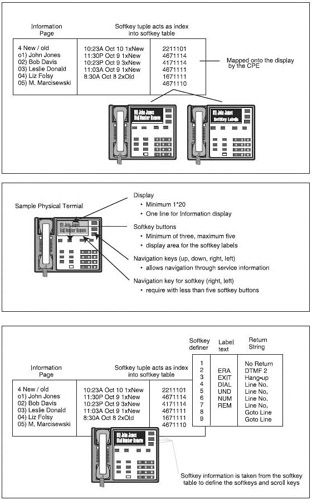
Analog Display Services Interface. ADSI is a Telcordia standard defining a protocol on the flow of information between something (a switch, a server, a voice mail system, a service bureau ) and a subscriber's telephone, PC, data terminal or other communicating device with a screen. The simple idea of ADSI is to add words to, and therefore a modicum of simplicity of use to a system that usually uses only touchtones. Imagine a normal voice mail system. You call it. It answers with a voice menu. Push 1 to listen to your messages, 2 to erase them, 3 to store them, 4 to forward them, etc. It's confusing. You have to remember which is which. ADSI is designed to solve that. It's designed to send to your phone's screen the choices in words that you're hearing. You then have the choice of responding to what you hear or what you see. Your response is the same ” a touchtone button. ADSI's signaling is DTMF and standard Bell 202 modem signals from the service to your 202-modem equipped phone. From the phone to the service it's only touchtone. With ADSI, you don't hear the modem signaling because every time the service gets ready to send you information, it first sends a "mute" tone. ADSI works on every phone line in the world. For ADSI to work visually, you'll need a special ADSI-equipped phone (Nortel has one showing 8 lines by 20 characters ) or a piece of ADSI software in your PC. The nice feature of ADSI is that the standard is so flexible, it can work on cheap phones with a small display and more expensive phones with a bigger display and on a PC with a real big display.
-
A set of Microsoft ActiveX controls that abstract the capabilities of directory services from different network providers to present a single set of directory service interfaces for accessing and managing network resources.
ADSL
Asymmetric Digital Subscriber Line. One of a number of DSL technologies, and the most common one. ADSL is designed to deliver more bandwidth downstream (from the central office to the customer site) than upstream. The technical reason for this asymmetry has to do with issues of cross- coupled interference in the forms of FEXT (Far-End CrossTalk) and NEXT (Near-End CrossTalk). As it turns out, the asymmetry suits the applications perfectly , as DSL is used primarily for access to the Internet and Web, in which most people need fast downloads (music, software, presentations, etc.) but don't need high- speed uploads. They need it for e-mail and instant messaging. In ADSL, downstream rates range from 256,000 bits per second to as much as nine million bits per second, whereas upstream bandwidth ranges from 16 to 640 thousand bits per second. But these figures are changing. And these days, phone companies, which are the primary providers of ADSL service, sell their offerings in all sorts of speeds. Typically the more you pay, the faster service you get. ADSL transmissions work at distances up to 18,000 feet (5,488 meters ) over a single copper twisted pair. See also HDSL, SDSL, and VDSL.
ADSL was developed by Telcordia and is now standardized by ANSI as T1.413; ETSI (European Telecommunications Standards Committee) contributed an Annex to the standards to reflect European requirements. ADSL technology splits the bandwidth of a qualifying pair to support multiple channels. An analog channel running at 4 kHz and below supports analog voice and fax. Packet data runs at 25kHz and above. Performance of ADSL lines is subject to the condition of the twisted-pair cable plant. Factors which affect performance include length of the loop, wire gauge (diameter), presence of bridge taps (better not to have any), and cross-coupled interference (NEXT and FEXT). Assuming no bridge taps and assuming 24-gauge copper, ADSL will deliver downstream 1.5/2.0 Mbps over a distance of about 18,000 ft (5.5 km.). At 6.1 Mbps, 12,000 ft (3.7 km.) is the maximum length of the loop. Where the length of the loop exceeds those maximums, the achievable transmission rate drops precipitously due to signal attenuation and associated error performance. Error performance is addressed through FEC (Forward Error Correction), thereby maximizing throughput. Special electronics at both ends of the connection are required in order to accomplish the minor miracle of ADSL. At the carrier end of the connection is placed an ATU-C (ADSL Termination Unit-Centralized), while an ATU-R (ADSL Termination Unit ”Remote) is placed at the customer premises. In order to achieve such a high data rate over UTP, relatively sophisticated compression techniques must be employed. While the standard calls for use of DMT (Discrete Multi-Tone), DMT implementations have experienced some difficulty. See also ADSL Forum, ADSL Lite, ADSL2 and DSL Filter.
ADSL Forum
The ADSL Forum is an industry association formed to promote the ADSL concept and to facilitate the development of ADSL system architectures and protocols for major ADSL applications. Its anme ahs been changed to DSL Forum.
ADSL Lite
Also known as G.lite, Universal ADSL and Splitterless ADSL, a proposal of the UAWG (Universal ADSL Working Group) for a simplified version of ADSL. An interoperable extension of ANSI T-1.413 ADSL, ADSL Lite is application-specific, designed specifically for Internet access, which is unlike the original ADSL concept. ADSL Lite allows access to the Internet through a modem (either internal or external) operating at speeds of as much as 1.5 Mbps over existing twisted pair local loops of relatively short length (under three miles) and of good quality, with no loading. According to the UAWG, "By reducing the complexity of the on-site installation and the need for new wiring at the user's home, G.Lite ADSL makes it possible to more cost-effectively increase bandwidth for the consumer up to 30 times the speed of the current highest-speed analog modem technology. With the ability to deliver "always-on" Internet access at higher speeds, G.Lite ADSL dramatically improves the consumer's online experience. In late March, 1999, I was lucky enough to have a G.Lite ADSL line installed at my home. Everything above is accurate. The line is 30 times as fast a 56 Kbps dialup. It is "always on." This means my emails flow at me constantly. I don't have to dial in. I get them within seconds of my correspondents sending them. And, the best yet, my line is only $60 a month, about twice what a dial-up phone line plus unlimited usage ISP service cost me ” but at least one tenth what a fractional (i.e. slower speed) T-1 would cost me. I am very pleased.
ADSL2
Also known as ITU Recommendation G.992.3, ADSL2 was approved by the ITUT in August 2002. ADSL2 improvements include line diagnostics, power management, power cutback, reduced framing and on-line configuration.
ADSP
Apple Datastream Protocol. A transport mechanism for interprocess communications between Apple Macintosh and Dec Vax minicomputers.
ADSTAR
Automated Document STorage And Retrieval.
ADSU
ATM DSU. Terminal adapter used to access an ATM network via an HSSI-compatible device. See also DSU.
ADT
-
Abstract Data Type.
-
Audio Tracking Database.
ADTF
ACR Decrease Time Factor: This is the time permitted between sending RM-cells before the rate is decreased to ICR (Initial Cell Rate). The ADTF range is .01 to 10.23 sec with granularity of 10 ms.
ADTS
Automated Digital Terminal System.
ADU
Asynchronous Data Unit.
Advance Payment
Payment of all or part of a charge required before start of service.
Advance Replacement
See Advance Replacement.
Advance Replacement Warranty
A warranty service whereby the dealer sends the customer a replacement component before the customer returns the defective product. This not only accelerates the replacement time, but also helps the buyer if the component is vital. When you buy vital telecom gear, it's good to check that your equipment has an Advance Replacement Warranty or Guarantee.
Advanced Branch Exchange
ABX. An uncommon term meaning a private branch exchange (PBX) with advanced features normally including the ability to handle both voice and data in some sort of integrated way.
Advanced Communications Service
ACS. A large data communications network established by AT&T.
Advanced CoS Management
Advanced Class of Service Management. Essential for delivering the required QoS to all applications. Cisco switches contain per-VC queuing, per-VC rate scheduling, multiple CoS queuing, and egress queuing. This enables network managers to refine connections to meet specific application needs. Formerly called FairShare and OptiClass.
Advanced Data Communications Control Procedures
ADCCP. A bit-oriented, link-layer , ANSI-standard communications protocol.
Advanced Data Communications Control Protocol
See AEP.
Advanced Intelligent Network
AIN. The local Bell telephone companies' architecture for the 1990s and beyond. See AIN for a much fuller explanation.
Advanced Interactive Executive
AIX. An IBM version of UNIX. AIX runs on PS/2 computers, IBM workstations, minicomputers, and mainframes.
Advanced Interactive Video
AIV. Interactive videodisc format and system using LV-ROM, a method of storing analog video, digital audio, and digital data on a single videodisc. The system was developed by Philips UK, the British Broadcasting Corporation, Acorn Computer, and Logica Ltd. Most prominent application was the BBC's Domesday Project.
Advanced Mobile Phone Service
AMPS. The analog cellular system originally developed by AT&T and currently installed throughout the United States (800 MHz) and various other regions around the world. AMPS transmits data by varying the frequency of a radio signal. The system uses Frequency Division Multiple Access (FDMA) for access control and Frequency Division Duplex (FDD) for two-way base station-to-subscriber conversation. Each AMPS cell site can accomodate 832 simultaneous calls. See AMPS.
Advanced Peer-to-Peer Networking
APPN. An SNA protocol that allows network nodes to interact without using a host computer. Instead, each network device runs both client and server portions of an application.
Advanced Power Management
An industry standard for taking advantage of a computer's power saving features. Used particularly in battery- powered laptops.
Advanced Private Line Termination
An AT&T/Lucent term which means the PBX user gets access to all the services of an Enhanced Private Switched Communications Services (EPCS) network. It also works when it is associated with AT&T's Common Control Switching Arrangement (CCSA) network.
Advanced Radio Data Information Service
ARDIS. A network originally developed by Motorola for IBM's field service personnel. The service was established commercially in 1990 by a partnership between IBM and Motorola. In 1994, IBM sold its interest back to Motorola. ARDIS has coverage in more than 400 major metropolitan areas and more than 10,000 cities. The ARDIS network is based on a Motorola technology called Data TAC and has traditionally focused on vertical markets (i.e. specialized applications) with major customers, such as Otis Elevator, Sears, and a host of municipal public safety and emergency departments.
Advanced Research Projects Administration Network
ARPANet. The precursor to the Internet. Developed in the late 1960s by the Department of Defense as an experiment in wide-area networking that could survive a nuclear attack.
Advanced Services
This is the FCC's definition: Advanced telecommunications capability is the availability of high-speed, switched, broadband telecommunications that enables users to originate and receive high-quality voice, data, graphics, and video using any technology.
An older telephony definition of advanced services is as follows: Value-added telephony services beyond standard analog voice service. Advanced services include call waiting and call forwarding, private branch exchanges, ISDN, digital data, and other voice and data services.
Advanced Television System
ATV. Any television technology that provides audio and video quality that is better than is provided by the current television broadcast system, or that otherwise enhances the current system. This definition, courtesy the FCC. Your taxpayer monies paid for it. See also ATV, DTV, HDTV, and SDTV.
Advanced Voice Busy Out
AVBO.
Advancenet
An Ethernet-based local area network from Hewlett Packard, Palo Alto, CA. See Ethernet.
Adventure Gaming
An interactive role-playing computer game in which the player becomes a character in the narrative.
Advergaming
An advertising technique in which the detailed product information is embedded in a computer game played online, designed to actively engage the player with the marketing message. It's aimed at young people. These games often capture information about the players which can be used in follow-up marketing campaigns .
Advertainment
This is marketing-speak for television adverts that are designed to be entertaining or funny , with the placement of the product played down. Some have been created by Hollywood directors such as the Coen Brothers or Spike Lee. There is now even a video-on-demand channel in the US on which you can watch your favorites.
Advertising
A packet switched networking term. Advertising is a process in which routing or service updates are sent at specified intervals so that other routers on the network can maintain lists of usable routes.
Advice of Charge
AOC. Basically this is fancy name for seeing on your phone what you're being charged for the call as you speak. This service comes with some cell phones and some ISDN phones.
Adviser
Some people think it should be spelled adviser. Some think it should be spelled advisor. The most common spelling is adviser.
Advisor
See Adviser.
Advisory Tones
Signals such as dial tone, busy, ringing, fast-busy, call-waiting, camp-on and all the other tones your telephone system uses to tell you that something is happening or about to happen.
AE
Account Executive. A fancy, schmanzy name for a salesperson. The idea is that the customer is an "account," and the salesman is the executive running the account. Telephone companies call their salespeople account executives ” especially on the equipment and non-long distance side.
AEB
Analog Expansion Bus. The analog voice processing bus designed by Dialogic which allows multiple cards to route audio signals within a PC. It is used to interface DTI/124 and D/4x voice response component boards which fit in an AT-expansion slot of a PC. See also PEB and SCSA which are more modern digital expansion buses.
AEC
-
Acoustic Echo Cancellation.
-
Alternate Exchange Carrier. See CLEC.
AECN
Alternate Exchange Carrier Name. A unique identifier for a CLEC. It is a 4 digit number. CLEC stands for competitive local exchange carrier. Some phone companies call the AECN an ECC, which stands for Exchange Carrier Code. See ECC and Industry Standard Codes.
AECS Plan
Aeronautical Emergency Communications System Plan. The AECS Plan provides for the operation of aeronautical communications stations on a voluntary, organized basis to provide the President and the Federal Government, as well as heads of state and local governments , or their designated representatives, and the aeronautical industry, with a means of communicating during an emergency.
AEMIS
Automatic Electronic Management Information System. This was the first computerized UCD/ACD reporting system introduced by AT&T for CO UCD (Uniform Call Distribution). This package was updated to become the PRO 150/500 system for UCD management on the Dimension PBX/UCD. AEMIS was the successor to the FADS or Force Administration Data System. It was an electro-mechanical system of peg counters and different colored busy lamp fields used to note trunk and position status.
AEP
AppleTalk Echo Protocol. Used to test connectivity between two AppleTalk nodes. One node sends a packet to another node and receives a duplicate, or echo, of that packet.
Aerial Cable
Cables strung outside and overhead. They're called aerial even though they only hang from poles or buildings . Some aerial cable hangs by its own strength. Some is supported by steel wire above it. Stringing aerial cable is cheaper than burying it, though buried cable lasts longer.
Aerial Cross Box
Also called a tree stand. A cross box on a pole. Used when there's a narrow easement.
Aerial Distribution Method
A method of running cables through the air, typically pole-to-pole. The old fashioned way. Some phone companies say aerial cable is more reliable than underground . Certainly, it's cheaper to fix or add to. It just looks less appetizing.
Aerial Insert
In a direct-buried or underground cable run, an aerial insert is a cable rise to a point above ground, followed by an overhead run, e.g., on poles, followed by a drop back into the ground. An aerial insert is used in places where it is not possible or practical to remain underground, such as might be encountered in crossing a deep ditch, canal, river , or subway line.
Aerial Plant
Cable and other telephone paraphernalia that is suspended in the air on telephone or electric utility poles.
Aerial Service Wire Splice
A device used to splice aerial service wire and attached to the aerial wire. It's also called a football or a potato. Why? Because that's its shape.
AERM
SS7 MTP 2 function that provides monitoring of link alignment errors.
Aeronautical Advisory Station
An aeronautical station used for advisory and civil defense communications primarily with private aircraft.
Aeronautical Broadcast Station
An aeronautical station which makes scheduled broadcasts of meteorological information and notices to airmen. In certain instances, an aeronautical broadcast station may be placed on board a ship.
Aeronautical Earth Station
An earth station in the fixed-satellite service, or, in some cases, in the aeronautical mobile-satellite service, located at a specified fixed point on land to provide a feeder link for the aeronautical mobile-satellite service.
Aeronautical Emergency Communications System
AECS Plan. The AECS Plan provides for the operation of aeronautical communications stations, on a voluntary, organized basis, to provide the President and the Federal Government, as well as heads of state and local governments, or their designated representatives, and the aeronautical industry with communications in an emergency.
Aeronautical Fixed Service
A radiocommunication service between specified fixed points provided primarily for the safety of air navigation and for the regular, efficient and economical operation of air transport.
Aeronautical Fixed Station
A station in the aeronautical fixed service.
Aeronautical Mobile OR (off-route) Service
An aeronautical mobile service intended for communications, including those relating to flight coordination, primarily outside national or international civil air routes.
Aeronautical Mobile R (route) Service
An aeronautical mobile service reserved for communications relating to safety and regularity of flight, primarily along national or international civil air routes.
Aeronautical Mobile Satellite Service
A mobile satellite service in which mobile Earth stations are located on board aircraft; survival craft stations and emergency position-indicating radiobeacon stations may also participate in this service.
Aeronautical Mobile Satellite (OR) (off-route) Service
An aeronautical mobile-satellite service intended for communications, including those relating to flight coordination, primarily outside national and international civil air routes.
Aeronautical Mobile-Satellite (R) (route) Service
An aeronautical mobile-satellite service reserved for communications relating to safety and regularity of flight, primarily along national or international civil air routes.
Aeronautical Mobile Service
A mobile service between aeronautical stations and aircraft stations, or between aircraft stations, in which survival craft stations may participate; emergency position-indicating radiobeacon stations may also participate in this service on designated distress and emergency frequencies.
Aeronautical Multicom Service
A mobile service not open to public correspondence, used to provide communications essential to conduct activities being performed by or directed from private aircraft.
Aeronautical Radio Inc.
ARINC. The organization that coordinates the design and management of telecommunications systems for the airline industry. It's one of the largest buyers of telecommunications services and equipment in the world.
Aeronautical Radionavigation-Satellite Service
A radionavigation-satellite service in which Earth stations are located on board aircraft.
Aeronautical Radionavigation Service
A radionavigation service intended for the benefit and for the safe operation of aircraft.
Aeronautical Station
A land station in the aeronautical mobile service. In certain instances, an aeronautical station may be located on board ship or on a platform at sea.
Aerospace
Air force publicists coined the term "aerospace" to convince everyone that space was the business of those who fly in the air. According to the Economist Magazine, the "aerospace industry" was quickly accepted into the language, perhaps because President Eisenhower's alternative, the "military industrial complex," sounded rather more sinister. After the Apollo program, which ended in 1972, the "space" in aerospace often seemed like a syllable tacked on to make building airplanes sound grander. But the growth in satellite use in the 1980s made space a respectable business in its own right. In America as of writing in the fall of 1991, the annual sales of space hardware are now bigger than those of civilian aircraft.
AES
Advanced Encryption Standard. A standard for encryption which is intended to replace DES (Data Encryption Standard), a standard developed by IBM in 1977 and thought to be virtually uncrackable until 1997. The AES standard, which is expected to be developed and released in 2000, will be a symmetric, or private key, algorithm. It also will be a block cipher supporting key lengths ranging from 128 to 256 bits, and variable-length blocks of data. See also Block Cipher, DES, Encryption, and Private Key.
AET
Application Entity Title. The authoritative name of an OSI application entity, usually a Distinguished Name from the Directory.
AF
-
Audio Frequency. The range of frequencies which theoretically are audible to the human ear; i.e., 30 Hz - 20 KHz. Truly high fidelity audio covers the entire range. Full AF is not practical over the PSTN, as to much bandwidth is required. Most of us can't hear the full AF range, anyway. As you get older, your hearing deteriorates. See also Bandwidth.
-
Assigned Frame. Motorola definition.
AFAIK
As Far As I Know.
AFCEA
Armed Forces Communications and Electronics Association. An organization of military communications personnel and suppliers who fulfill the specialized needs of government and military communications. They run a big convention each year in Washington in May-June. www.afcea.org.
AFE
See Analog Front End.
AFI
An ATM term. Authority and Format Identifier: This identifier is part of the network level address header.
Affiliate
-
This definition from the Telecommunications Act of 1996. The term 'affiliate' means a person that (directly or indirectly) owns or controls, is owned or controlled by, or is under common ownership or control with, another person. For purposes of this paragraph, the term 'own' means to own an equity interest (or the equivalent thereof) of more than 10 percent. See the Telecommunications Act Of 1996.
-
A broadcast TV station not owned by a network, but one which includes the network's programs and commercials in its programming schedule.
Affiliated Sales Agency
ASA. A term for a company which resells the service of a phone company. Typically, the phone company pays the ASA a commission. Sometimes the commission is so large that it blurs the thinking of the ASA into recommending to its customers telecom products and services they would be better without.
Affiliates
Sites that steer user to another e-commerce site in return for a piece of the action, i.e. a percentage of any buy. Go to my site, www.harrynewton.com. There you'll find a button that suggests you buy this dictionary via ecommerce. Click on the button. It gets you to Amazon. If you buy the dictionary, I get 7% of what you paid from Amazon. I'm an Amazon sales affiliate. Please buy the book. I need the money.
AFI
Authority and Format Identifier. The portion of an NSAP format ATM address that identifies the type and format of the IDI portion of an ATM address. See also IDI and NSAP.
AFIPS
American Federation of Information Processing Societies. A national, highly- respected organization formed by data processing societies to keep abreast of advances in the field. AFIPS organizes one of the biggest trade shows in the data processing industry ” the NCC (National Computer Conference).
Affinity
Requirements of an MPLS traffic engineering tunnel on the attributes of the links it will cross. The tunnel's affinity bits and affinity mask bits of the tunnel must match the attribute bits of the various links carrying the tunnel.
AFI
Authority and Format Identifier. The part of an NSAP-format ATM address that identifies the type and the format of the IDI portion of an ATM address. See also IDI and NSAP.
AFN
All Fiber Network. Burlington, Vermont is building an AFN network for its municipality of 40,000 people. The AFN will first support city services. Then it will extend fast Internet service to its businesses and residences.
AFNOR
Acronym for Association Francaise de Normalisation. France's national standards-setting organization.
AFP
AppleTalk File Protocol. Apple's network protocol, used to provide access between file servers and clients in an AppleShare network. AFP is also used by Novell's products for the Macintosh.
AFS
Andrew File System.
AFT
Automatic Fine Tuning; See AFC.
After-call Wrap-up
The time an employee spends completing a transaction after the call has been disconnected. Sometimes it's a few seconds. Sometimes it can be minutes. Depends on what the caller wants.
Aftermarket
Trading in the Initial Public Offering after its IPO offering. Trading volume in IPOs is extremely high on the first day because of flipping (immediate selling) and aftermarket orders.
AGC
Automatic Gain Control. There are two electronic ways you can control the recording of something ” Manual or Automatic Gain Control (AGC). AGC is an electronic circuit in tape recorders , speakerphones, and other voice devices which is used to maintain volume. AGC is not always a brilliant idea since it will attempt to produce a constant volume level, that is, it will try to equalize all sounds ” the volume of your voice, and, when you stop talking, the circuit static and/or general room noise which you do not want amplified. Never record a seminar or speech using AGC. The recording will be decidedly amateurish. Manual Gain Control means there is record volume control and is thus, preferred in professional applications.
AGCOMNET
US Department of Agriculture's voice and data communications network.
Aged Packet
A data packet which has exceeded its maximum predefined node visit count or time in the network.
Agenda
A list, outline, or plan of things to be considered or done.
Agent
-
The classic definition of an agent is an entity acting on behalf of another.
-
This term comes from the huge telephone call-in reservation centers which the airlines, hotels and car rental services run. An agent is the person who answers your call, takes your order or answers your question. Agents are also called Telephone Sales Representatives or Communicators. The term "agent" was first used in the airline business. It came from gate or counter ticket agent.
-
An "Agent" is the person or persons you have legally authorized to order your telephone service and equipment from telephone companies.
-
In the computer programming sense of the word, an agent acts on behalf of another person or thing, with delegated authority. The agent's goals are those of the entity that created it. An agent is an active object with a mission, but agents are abstractions that can be implemented in any way, whereas an object has a formal definition.
Business Week in its February 14, 1994 issue wrote, "It's what computer scientists call an 'agent' ” a kind of software program that's powerful and autonomous enough to do what all good robots should: help the harried humans by carrying out tedious , time-consuming , and complex tasks. Software agents just now emerging from the research labs can scan data banks by the dozen , schedule meetings, tidy up electronic in-boxes, and handle a growing list of clerical jobs."
-
Windows 95 Resource Kit defined agent slightly differently. It said that an agent was software that runs on a client computer for use by administrative software running on a server. Agents are typically used to support administrative actions, such as detecting system information or running services.
See also Bot.
Agent Logon/ Logoff
A call center term. Agents begin their day by punching some buttons on their phone. This indicates to the automatic call distributor that they are now ready to take calls. Later in the day, they punch some other buttons and indicate to the ACD that they are now ready to stop working. This is called logoff.
Agent Sign On/Sign Off
A feature which allows any ACD agent to occupy any position in the ACD without losing his or her personal identity. Statistics are collected and consolidated about this agent and calls are routed to this agent no matter where he sits or how many positions he may occupy at one time.
Aggregate AMA Record
A telephone company AIN term. An AMA record generated to record multiple instances of service usage within a specified aggregation interval. It is created by formatting peg counts of AMA events.
Aggregate Bandwidth
The total bandwidth of channel carrying a multiplexed bit stream. It includes the payload and the overhead. For example, a T-1 line has an aggregate full duplex bandwidth of 1.544 million bits per second.
Aggregate Rate
The sum of the channel data rates for a given application.
Aggregation
-
An AMA (Automatic Message Accounting) function that accumulates AMA data, resulting in a less than detailed AMA record.
-
An ATM term. Token A number assigned to an outside link by the border nodes at the ends of the outside link. The same number is associated with all uplinks and induced uplinks associated with the outside link. In the parent and all higher-level peer groups, all uplinks with the same aggregation token are aggregated.
-
Making otherwise scattered data accessible at a single location, usually via a Web page. Aggregation is necessary to make sense of the hodgepodge of otherwise useful corporate data ” which can range from catalog information to pricing material, to product support, to news or marketing materials ” that results when previously disparate computer systems at a company and its partners are tied together.
Aggregation Device
A specialized ISDN terminal adapter that can aggregate, or bond, the two B channels "on the fly" into a single higher-speed connection. Some aggregation devices also include an Ethernet bridge, i.e. a connection to a local area network.
Aggregator
A breed of long distance reseller. An aggregator is essentially a sales agent for a long distance company. Here's how it works: The aggregator goes to a long distance company and says "May I sell your long distance service at a discount?" The long distance company says Yes. The aggregator hits the street and sells cut-rate long distance service to any and everyone. The long distance provider installs the service and bills it. The aggregator makes his profit by charging a fixed monthly service fee, a percentage of savings or some other arrangement. The key to it: The end user saves some money because his calls are "aggregated" with those of ALL the customers of the aggregator and the long distance company extends a bulk savings to the aggregator. At least that's the theory. "Should you ” as an end-user ” consider buying your long distance from an aggregator? The simple answer is YES. Discounts are sometimes so deep it's not uncommon for a company using a major carrier to switch to billing through an aggregator and save 20% to 25% ” with nothing of substance happening. They still get their bills from their normal carrier and they still place and receive calls on their existing carriers as they had been doing. No wires are touched. No routing is changed.
"What about the pitfalls? There are some: First, don't buy long distance that isn't billed directly by the long distance carrier providing the service. If the aggregator does the billing, there's too much opportunity for "mischief," says Dick Kuehn, Cleveland consultant. "There's opportunity for doing things like increasing each of your calls by 30 seconds. And because a user has no answer supervision on his call detail records, it's very hard for the user to figure his exact timing." The problem, says Dick, is there's no way for a user to verify his own bill. Dick says "Carriers are honest. Resellers (aggregators that bill) are open to question."
Dick also believes you probably shouldn't deal with an aggregator who bills you a percentage of "savings." This is also open to abuse. There are so many rates, so many changes monthly, so many options that it's virtually impossible for the user to figure out what he would have paid had he not gone with the aggregator. The calculation is too open to abuse.
The panoply of companies in the long distance business ” not only aggregators ” has expanded dramatically. And confusion between companies and what they did became rife. All, of course, purport to save you money on your long distance bills. And many do. Here's a simple explanation of the major categories:
FACILITIES BASED CARRIER. Owns most of its circuits. Has own sales force and possibly independent sales agents. Best examples: AT&T, WorldCom, Allnet and Sprint.
TRADITIONAL RESELLER. Rents/leases most circuits or buys bulk time from carrier. Resells under own brand name, has published prices, sends own bills. Appears to be (and for all practical purposes is) same as the carriers.
AGGREGATOR. "Sponsor" who buys carrier's (typically AT&T) multi-location 800 or outbound service; enrolls other businesses as sites; volume discounts for all based on total calling at all sites. End user is still the carrier's, not the aggregator's. The carrier typically does the billing.
REBILLER: (Also called "Switchless Reseller"). Buys service as multi-location customer from carrier. Signs up individual sites (just like aggregator). Generates own end-user bills. No switch or network, but does sales, customer service, billing for long distance calls. Sometimes the rebiller's bills are more detailed than the bills you get directly from the carrier.
SALES AGENTS: Businesses or groups who are not direct employees of carrier, but who receive sales commissions from carrier. Customers belong to carrier and carrier does billing.
OTHER THIRD-PARTY MARKETERS. Buying co-ops, user groups, long distance brokers , pyramid (legal) marketing systems, shared tenant providers, Centrex aggregators, affinity groups (like college alumni and church congregation groups).
Aggressive Mode
The connection mode that eliminates several steps during internet key exchange authentication negotiation) between two or more IPsec peers. Aggressive mode is faster than main mode but not as secure. See IPsec, IKE.
Aging
The change in properties of a material with time under specific conditions.
Agnostic
According to several dictionary definitions, which I have blended together, an agnostic is a person who holds the view that any ultimate reality, or absolute truth, (i.e., God) is unknown and probably unknowable. An agnostic is neither a believer nor a non- believer (i.e., atheist), but just isn't committed either way, since, in his opinion, there's no way to know the truth for sure. The term generally relates to the domain of religion. In a telecommunications context, we use the term in more or less the same way. For example, a Layer 1 (i.e., Physical Layer) protocol (e.g., T-carrier, SONET, or DWDM) neither knows nor cares what higher-layer protocols (e.g., PCM, Frame Relay, or TCP/IP) are running over it and neither knows nor cares about the native applications (e.g., voice, video, or LAN-to- LAN internetworking). The Layer 1 circuit just creates and hauls the signal. There are many ways to use the word agnostic around the telecom and computing industries. But the meaning is always the same. An OS agnostic piece of equipment means that it will run on several operating systems ” Windows, Linux, Unix, etc. But ” and this is the caveat ” every buzzword (like agnostic) is ultimately a marketing/sales term. And before you believe it all, you'd better check. And then check again. And again.
AGP
Accelerated Graphics Port. An Intel-developed interface that enables high-speed graphics. Graphics data move between the PC's graphics controller and computer memory directly, instead of being cached in video memory. An interface specification that enables 3-D graphics to display quickly on ordinary personal computers. AGP is designed to convey 3-D images (for example, from Web sites or CD-ROMs) much more quickly and smoothly than is possible today on any computer other than an expensive graphics workstation. It is especially useful in conjuction with gaming, three-dimensional (3D) video, and sophisticated scientific/engineering graphics programs. The interface uses your computer's random access memory (RAM) to refresh the monitor image and to support the texture mapping, z-buffering, and alpha blending required for 3-D image display. AGP offers high-speed data transfer to and from RAM, optimizing the use of memory and minimizing the amount of memory necessary for high-performance graphics. The AGP main memory use is dynamic, meaning that when not being used for accelerated graphics, main memory is restored for use by the operating system or by other applications. AGP runs at several times the bus speed of conventional Peripheral Component Interconnect (PCI). Because of this, the data transfer rate using AGP is significantly greater than with PCI video cards. AGP employs eight sideband address lines, so multiple data transfers can take place concurrently. The final 8X specification was released in September 2002 yielding a throughput of 2.1 gigabytes per second. You can buy AGP graphics boards. They're very powerful. But you must have an AGP "port" on your motherboard.
AGPS
Assisted Global Positioning System. See GPS.
AGTK
Application Generator ToolKit. A set of tools that are used to implement and modify a voice-processing application. It includes software to create the script and packages for the creation and editing of prompts. See Application Generator.
AH
Authentication Header Protocol. A protocol used in IPSec that authenticates a packet IP header and payload (content). If a packet is modified during transmission, the recipient is notified. See IPSec.
AHD
Audio High Density. System of digital audio recording on grooveless discs, employing an electronically -guided capacitance pickup.
AHFG
ATM-attached Host Functional Group: The group of functions performed by an ATM- attached host that supports the ATM Forum's specification for MPOA (Multiprotocol over ATM).
AHR
Abbreviation for ampere hour, measurement of battery power: how much current may be drawn for an hour . Important specification for portable computers, cellular phones, etc.
AHT
-
Average Handle Time. The amount of time an employee is occupied with an incoming call. This is the sum of talk time and after-call-work time. Contrast with Average Holding Time.
-
See Average Holding Time.
AHT Distribution
Average Handle Time Distribution. A set of factors (either 48 or 96) for each day of the week that defines the typical distribution of average handle times throughout the day. Each factor measures how far AHT in the half or quarter hour deviates from the AHT for day as a whole.
Ahoy
See Hello.
AI
Artificial Intelligence. Perhaps the next phase of computing. The present forms of AI in computer software are called Expert or Knowledge Based systems.
Ai
An ATM term. Signaling ID assigned by Exchange A.
AIA
-
An M.100/S.100 definition. Application Interface Adapter: a component providing the client side of a client server connection to an S.100 server. See M.100 and S.100.
-
Automatic Internal Administration.
-
American Institute of Architects.
AICC
Automatic Incoming Call Connection. A Rolm term for connecting an incoming call to the person's phone, without requiring him/her to press any keys.
AIDS
-
Access IDentifier.
-
A Trojan Horse software program (a virus) which caused extensive damage in December 1989.
AIFF
Audio Interchange File Format. This audio file format was developed by Apple Computer for storing high-quality sampled audio and musical instrument information. It is also used by Silicon Graphics and in several professional audio packages. Played by a variety of downloadable software on both the PC and the Mac. See also ADPCM, PCM, sound, TrueSpeech, VOC, WAV and waveform.
AIIM
Association for Information and Image Management.
AIM
-
Amplitude Intensity Modulation.
-
Association for Interactive Media. Originally called the Interactive Television Association (ITA). The AIM is a Washington association of companies and organizations involved with interactive media. According to the AIM CEO, "ITA has long been the indus- try's most forceful proponents of the view that high speed Internet and interactive television development are so interrelated that, from the customer's perspective, these services will be seamless." www.interactive hq.org.
AIMS
An Acronym for Auto Indexing Mass Storage. Indicates the AIMS Specification which is a standard card interface for storing large data such as image and multimedia files.
AIMUX
ATM Inverse Multiplexing: A device that allows multiple T-1 or E1 communications facilities to be combined into a single broadband facility for the transmission of ATM cells.
AIN
Advanced Intelligent Network. A now somewhat obsolete term. AIN was based on circuit switching, not on today's more modern packet switching. AIN was a term promoted by Bellcore (now Telcordia) and adopted by Bellcore's original owners , the regional Bell holding companies, and by AT&T and virtually every other phone company. AIN was meant to indicate the architecture of their networks for the 1990s and beyond. Much AIN architecture was introduced in varying degrees. But most of the features thought for it never happened . While every phone company had a different interpretation of what their AIN is (or was) , there seems to be two consistent threads. First, the network can affect (i.e. change) the routing of calls within it from moment to moment based on some criteria other than the normal, old-time criteria of simply finding a path through the network for the call, based on the number originally dialed . Second, the originator or the ultimate receiver of the call can somehow inject intelligence into the network and affect the flow of his call (either outbound or inbound). The concept of AIN is simple. Before calls are sent to their final destination, the network queries a database. "What should I do at this very moment with this phone call?" The disposition of the call depends on the response. That database may belong to the phone company. Or it may belong to the customer. It makes no difference, so long as they're connected. And various carriers (phone companies) have proposed and implemented various ways of joining these databases. Initial AIN services tended to be focused on inbound inbound toll-free calls. Although no two phone companies seem to have the same idea as to what an Advanced Intelligent Network is, (some call it just an Intelligent Network), it generally includes three basic elements:
-
Signal Control Points. SCPs. Computers that hold databases in which customer-specific information used by the network to route calls is stored.
-
Signal Switching Points. SSPs. Digital telephone switches, which can talk to SCPs and ask them for customer-specific instructions as to how the call should be completed.
-
Signal Transfer Points. STPs. Packet switches that shuttle messages between SSPs and SCPs.
All three communicate via out of band signaling, typically using Signaling System 7 (SS7) protocol. The AIN has increased in complexity, as carriers have added voice response equipment that can prompt callers to enter further instructions as to how they'd like their call handled. Despite the differences between AIN networks, all work fundamentally the same, according to Mark Langner at the time with TeleChoice, Verona, NJ: The SS7 identifies that a call requires intelligent network processing. The SSP creates a query to find out how this call should be handled. The query is passed via out-of- band signaling through STPs to an SCP. That interprets the query based on the criteria in its database and information provided by the SSP. Once the SCP has determined how the call is to be handled, it returns a message through STPs to the SSP. This message instructs the SSP how the call should be handled in the network. According to Langner, the number of actions that could take place at the SCP are truly infinite. The call could be translated into a different number for completion. It could be routed to a user's private network for on-net handling. It could be sent to a voice response unit in the carrier network, where a message is played to the caller. Or it could even be blocked, preventing completion of the call.
Among the IN (Intelligent Network) services, some manufacturers including Ericsson has identified:
-
Enhanced number translation services functions
-
Enhanced screening services, i.e. selective call diversion
-
Selective forwarding of calls * Location-dependent call forwarding
-
Improvements to voice announcements
-
Services to support fixed and mobile integration, i.e. personal communications services, PCS and universal personal telecommunications, UPT, and
-
Enhanced billing.
See AIN definitions below and NCD, SCP, SiteRP, SS7, SSP and STP.
AIN Release 0
Advanced Intelligent Network Release defined by individual Bell Operating Companies for initial deployment in 1991, or so. See AIN.
AIN Release 0.0
Advanced Intelligent Network Release based on Ameritech specifications with input from Telcordia and some vendors . Contains three trigger detection points. Deployed in 1992 (U.S.) and end of 1993 (Canada). First service for this architecture was "Switch Redirect" for Bell Atlantic (for switch or line failure.) See AIN.
AIN Release 0.1
Advanced Intelligent Network Release provides for some additional functionality and more extensions to Rel 0.0. Contains 5 trigger detection points. See AIN.
AIN Rel 1.0
Advanced Intelligent Network Release target architecture for AIN. Contains 32 trigger detection points. (Hence Rel 0.0 & 0.1). See AIN.
AIN Release 1 Logical Resources
For Bell Operating Companies, the logical network resources configured and updated to provide Advanced Intelligent Network Release 1 subscriber services (e.g., SLP and trigger data). See AIN.
AIN Release 1 Switching System
An access tandem, local tandem or end office that contains an ASC (Advanced Intelligent Network Release 1 Switch Capabilities) functional group. See AIN.
AIN Release 2
An Advanced Intelligent Network Release for initial deployment in 1995, evolving from AIN Release 1 and supporting an expanded range of information networking services from the Bell operating telephone companies. See AIN.
AIN Switch Capabilities
ASC. A functional group residing in an Advanced Intelligent Network Release 1 Switching System that contains the Network Access, Service Switching, Information Management, Service Assistance and Operations FEs (Functional Entities). See AIN.
AINTCC
Automated INTercept Call Completion. A new feature of Northern Telecom's central offices. The AINTCC feature provides options for connecting a caller automatically to an intercepted number after hearing an announcement, or connecting a caller to an intercepted number without an announcement. Not using an announcement makes the number change transparent to the caller. The called (intercepted) party then has the option of informing the caller of the number change.
AIOD
Automatic Identification of Outward Dialing is the ability of the telephone system to know the specific extension placing a call. It's used as part of the process of recording the detail of each telephone call for billback and cost control purposes. See AIOD Leads and Call Accounting System.
AIOD Leads
Terminal equipment leads used solely to transmit automatic identified outward dialing (AIOD) data from a PBX to the public switched telephone network or to switched service networks (e.g., EPSDS), so that a vendor can provide a detailed monthly bill identifying long-distance usage by individual PBX extensions, tie-trunks, or the attendant.
AIR
An ATM term. Additive Increase Rate: An ABR service parameter, AIR controls the rate at which the cell transmission rate increases .
Air Coax
A form of coaxial cable which uses air as a dielectric.
Air Blown Fiber
ABF. Small, flexible plastic microduct tubing installed prior to the installation of individual or multiple optical fibers that are "blown in" through the microduct using compressed air. Fibers can travel 300 meters (1,000 ft) or more in a single run or turn up to 300 tight corners in a matter of seconds. When network changes are needed, the installer simply "blows out" the old fiber, then blows in new fiber, with minimal disruption in an office environment.
Air Conditioning
In the Department of Defense, air conditioning is a synonym for the term "environmental control," which is the process of simultaneously controlling the temperature, relative humidity, air cleanliness, and air motion in a space to meet the requirements of the occupants , a process, or equipment.
Air Gap Termination
Nathan Oldacre, who works for ITC^Deltacom, sent me this: Air Gap Termination is a term we have used quite a bit at our company. This phrase is used whenver something gets unplugged by accident . One day, we were working when all our systems technicians came in to install a new UPS for our LAN server. All of a sudden all 50 users in our department lost their network connections. Being friends with the technicians, I asked Marcus Flack if he was aware of our problem. He told me that the router we were connected to had experienced a brief air gap termination. Brian French looked in my eye and said, "Marcus stepped on the power cord." Since then we have had several outages due to air gap terminations of various type.
Air Handling Plenum
A designated area, closed or open, used for environmental air circulation (return air). For a larger explanation, see Plenum.
Air Interface
Air interface is a cellular industry term. It refers to the system that ensures compatibility between equipment (cell phones) and the base stations. It involves the specification of channel frequencies and widths, modulation, power and power sensitivity levels, and data framing. The system also selects which radio channels are employed during a call. Air interface is the standard operating system of a mobile network. A four- layer protocol stack which ensures compatibility between terminal equipment and base stations, or hubs, through the development of a standard. In terms of the OSI Reference Model, the layers include the Physical (PHY), the Media Access Control (MAC) layer, the Data Link Control (DLC) layer, and the Network layer. The PHY layer specifies radio characteristics such as channel frequencies and widths, modulation schemes, power and power sensitivity levels, and data framing. The MAC layer, which cuts across the PHY and DLC layers, specifies the procedures by which the wireless terminal and the base station negotiate selection of the radio channel to be employed. The DLC layer specifies the manner in which the frames are sequenced , and the mechanism used to ensure their integrity during transmission. The Network layer specifies the mechanism used to identify and authenticate the wireless terminal to the base station. Air interfaces are specified for technologies such as AMPS (Advanced Mobile Phone System), CDMA (Code Division Multiple Access), DECT (Digital European Cordless Telecommunications), GSM (Global System for Mobile Communications), PCS (Personal Telecommunications Services), and PWT (Personal Wireless Telecommunications), and TDMA (Time Division Multiple Access). See also AMPS, CDMA, DECT, GSM, OSI Reference Model, PCS, PWT, TDMA.
Air Pressure
Air pressure at sea level is roughly equal to the weight of an elephant spread over a small coffee table.
Air Pressure Cable
Telephone cable equipped with air-pressure equipment so the phone company can determine when there's a problem with the line. When a cable is cut, the pressure drops and the company is notified of the problem. Nitrogen is often used instead of air because nitrogen is noncorrosive. Nitrogen also prevents water entering the cable when there's a break.
Air Rights
The right of a landowner to protection of access to light and air above a structure. Air rights have value in many cities and can be sold. They might be sold, for example, to an adjoining building which can then build higher and bigger.
Air Space Coaxial Cable
One in which air is the essential dielectric material. A spirally wound synthetic filament of spacer may be used to center the conductor.
Air Time
Time spent talking on a cellular network to calculate billing. See also Airtime.
Air-To-Ground
See ATG.
Airborne Radio Relay
-
Airborne equipment used to relay radio transmission from selected originating transmitters.
-
A technique employing aircraft fitted with radio relay stations for the purpose of increasing the range, flexibility, or physical security of communications systems.
Airbrush
A computer imaging term. A fine-mist paint tool used to create halos , fog, clouds, and similar effects. Most paint programs let you control the size and shape of the application area. Some packages provide a transparency adjustment that determines the density of the applied color .
Aircraft Earth Station
A mobile Earth station in the aeronautical mobile-satellite service located on board an aircraft.
Aircraft Emergency Frequency
An international aeronautical emergency frequency, such as 121.5 MHz (civil) and 243.0 MHz (military), for aircraft stations and stations concerned with safety and regulation of flight along national or international civil air routes and maritime mobile service stations authorized to communicate for safety purposes.
Aircraft Station
A mobile station in the aeronautical mobile service, other than a survival craft station, located on board an aircraft.
![Newton[ap]s Telecom Dictionary](/icons/blank_book.jpg "Newton[ap]s Telecom Dictionary")