Training
One development tool that is often confused with coaching is training.
Training is the process by which someone learns a new skill or piece of knowledge. It is giving someone the tools to do a job, thereby moving that person from conscious incompetence to conscious competence (see Chapter 2). At the end of a training session the learner may be able to do the job, but not necessarily achieve the required standard all of the time. Training can be formal (eg training courses) or informal (such as on-the-job instruction).
True learning does not take place until the learner has transferred it from the training environment into the ˜real world , and made a persistent change in behaviour.
This is where coaching comes in. Coaching takes place either when a person is consciously competent or unconsciously competent, but needs to move his or her performance to the next level.
It is worth noting that sometimes learners will describe themselves as being consciously incompetent, where in reality they have the skills and/or knowledge required to undertake the task, but they have not used them in this particular way. In this situation we believe that there will not necessarily be a requirement for training and that coaching will support individuals in transferring their skills into another setting. This is an excellent example of why it is so important to get to know your learner prior to coaching.
Coaching helps people to reflect on their performance in a specific area with an informed, objective helper. It is about helping individuals to implement their learning within the workplace and therefore improve their performance. It is not about teaching something new. The prime focus of coaching should be on using existing knowledge and skills, perhaps reviewing attitude and approach, to maximize performance.
Many trainers struggle to define the difference between coaching and training “ some because they like to think that training has a bigger impact on performance than it has; others because their style is more facilitative and they incorporate coaching within their sessions.
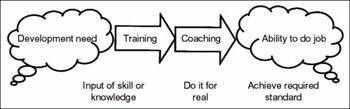
Figure 1.2: The continuum of development
We believe that training and coaching will often overlap. Sometimes when coaching someone, it may become apparent that he or she does not have the
necessary skills or background knowledge; at this point, the coaching stops and training begins. Training and coaching are part of the continuum of development.
It is possible, therefore, that within a person s role there will be many coaching experiences “ potentially for as many skills as are required for that position (see Figure 1.3). An effective personal development plan (PDP) will prioritize the skills that need working on at any particular time in order to ensure that the individual is fulfilling his or her potential and achieving business objectives.
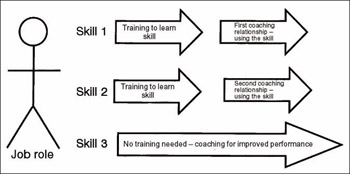
Figure 1.3: The relationship of coaching with training: how an individual might develop different skills for a job
Coaching is fundamentally a relationship between two people that exists for a given purpose; once that purpose has been achieved, that relationship is no longer required. The purpose? To help individuals move from where they are to where they want or need to be “ to develop them.
Let s look at some other terms that are linked to and confused with coaching.

EAN: 2147483647
Pages: 130
- Key #1: Delight Your Customers with Speed and Quality
- Key #3: Work Together for Maximum Gain
- When Companies Start Using Lean Six Sigma
- Making Improvements That Last: An Illustrated Guide to DMAIC and the Lean Six Sigma Toolkit
- The Experience of Making Improvements: What Its Like to Work on Lean Six Sigma Projects