| only for RuBoard - do not distribute or recompile |
| only for RuBoard - do not distribute or recompile |
| only for RuBoard - do not distribute or recompile |
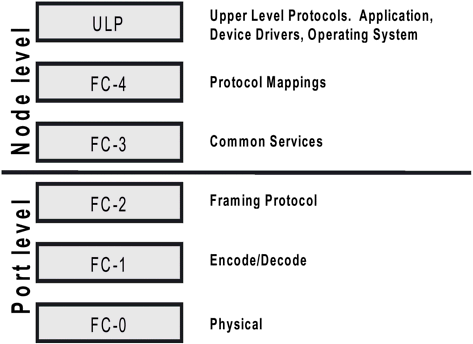
Fibre Channel Protocol (FCP) functional levels are FC-0 through FC-4. The FC-3 and FC-4 levels are outside the port level, permitting the sharing of resources of several ports in the event of future extensions. Applications lie above the FC-4 level. For example, the peripheral drivers for a SCSI application that typically communicates with Host Bus Adapters (HBAs) will communicate with the FC-4 level.
As shown in Figure 3-8, FC-0, FC-1, and FC-2 are implemented at the port level. FC-3, FC-4, and the Upper Level Protocols (ULPs) are implemented at the node level. Fibre Channel considers that which is not visible on the link (above the FC-0 physical level) to be system dependent, and simply identifies the functions to be performed. It does not require allocation or placement.
Figure 3-8 shows an example of a simple point-to-point (
Figure 3-9 shows another way to
Figure 3-10 shows yet more detail. This figure shows that there are five levels used by Fibre Channel, (FC-0 through FC-4) separating the Upper Level Protocols into the system interface. Also, you can see that FC-4 can accommodate not only the channel protocols of SCSI, IPI, and others, but can also accommodate network protocols like IEEE 802.2.
Now you have a good overview of the different functional levels within Fibre Channel. Continue on to the
| only for RuBoard - do not distribute or recompile |
| only for RuBoard - do not distribute or recompile |
Level FC-0 deals with the physical variants:
fiber
connectors
receivers
data encoders/decoders
serializers/deserializers
transmitters
FC-0 deals
Remember, Chapter 1 stated that the main purpose of Fibre Channel is to have any number of existing protocols over a variety of physical media and existing cable options. Therefore, FC-0 provides for four types of connectors to accommodate for the variety of physical media, and for possible existing cable.
The single mode and
An example for use might be to connect two
A word of caution, when working in a mixed environment of single and multimode cabling: be aware that the connectors have been keyed to prevent accidental connection of single mode to multimode or the reverse. However, the keying of the connectors is not perfect nor completely standardized. Also, multi-mode fiber cable does not work with single mode transmitters and receivers. The single mode light rattles around in the big 50 or 62.5 um fibers and dissipates quickly,
The Fibre Channel standard does provide for connections to coax and
For coax cable:
the TNC for receive
the BNC for transmit
For copper cable the
Open Fibre Control (OFC) is a safety feature used to prohibit the laser light from functioning when there is a break or disconnect in the fiber cable. This is used
However, this does not mean you should look at or point the fiber cable directly at your eye, since there still could be some damage. When checking a fiber cable to see if a laser light exists, point the cable end at a white piece of paper. If a red dot appears on the paper, the transmitting laser is functioning.
Wavelength is a topic
Shortwave lasers are used for FC-AL links, up to approximately 500 meters. They are typically used with multimode fiber. The preferred fiber core size is 50-micron. 62.5-micron core size is also supported for compatibility with existing FDDI installations. However, fiber of this type has smaller bandwidth and, in this case, the distance is limited by the fiber bandwidth. The length recommendation for the 62.5-micron fiber cable is 175 meters.
When pulling new cable, it is recommended that the customer pull both 9- and 50-micron cable to accommodate future expansion.
| only for RuBoard - do not distribute or recompile |