Flylib.com

Books Software


Right-Clicking to Display Menus


Right-Clicking to Display Menus

graphics/01inf10.jpg

graphics/one_icon.jpg

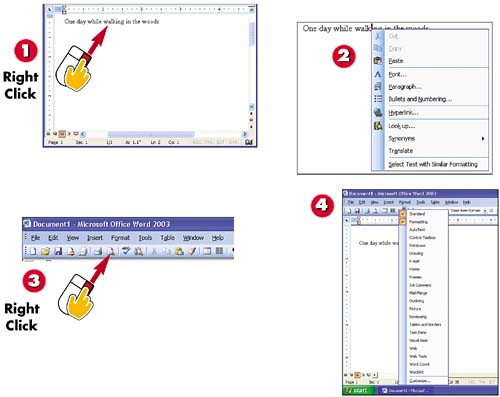
Type a few words in your document, and then right-click anywhere on the text.

graphics/tow_icon.jpg

A context menu appears with commands for working with text. Click outside the menu to close it.

graphics/three_icon.jpg

Right-click any one of the toolbars in the Word window.

graphics/foure_icon.jpg

This time, the context menu lists your available toolbars. Click outside the menu to close it.

INTRODUCTION

In addition to using the pull-down menus at the top of the Word window, you can also use context menus to issue commands. These are small menus that you display by clicking with the right-hand mouse button. The commands in a context menu vary depending on where you right-click. For example, if you right-click text, you get commands for editing and formatting text. If you right-click a toolbar, you get a list of toolbars that you can display or hide (see "Working with Toolbars" later in this part for more information about toolbars). To choose a command in a context menu, simply left-click it.

TIP

Using Word's Main Menus

If you forget to use shortcut menus, don't worry about it. All of the commands in these menus are also available in the pull-down menu system.

Hiding the Ruler

graphics/01inf11.jpg

graphics/one_icon.jpg

Click View in the menu bar.

graphics/tow_icon.jpg

The check mark next to the Ruler command tells you that the rulers are currently displayed. Click the Ruler command.

graphics/three_icon.jpg

The rulers are now hidden.

graphics/foure_icon.jpg

Open the View menu and choose Ruler again to bring the rulers back.

INTRODUCTION

By default, a horizontal ruler appears underneath the toolbars in the Word window, and a vertical ruler appears on the left edge of any documents open in that window. You can use these rulers to quickly adjust tabs, indents, and margins (you'll learn about these formatting techniques in Parts 6 and 7). You might want to hide them, however, so that you can see more of your document. You can easily display them again whenever you like.


Working with Dialog Boxes

graphics/01inf12.jpg

graphics/one_icon.jpg

Open the File menu and choose Print to display the Print dialog box.

graphics/tow_icon.jpg

Click the down arrow to the right of the Name box to display a drop-down list of installed printers.

graphics/three_icon.jpg

Click the down arrow again to close the list without making a selection.

INTRODUCTION

All of Word's menu commands that are followed by an ellipses ( ) lead to a dialog box, most of which give you options for specifying exactly what you want to do before Word actually performs the command. Once you've made your selections in a dialog box, you click the OK button to tell Word to carry out the command. If you decide not to go ahead with a command, you can back out of the dialog box by clicking the Cancel button. Here you take a quick look at the elements commonly found in dialog boxes, using the Print dialog box as an example.

graphics/01inf13.jpg

graphics/foure_icon.jpg

Click the Pages option button to select it. The text box to its right lets you type the page numbers you want to print.

graphics/five_icon.jpg

Click the up or down spinner arrows to the right of the Number of copies box to increase or decrease the number of copies printed.

graphics/six_icon.jpg

Click the Collate check box twice to clear the check box and then mark it again.

graphics/seven_icon.jpg

Click the Cancel button to close the Print dialog box without printing your document.

TIP

Selecting Options

If you see a group of option buttons (buttons that are circular in shape) in a dialog box, you can mark only one of them. In contrast, if you see a group of check boxes ( buttons that are square in shape), you can mark as many of them as you like.