Flylib.com

Books Software


USING HELP


USING HELP

As with previous versions of Adobe Acrobat, pressing the F1 key (in Windows) or the -? keys (on the Mac) activates Acrobat's online Help. This Help file is independent of the Help file that is common to Photoshop, Illustrator, GoLive, and InDesign, and it contains very specific information that is not available elsewhere.
The Help File

The Help file contains two panes: a Navigation pane on the left side and a Topic pane on the right side. Entries selected in the Navigation pane are explained in detail in the Topic pane. The Navigation pane has three tabs you can use to look up information:

  • Contents : The Contents tab displays entries in an organized way and resembles a book's table of contents. Information is grouped in several expandable main headers.

  • Search : The Search tab contains a text field where you can type a word or phrase to look up. Matching entries are listed underneath it.

  • Index : The Index tab contains a very detailed list of most command words and terms used in Acrobat and included in the Help file. These words are sorted in alphabetical order.

The How To Pane

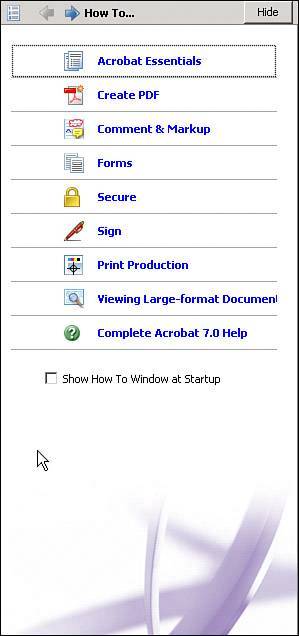
In addition to the Help file, Acrobat also has a built-in How To option that contains step-by-step instructions on how to accomplish many tasks in Acrobat. In addition to these instructions, the How To pane also displays links to relevant information in the Help file (see Figure 43.50).

Figure 43.50. The How To pane contains instructions to accomplish advanced and new tasks. These instructions are grouped under eight generic headings. The complete Help file can also be accessed from the How To pane.


Help for People with Visual or Motor Impairments

Acrobat makes it easier for people who have impediments to interact with its interface via the Accessibility Setup Assistant.

Found under the Advanced, Accessibility Setup Assistant menu, this wizard guides you through the steps to set up screen readers and magnifiers. If Acrobat detects during installation that accessibility features are present in your computer, the Accessibility Setup Assistant appears the first time you run Acrobat.

In addition to these settings, you can also use the accessibility options found under the Edit, Preferences menu to change colors and fine-tune other settings.

If you use a third-party voice reader or Braille reader, you can adjust its settings from within Acrobat by using the Advanced, Accessibility, Change Reading Options command.


Chapter 44. WORKING WITH ADVANCED ACROBAT PDF FILES

IN THIS CHAPTER

Understanding Optical Character Recognition (OCR) 996

Understanding Fonts 997

Understanding Color 997

Compressing PDF Files 1000

Preparing Files for Press 1001

Embedding and Displaying 3D Objects 1011

Collecting Data from Forms 1011

The JavaScript Editor 1014

The Organizer 1015

In addition to commenting, embedding voice annotations, editing text, and rearranging pages, Acrobat puts a few more advanced features in your hands to enhance your ability to produce files for press production. Again, if your files require any heavy editing it's better that it be done in the application that created them rather than in Acrobat. These tools in Acrobat enhance your file for optimum reproduction.


UNDERSTANDING OPTICAL CHARACTER RECOGNITION (OCR)

Optical Character Recognition (OCR) is the ability to "read" text from a rasterized image and create an editable text from it. There are two ways to use the OCR engine that is built inside Acrobat and each depends on whether the image that contains the text has already been scanned.

If the image is already part of a PDF document, open the OCR engine by choosing Document, Recognize Text Using OCR, Start. In the Recognize Text dialog you can adjust language, resolution to downsample images, and the output method in addition to specifying pages of the document you want processed . Acrobat recognizes not only the text but also the font and other formatting and presents the converted text so that it looks as close to the original as possible (see Figure 44.1). If you need to process only one scanned image in a document you can click on it with the Select tool to select it. Next, right-click (in Windows) or Control-click (on the Mac) on it and select Recognize Text using OCR from the context menu.

Figure 44.1. Acrobat makes it easy to use OCR to generate editable text.


If you have a printed pageor several pageswith text that you need to convert to editable text you need to bring it into Acrobat first. To do this, choose File, Create PDF, From Scanner. A dialog prompts you to select your scanner and edit OCR settings. These OCR settings are the same as when using the previous method. You can use this feature to scan long paper documents, for example, if your scanner has an auto-feeder. Acrobat generates the total number of pages of the original document.