Hotspot Networks(c) Wi-Fi for Public Access Locations
Authors: Minoli D.
Published year: 2005
Pages: 40-41/88
Buy this book on amazon.com >>

Differences Between ESS and IBSS LANs

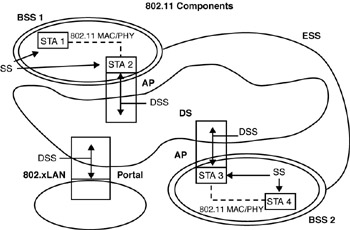
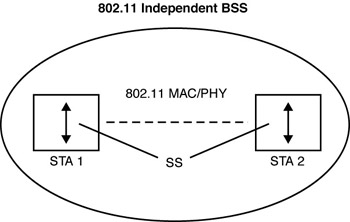
When the concept of the IBSS LAN was introduced, we noted that an IBSS is often used to support an ad hoc network. In an IBSS network, an STA communicates directly with one or more other STAs. Consider the full IEEE 802.11 architecture, as shown in Figure 5-7. An IBSS consists of STAs that are directly connected. Thus, there is, by definition, only one BSS. Further, since there is no physical DS, there cannot be a portal, an integrated wired LAN, or the DSSs. The logical picture reduces to Figure 5-8. Only the minimum two stations are shown, although an IBSS may have an arbitrary number of members . In an IBSS, only Class 1 and 2 frames are allowed since there is no DS in an IBSS. The services that apply to an IBSS are the SSs.
click to expand
Figure 5-7: IEEE 802.11 architecture (again)
click to expand
Figure 5-8: 802.11 IBSS

Message Information Contents That Support Services

Each service is supported by one or more IEEE 802.11 messages. Information items are given by name .

Data

For an STA to send data to another STA, it sends a data message, as shown in the following:

  • Message type: data

  • Message subtype: data

  • Information items:

    • IEEE source address of message

    • IEEE destination address of message

    • BSSID

  • Direction of message: from STA to STA

Association

For an STA to associate, the association service causes the following messages to occur.

Association Request

  • Message type: management

  • Message subtype: association request

  • Information items:

    • IEEE address of the STA initiating the association

    • IEEE address of the AP with which the initiating station will associate

    • ESSID

  • Direction of message: from STA to AP

Association Response

  • Message type: management

  • Message subtype: association response

  • Information items:

    • Result of the requested association. This is an item with the values successful and unsuccessful .

    • If the association is successful, the response will include the association identifier (AID).

  • Direction of message: from AP to STA

Reassociation

For an STA to reassociate, the reassociation service causes the following message to occur.

Reassociation Request

  • Message type: management

  • Message subtype: reassociation request

  • Information items:

    • IEEE address of the STA initiating the reassociation

    • IEEE address of the AP with which the initiating station will reassociate

    • IEEE address of the AP with which the initiating station is currently associated

    • ESSID

  • Direction of message: from STA to AP (the AP with which the STA is requesting reassociation)

The address of the current AP is included for efficiency. The inclusion of the current AP address facilitates MAC reassociation to be independent of the DS implementation.

Reassociation Response

  • Message type: management

  • Message subtype: reassociation response

  • Information items:

    • Result of the requested reassociation. This is an item with the values successful and unsuccessful.

    • If the reassociation is successful, the response will include the AID.

  • Direction of message: from AP to STA

Disassociation

For an STA to terminate an active association, the disassociation service causes the following message to occur.

  • Message type: management

  • Message subtype: disassociation

  • Information items:

    • IEEE address of the station that is being disassociated. This will be the broadcast address in the case of an AP disassociating with all associated stations .

    • IEEE address of the AP with which the station is currently associated.

  • Direction of message: from STA to STA (for example, STA to AP or AP to STA)

Privacy

For an STA to invoke the WEP privacy algorithm (as controlled by the related MIB attributes), the privacy service causes MAC protocol data unit (MPDU) encryption and sets the WEP frame header bit appropriately.

Authentication

For an STA to authenticate with another STA, the authentication service causes one or more authentication management frames to be exchanged. The exact sequence of frames and their content is dependent on the authentication scheme invoked. For all authentication schemes, the authentication algorithm is identified within the management frame body. In an IBSS environment, either station may be the initiating STA (STA 1). In an ESS environment, STA 1 is the mobile STA, and STA 2 is the AP.

Authentication (First Frame of Sequence)

  • Message type: management

  • Message subtype: authentication

  • Information items:

    • Authentication algorithm identification

    • Station identity assertion

    • Authentication transaction sequence number

    • Authentication algorithm-dependent information

  • Direction of message: first frame in the transaction sequence is always from STA 1 to STA 2

The first frame in an authentication sequence will always be unencrypted.

Authentication (Intermediate Sequence Frames)

  • Message type: management

  • Message subtype: authentication

  • Information items:

    • Authentication algorithm identification

    • Authentication transaction sequence number

    • Authentication algorithm-dependent information

  • Direction of message:

    • Even transaction sequence numbers : from STA 2 to STA 1

    • Odd transaction sequence numbers: from STA 1 to STA 2

Authentication (Final Frame of Sequence)

  • Message type: management

  • Message subtype: authentication

  • Information items:

    • Authentication algorithm identification.

    • Authentication transaction sequence number.

    • Authentication algorithm-dependent information.

    • The result of the requested authentication. This is an item with values successful and unsuccessful.

  • Direction of message: from STA 2 to STA 1

Deauthentication

For an STA to invalidate an active authentication, the following message is sent:

  • Message type: management

  • Message subtype: deauthentication

  • Information items:

    • IEEE address of the STA that is being deauthenticated.

    • IEEE address of the STA with which the STA is currently authenticated.

    • This will be the broadcast address in the case of an STA deauthenticating all STAs currently authenticated.

  • Direction of message: from STA to STA

Hotspot Networks(c) Wi-Fi for Public Access Locations
Authors: Minoli D.
Published year: 2005
Pages: 40-41/88
Buy this book on amazon.com >>

Similar books
