Chapter 5: IEEE 802.11
|
|
Overview
This chapter is a partial redux of the IEEE standard “IEEE Standard for Information Technology — Telecommunications and information exchange between systems — Local and metropolitan area networks — Specific requirements — Part 11: Wireless LAN Medium Access Control (MAC) and Physical Layer (PHY) specifications, which was adopted by the ISO/IEC and redesignated as ISO/IEC 8802-11:1999(E).”[1] This material is for pedagogical, advocacy, and educational purposes. It is meant to acquaint the reader with the major concepts of the most important protocol for hotspot networking. Developers and readers interested in the complete specification and subtending details should refer directly to the full standard from IEEE.
The standard defines the protocol and compatible interconnection of data communication equipment via the air, radio, or infrared in a local area network (LAN) using the carrier sense multiple access with collision avoidance (CSMA/CA) medium-sharing mechanism. The MAC supports operation under control of an access point (AP) as well as between independent stations. The protocol includes authentication, association, and reassociation services, an optional encryption/decryption procedure, power management,[2] and a point coordination function (PCF) for the time-bounded transfer of data. The infrared (IR) implementation of the PHY supports 1 Mbps data rate with an optional 2 Mbps extension. The radio implementations of the PHY specify either a frequency-hopping spread spectrum (FHSS) supporting 1 Mbps and an optional 2 Mbps data rate or a direct sequence spread spectrum (DSSS) supporting both 1 and 2 Mbps data rates. For the basic protocol model, see Figure 5-1.
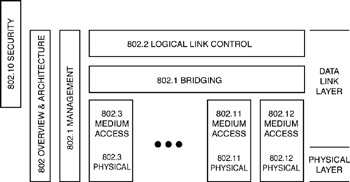
Figure 5-1: Basic protocol model, IEEE 802.11
Specifically, the IEEE 802.11 standard
-
Describes the functions and services required by an IEEE-802.11-compliant device to operate within ad hoc and infrastructure networks as well as the aspects of station mobility (transition) within those networks
-
Defines the MAC procedures to support the asynchronous MAC service data unit (MSDU) delivery services
-
Defines several PHY signaling techniques and interface functions that are controlled by the IEEE 802.11 MAC
-
Permits the operation of an IEEE-802.11-conformant device within a wireless local area network (WLAN) that may coexist with multiple overlapping IEEE 802.11 WLANs
-
Describes the requirements and procedures to provide privacy of user information being transferred over the wireless medium (WM) and authentication of IEEE 802.11 conformant devices
IEEE 802.11 uses an abstract architecture to describe functional components of an IEEE 802.11 LAN. The architectural descriptions are not intended to represent any specific physical implementation of IEEE 802.11.
802.11b and 802.11a are extensions of the basic standard and aim at supporting higher speeds. These are not further discussed here.
[1]The ANSI/IEEE Std 802.11, 1999 Edition [ISO/IEC 8802-11: 1999] standard is a revision of IEEE Std 802.11-1997. The management information base (MIB) according to Open Systems Interconnection (OSI) rules has been removed, redundant management items have been removed, and Annex D has been completed with the MIB according to Simple Network Management Protocol (SNMP).
[2]This reduces power consumption in mobile stations.
|
|

EAN: N/A
Pages: 88