Tool 11: Attribute Listing
| AKA | N/A |
| Classification | Idea Generating (IG) |
Tool description
Developed by Robert Crawford during the 1930s, the attribute listing technique is an idea-generating tool for identifying process, product, and service improvement opportunities. Attributes of a product, service, or process are systematically changed or substituted to search for problem solutions or improvement ideas.
Typical application
-
To modify product, process, or service characteristics in order to bring problem-solving or improvement ideas to the surface.
-
To examine essential problem-related attributes to possibly change or modify them in order to eliminate or reduce the problem.
Problem-solving phase
| Select and define problem or opportunity | |
| → | Identify and analyze causes or potential change |
| → | Develop and plan possible solutions or change |
| Implement and evaluate solution or change | |
| Measure and report solution or change results | |
| Recognize and reward team efforts |
Typically used by
| Research/statistics | |
| 1 | Creativity/innovation |
| Engineering | |
| Project management | |
| Manufacturing | |
| Marketing/sales | |
| Administration/documentation | |
| Servicing/support | |
| 2 | Customer/quality metrics |
| 3 | Change management |
 |
before
-
Brainstorming
-
Defect Map
-
Stimulus Analysis
-
Fresh eye
-
Circles of knowledge
after
-
Circle of opportunity
-
Information needs analysis
-
Opportunity Analysis
-
Creativity assessment
-
Presentation
|
Notes and key points
-
To keep a session focused, limit the use of attributes to seven per session.
Problem-solving phase
-
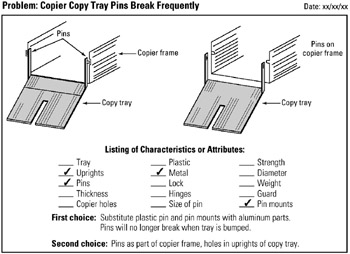
STEP 1 First, the problem statement is discussed. See example Copier Copy Tray Pins Break Frequently,
-
STEP 2 All characteristics or attributes of the product, process, or service are listed.
-
STEP 3 Next, the problem-related, essential characteristics are identified and recorded.
-
STEP 4 Lastly, the modification or substitution of all characteristics is systematically discussed by team participants. This often results in finding a solution to the problem or an improvement opportunity as shown in the example.
-
STEP 5 The recorded information is dated.
Example of tool application

EAN: 2147483647
Pages: 326