Overview of Service Level Management
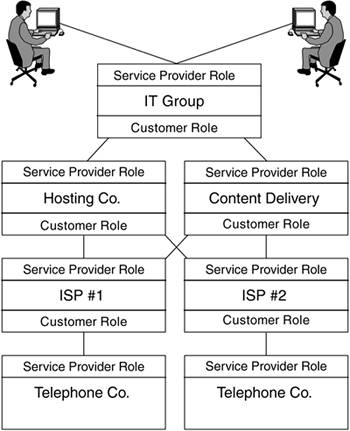
| Often, one group's service provider is another group's customer. It is critical to understand that service delivery is often, in fact, a chain of such relationships. As Figure 2-1 shows, some entities, such as an IT group, can play different roles in the service delivery process. As shown in the figure, a hosting company can be a customer of multiple service providers while in turn acting as a service provider. An IT group may be a customer of several service providers offering basic Internet connectivity, application hosting, content delivery, or other services. Customers may use multiple providers of the same service to increase their availability and to protect against dependence on a single provider. Customers will also use specialized service providers to fulfill particular needs. Figure 2-1. Roles of Customers and Service Providers
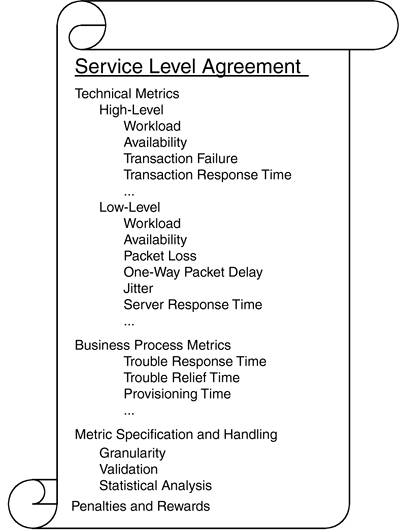
The Internal Role of the IT GroupAn IT group serves the entire organization by aggregating demands of individual business units and using them as leverage to reduce overall costs from service providers. Today, such IT groups are making the necessary adjustments as managed services become a mandatory requirement. IT managers are constantly reassessing the business and strategic trade-offs of developing internal competence and expertise as opposed to outsourcing more of the traditional IT work to external providers. The goal is to save money, protect strategic assets, and maintain the necessary flexibility to meet new challenges. The External Role of the IT GroupIT groups are increasingly being required to provide specific levels of service, and they are also more frequently involved in helping business units negotiate agreements with external service providers. Business units often choose to deal directly with service providers when they have specialized needs or when they determine that the IT group cannot offer services with competitive costs and benefits. IT groups must therefore manage their own service levels as well as those of service providers, and they must track compliance with negotiated SLAs. The Components of Service Level ManagementThe process of monitoring service quality, detecting potential or actual problems, taking actions necessary to maintain or restore the necessary service quality, and reporting on achieved service levels is the core of SLM. Effective SLM solutions must deliver acceptable service quality at an acceptable price. Acceptable quality from a customer perspective means an ability to use the managed services effectively. For example, acceptable quality may mean that an external customer or business partner can transact the necessary business that will generate revenues, strengthen business partnerships, increase the Internet brand, or improve internal productivity. Specific ongoing measurements are carried out to determine acceptable service quality levels, and noncompliance is noted and reported. Acceptable costs must also be considered, because over-provisioning and throwing money at service quality problems is not an acceptable strategy for either service providers or their customers (and in spite of the cost, it often doesn't solve the problem). Service management policies are applied to critical resources so that they are allocated to the appropriate services; inappropriate activities are curtailed. Service providers that manage resources effectively deliver superior service quality at competitive prices. Their customers, in turn, must also increase their online business effectiveness and strengthen their bottom-line results. The Participants in a Service Level AgreementThe SLA is the basic tool used to define acceptable quality and any relationships between quality and price. Because the SLA has value for both providers and customers, it's a wonder why it has taken so long for it to become important. In practice, many organizations and providers find the process of negotiating an acceptable SLA to be a difficult task. As with many technical offerings, customers often experience difficulty in expressing what they need in technical terms that are both measurable and manageable; therefore, they have difficulty specifying their needs precisely and verifying that they are getting what they pay for. Service providers, on the other hand, appreciate clearly-specified requirements and want to take advantage of the opportunity to offer profitable premium services, but they also want to minimize the risks of public failure and avoid increasingly stringent financial penalties for noncompliance with the terms of the SLA. Metrics Within a Service Level AgreementMeasurement is a key part of an SLA, and most SLAs have two different classes of metrics, as shown in Figure 2-2, which may be divided into technical metrics and business process metrics. Technical metrics include both high-level technical metrics, such as the success rate of an entire transaction as seen by an end user, and low-level technical metrics, such as the error rate of an underlying communications network. Business process metrics include measures of provider business practices, such as the speed with which they respond to problem reports. Figure 2-2. Contents of a Service Level Agreement
Service providers may package the metrics into specific profiles that suit common customer requirements while simplifying the process of selecting and specifying the parameters. Service profiles help the service provider by simplifying their planning and resource allocation operations. |

EAN: 2147483647
Pages: 128