| The square boxes in Figure 6-1 represent the applications and services that need to connect to each other and share data through the bus. From the perspective of the integration architect who is assembling services to form a process flow, all applications and services are treated as abstract endpoints. What the endpoints actually represent can be very diverse. An endpoint may represent a discrete operation, such as a specialized service for calculating sales tax. The underlying implementation of the endpoint could represent a local binding to an application adapter, or a callout to an external web service. Figure 6-1. Everything that is connected into the bus is viewed as an abstract endpoint 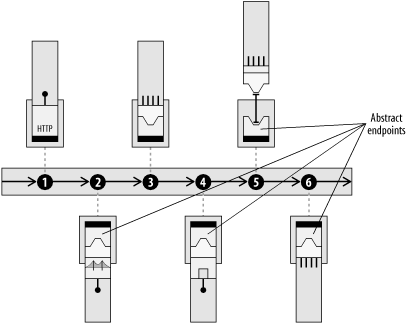
This endpoint abstraction allows an integration architect to use higher-level tools to assemble service endpoints into process flows (Figure 6-2). Figure 6-2. Integration architect's view of service endpoints in an SOA 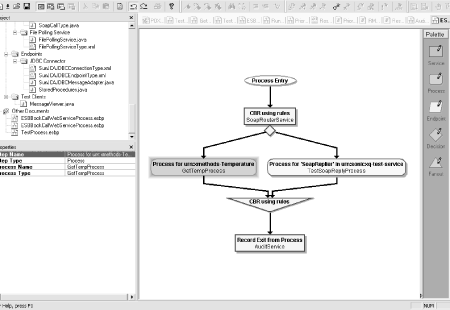
An endpoint may represent a single, monolithic application, such as a legacy payroll system. It may represent a suite of applications or an ERP system from an application vendor. It may represent an island of integration from a successful integration broker project. It may represent a whole department or business unit that has a microcosm of its own, yet also needs to link into corporate information channels and share data. It may represent the interface to a business partner with completely separate IT systems. All service endpoints in an ESB are equal participants in an event-driven SOA, whether the service represents a discrete operation or an interface to an entire ERP suite. From the point of view of the integration architect (you), service endpoints are just logical abstractions of services that are plugged into the bus. The task of building out an integration network involves tying together service endpoints and applying choreography, transformation, and routing rules into process flows between applications. The actual physical locations of the services can be anywhere that is accessible by the bus. | 