Five Components That Make X-Teams Successful
X-teams are set apart from traditional teams by five hallmarks: external activity, extensive ties, expandable structures, flexible membership, and internal mechanisms for execution. (See figure 13.1.)
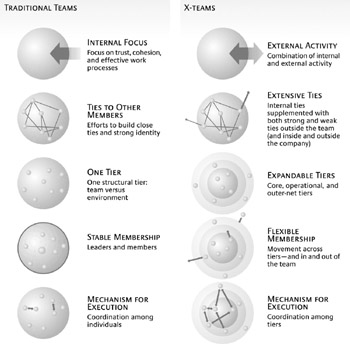
Figure 13.1: X-Teams Versus Traditional Teams: Five Components
External Activity
The first hallmark of the X-team is members' external activity.[2] Members manage across boundaries, reaching into the political, informational and task-specific structures around them. In some cases, the team leader takes on the outreach; in other cases, it is shared by everyone. High levels of external activity are key, but effectiveness depends on knowing when to use the particular kind called for: ambassadorship, scouting, or task coordination.
It doesn't matter how technically competent a team is if the most relevant competency is the ability to lobby for resources with top management. And even resources mean little without an ability to reach outsiders who have the knowledge and information to help team members apply the resources effectively. Thus at any given time, any X-team member may be conducting one or more of the three external activities.
Ambassadorial Activity Ambassadorial activity is aimed at managing upward—that is, marketing the project and the team to the company power structure, maintaining the team's reputation, lobbying for resources, and keeping track of allies and competitors. Ambassadorial activity helps the team link its work to key strategic initiatives; and it alerts team members to shifting organizational strategies and political upheaval so that potential threats can be identified and the damage limited.
For example, the leader of what we call the Swallow team wanted to manufacture a new computer using a revolutionary design. The company's operating committee, however, wanted only a product upgrade. The team leader worked with a key decision maker on the operating committee to portray the benefits of the product to the organization—and eventually got permission for the design. He continued to provide updates on the team's progress, while keeping tabs on the committee's key resource-allocation decisions.
Scouting Scouting activity helps a team gather information located throughout the company and the industry. It involves lateral and downward searches through the organization to understand who has knowledge and expertise. It also means investigating markets, new technologies, and competitor activities. Team members in our studies used many different modes of scouting, from the ambitious and expensive (hiring consultants) to the quick and cheap (having a cup of coffee with an old college professor or spending an hour surfing the Internet).
Effective teams monitor how much information they need—for some, extensive scouting early on to get the lay of the land is all that's needed. For others, scouting continues throughout the life of the team. In particular, teams working with technologies created by outsiders can never relax their scouting activities.
Task Coordination Task-coordinator activity is much more focused than scouting. It's for managing the lateral connections across functions and the interdependencies with other units. Team members negotiate with other groups, trade their services and get feedback on how well their work meets expectations. Task-coordinator activity involves cajoling and pushing other groups to follow through on commitments so that the team can meet its deadlines and keep work flowing. When the Swallow team needed to check some new components quickly and learned that the testing machine was booked, team members explored swapping times with another team, using the machine at night, or using machines elsewhere—whatever it took to keep the work on track.
Extensive Ties
In order to engage in such external activity, team members need to have extensive ties with outsiders. Ties that academic researchers call weak ties are good for certain purposes—for example, when teams need to round up handy knowledge and expertise within the company. One team we studied gave a senior position to a new hire straight out of graduate school because of his ties to important experts at prestigious academic institutions. The ties were weak but extensive and contributed immensely to the success of the team's project.
Strong ties, however, facilitate higher levels of cooperation and the transfer of complex knowledge. Strong ties are most likely to be forged when relationships are critical to both sides and built over long periods of time.[3] In the case of Swallow, the team leader's prior relationship with the operating-committee member helped snare funding for the revolutionary computer design. And the three team members from manufacturing had ties that smoothed the transition from design to production.
Expandable Tiers
But how to structure a large, complex team? How to combine the identity and separateness of a team with the dense ties and external interactions needed to accomplish today's work? Our research shows that X-teams operate through three distinct tiers that create differentiated types of team membership—the core tier, operational tier, and outer-net tier—and that members may perform duties within more than one tier.
Core Members The core of the X-team is often, but not always, present at the start of the team. Core members carry the team's history and identity. While simultaneously coordinating the multiple parts of the team, they create the team strategy and make key decisions. They understand why early decisions were made and can offer a rationale for current decisions and structures. The core is not a management level, however. Core members frequently work beside other members of equal or higher rank, and serve on other X-teams as operational or outer-net members.
The first core member of the Swallow team was the leader; then two senior engineers joined and helped to create the original product design and to choose more members. The core members were committed to the revolutionary computer concept and accepted its risks. They understood how quickly they had to act in order to make an impact on the market. The core members chose more engineers for the team, helped coordinate the work across subgroups, and kept in touch with the company's operating committee and other groups. They decided when to get feedback from outsiders, and they set up a process to make the critical decisions about how compatible with industry standards to make the design. They organized team social events—and when members had to work long hours to make a deadline, they even brought in beds.
Having multiple people in the core helps keep the team going when one or two core members leave, and it allows a core member who gets involved with operational work to hand off core tasks. Teams that lose all their core members at once take many months to get back on track.
Operational Members The team's operational members do the ongoing work. Whether that's designing a computer, creating an academic course, or deciding where to drill for oil, the operational members get the job done. They often are tightly connected to one another and to the core (and may include some core members). In the Swallow group, 15 engineers were brought into the operational layer to work on the preliminary design. They made key technical decisions, but each focused on one part of the design and left oversight of the whole to the core.
Outer-Net Members Outer-net members often join the team to handle some task that is separable from ongoing work. They may be part-time or part-cycle members, tied barely at all to one another but strongly to the operational or core members. Outer-net members bring specialized expertise, and different individuals may participate in the outer net as the task of the team changes.
For example, when the Swallow team wanted to ensure its initial design made sense to others, it brought in outer-net people from other parts of R&D. For two weeks, the enlarged team met to discuss the design, its potential problems, ideas for changes, and solutions for problems that operational members had identified. Then those new members left. Meanwhile, designated members of the core group met weekly with different outer-net members—people from purchasing, diagnostics, and marketing—for information sharing, feedback, and smoothing the flow of work across groups. Some X-teams' outer nets also include people from other companies.
The three-tier structure is currently in use at a small, entrepreneurial startup we know—except that the employees there say "pigs", "chickens", and "cows" to refer to core, operational, and outer-net team members. Think about a bacon-and-eggs breakfast. The pig is committed (he's given his life), the chicken is involved, and the cow provides milk that enhances the meal. The startup's terms are handy for discussing roles and responsibilities. A person might say, "You don't need to do that; you're only a chicken" or "We need this cow to graze here for at least two weeks".
Flexible Membership
X-team membership is fluid.[4] People may move in and out of the team during its life or move across layers. In a product-development team similar to Swallow, there was a manufacturing member who shifted from outer-net member to operational member to core member. At first, he was an adviser about components; next he worked on the actual product; then he organized the whole team when it needed to move the product into manufacturing. He became team leader and managed the transition of team members back into engineering as more manufacturing members were brought in.
Mechanisms for Execution
An increasing focus on the external context does not mean that the internal team processes are unimportant. In fact, traditional coordination mechanisms such as clear roles and goals may be even more important when team members are communicating externally, membership is changing, and there are different versions of membership. The trick is to avoid getting so internally focused and tied to other team members that external outreach is ignored. X-teams find three different coordination mechanisms especially useful: integrative meetings, transparent decision making, and scheduling tools such as shared timelines.
First, through integrative meetings, team members share the external information each has obtained. That helps keep everyone informed and increases the information's value by making it widely available. The meetings ensure that decisions are based on real-time data from combinations of task-coordinator, scouting, and ambassadorial activity.
Second, transparent decision making, which keeps people informed about the reasons behind choices, is good for nudging everyone in the same direction and for maintaining motivation. Even when team members are frustrated that a component they have worked on has been dropped, they appreciate knowing about the change and why it has been made.
Finally, measures such as clearly communicated but flexible deadlines allow members to pace themselves and to coordinate work with others. The just-in-time flexibility allows for deadline shifts and adjustment. If external circumstances change, then work changes and new deadlines are established.
Putting the Pieces Together
X-team components form a self-reinforcing system. To engage in high levels of external activity, team members bring to the table outside ties forged in past professional experience. To be responsive to new information and new coordination needs, X-teams have flexible membership and a structure featuring multiple tiers and roles. To handle information and multiple activities, they have coordination mechanisms and a strong core. The five components cannot work in isolation. They complement one another. Although small or new teams may not have all five components, fully developed X-teams usually do.
[2]Ancona 1992.
[3]Granovetter 1973, Krackhardt 1992, Hansen 1999.
[4]Ancona and Caldwell 1998.

EAN: 2147483647
Pages: 214
- ERP Systems Impact on Organizations
- ERP System Acquisition: A Process Model and Results From an Austrian Survey
- Healthcare Information: From Administrative to Practice Databases
- Relevance and Micro-Relevance for the Professional as Determinants of IT-Diffusion and IT-Use in Healthcare
- Development of Interactive Web Sites to Enhance Police/Community Relations