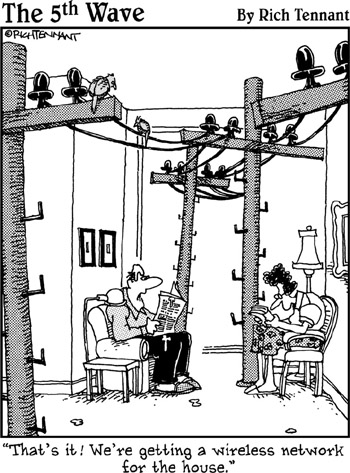
In this part …
You discover how to build a network yourself, which includes planning it and installing it. And you find out what choices are available for cable types, network operating systems, and all the other bits and pieces that you have to contend with.
Yes, some technical information is included in these chapters. Fear not! I bring you tidings of great joy! Lo, a working network is at hand, and you-yea, even you-can design it and install it yourself.
Okay, so you're convinced that you need to network your computers. What now? Do you stop by Computers-R-Us on the way to work, install the network before morning coffee, and expect the network to be fully operational by noon?
I don't think so.
Networking your computers is just like any other worthwhile endeavor: To do it right requires a bit of planning. This chapter helps you think through your network before you start spending money. It shows you how to come up with a networking plan that's every bit as good as the plan that a network consultant would charge $1,000 for.
This book is already saving you money!
Before you begin any networking project, whether it's a new network installation or an upgrade of an existing network, first make a detailed plan. If you make technical decisions too quickly, before
Here are some general thoughts to keep in mind while you create your network plan:
Don't rush the plan. The most costly networking mistakes are the ones you make before you install the network. Think things through and consider alternatives.
Write down the network plan. The plan doesn't have to be a fancy, 500- page document. If you want to make it look good, pick up a ½ -inch three- ring binder-big enough to hold your network plan with room to spare.
Ask someone else to read your network plan before you buy anything.
Preferably, ask someone who
Keep the plan up-to-date. If you add to the network, dig up the plan, dust it off, and update it.
| Tip |
"The best-laid schemes of mice and men gang oft agley, and leave us not but
|
One of the first steps in planning your network is making sure that you understand why you want the network in the first place. Here are some of the more common reasons for needing a network, all of them quite valid:
My co-worker and I exchange files using a flash drive just about every day. With a network, we could trade files without using the flash drive.
I don't want to buy everyone a printer when I know that the one we have now just sits there taking up space most of the day. Wouldn't buying a network be better than buying a printer for every computer?
I want to provide an Internet connection for all my computers. Many networks,
Someone figured out that we're destroying seven trees a day by printing interoffice memos on paper, so we want to give the rainforest a break by setting up an e-mail system and trying to print less of the routine stuff.
| Warning |
It won't work! One of the inescapable laws of business is that the more you try to eliminate paperwork, the more paperwork you end up creating. |
Business is so good that one person typing in orders eight hours each day can't keep up. With a network, I can have two people entering orders, and I don't have to pay overtime to either person.
My brother-in-law just put in a network at his office, and I don't want him to think that I'm behind the times.
Make sure that you identify all the reasons why you think you need a network and then write them down. Don't worry about winning the Pulitzer Prize for your stunning
If you were making a 500-page networking proposal, you would place the description of why a network is needed in a tabbed section labeled Justification. In your ½ -inch network binder, file the description under Purpose.
| Tip |
When you consider the reasons why you need a network, you may conclude that you don't need a network after all. That's okay. You can always use the binder for your stamp collection. |