Culture and Globalization
“I’m all for progress—it’s change I don’t like.”
—Mark Twain
The second half of the twentieth century witnessed cataclysmic change and upheaval in the world order and the interrelations of nations. The Marshall Plan and the semi-Americanization of Western Europe accelerated economic recovery in war-battered Germany, France, and Italy. Britain, France, Belgium, and the Netherlands lost huge empires, and the Cold War set in for forty-five years (encompassing hotter wars in Korea, Vietnam, several countries in Africa, and the Middle East). In the 1970s Japan and the Asian Tigers roared, China began to flex her muscles, and the Russians and Americans ventured frequently into space. In the
last decade of the century, Germany was reunified, the Soviet Union disintegrated, Saddam Hussein went into and out of Kuwait, and the United States emerged as the only true superpower. All in all, it was a memorable, momentous period in human history.
Yet it is possible that the closing two decades will be remembered, indeed distinguished and branded, not by events of a political or military nature but by sweeping developments in the field of technology. This was the IT Revolution. Its implications for educating the masses, personalizing e-commerce, accelerating international trading, globalizing business, and—dare we say it—standardizing cultures are still far from clear. It is on these last two items that I wish to comment in this chapter:
- What do we (currently) mean by the term globalization, and will commerce soon be globalized?
- To what extent will the IT Revolution (and the Internet) lead to globalization?
- Will culture itself be standardized? If so, when and to what degree?
Globalization
One definition of globalization might read as follows: an aggressive program for the imposition on indigenous industries and agriculture of Western norms of national economic management, economic deregulation, and market development, facilitating their takeover by multinational companies.
Significant cultural problems are bound to arise out of such a program, and we must examine these. One must also keep in mind, however, that globalization is not necessarily negative, and the concept is not as groundbreaking as one might think. In many ways the world economy around the year 1900 was as globalized as it is now, but World War I and its nervous aftermath led governments to impose trade barriers and capital controls, causing national economies to turn inward. Successive recessions in the 1920s and 1930s accentuated this trend. Even after World War II, global trade continued to be severely hampered by conflicting ideologies and national enmities. The economics of geography did not function efficiently either, as neighboring states such as Japan, China, Russia, India, and Pakistan failed to take advantage of proximity to each other. In Europe, the Iron Curtain caused similar problems.
In the 1980s many economies began to boom, and international trade blossomed. Significant recessions slowed down the process, but states such as Taiwan, Korea, and Singapore bounced back fairly rapidly, and the resilience and commitment to international trade in Japan and Hong Kong were always givens. In the main, the progress of internationalization, globalization, and the eventual global integration of world trade went forward, aided in no small measure by information technology.
Globalization, however, is only a word, not yet a tangible reality, subject to different interpretations and not a few misgivings. In the first place it is a Western recipe drawn up by the richest and most advanced nations. Its values are essentially materialistic (growth and creation of wealth). Billions of people in Asia and elsewhere—concerned with concepts such as face, national pride, collective welfare, inner harmony, and religion—place less emphasis on material benefits and see the globalization program as a self-serving ideology. Even before the turn of the twenty- first century the globalization model was being challenged. More trade, yes, but an intellectual consensus on global economic policy would eventually have to take into account Asian, Middle Eastern, African, and Latin American views and needs.
The actual assumptions of international economic deregulation and integration are of recent origin and have not yet stood the test of time. Trends may well be reversed, and already some multinationals and governments have changed their tune, advising partners to concentrate on national economic development and domestic savings—a strategy that has worked well in the past in Japan and Korea, where statist protectionism and export- led growth have been strong features. Governments now promise to “civilize” globalization (whatever that means!)
With different interpretations of globalization, it is inevitable that the process itself will be slowed. Latin Americans, for instance, will ultimately welcome a hemispheric economic part- nership with the United States and Canada but will expect a concurrent “globalization of respect,” in other words, explicit recognition of their social equality with Anglo-Saxons, perhaps even of their cultural superiority (which they believe exists). The French do not wish to enter into a global economic partnership with anyone except on similar terms.
For multi-active Africans, globalization sounds good in terms of facilitated emigration, more jobs, more export markets for their products, more aid and debt forgiveness, and more opportunity. Poverty is their main problem; their chief contribution to global cooperation will initially be cheap labor. For Arabs and many other Muslims, hindrance to global cooperation is political. Until current conflicts are resolved, globalization of their commerce (apart from the sale of oil) is a distant prospect.
Reactive Asians see a globalized world where meaningful partnerships with Western countries will integrate their own ambitions and expansions and will afford them greater opportunities for travel, leisure, and cultural exchange. Asians’ contributions will be significant—skilled and semiskilled labor at an acceptable cost, sophisticated technological and consumer products, stable populations, commercial expertise, energy and work ethic, and, above all, huge, hungry markets to sell into.
It will not be easy to reconcile these different concepts of a globalized world. For at least a decade or two, acting local will be a necessary complement of thinking global.
Information Technology and Globalization
The greatest ally of globalization is the power and flexibility of information technology. It is the driving force that opens markets, accelerates business opportunities, and hopefully creates more jobs than it eliminates. In the past 45 years global computing power has increased a billion-fold. Thomas Watson, the chairman of IBM who predicted in 1943 that there was a world market for 5 computers, was way off the mark (now over 300 million). The economic benefits offered by IT are huge, not the least of which is helping markets work more efficiently. It also speeds up innovation and experimentation. The tools get less expensive every year, and above all the Internet is truly global. Asian countries such as Taiwan, the Philippines, Thailand, Malaysia, and even China derive benefits not only from the ready information but also from being heavily involved in the manufacture of much of the computing equipment. A Nokia cell phone may be designed in London and made in China from parts produced in Canada and Sweden on the orders of a headquarters located in Finland. Economics and multinationals are impressively interconnected.
For most of human history the average growth in world economic output averaged less than 0.1 percent per annum. The spurts resulting from the invention of steam power and the Industrial Revolution (1780–1840), the advent of railways (1840–1890), and the coming of electricity and cars (1890–1950) fade into relative insignificance when compared with economic growth during the Information Age. It is a dizzying experience. We are inundated with far more information than we can ever process. This involves a hidden cost that is only partly counterbalanced by the reduction in price of hardware. Now technology changes so fast that the payback must be three to four years for infrastructure investments. Home products become obsolete in about the same time period. The convergence of technology brings competition to a level where speed and time-to-market count for everything. The customer is beginning not to care which technology is used. Whoever gets the market share becomes the standard (Microsoft). Success is the strongest reinforcer of e-commerce culture.
The euphoria surrounding technology must be seen, though, for what it is. The economic benefits are enormous, but the laws of global economy still apply. The Internet, though epoch-making, will not turn conventional economic wisdom on its head. A period of continued structural change lies ahead.
The Internet culture is still in its infancy, but some interesting trends are already emerging. This fledgling culture encourages entrepreneurialism and Western-style individualism and necessitates a rapid decision cycle. It is a risk-taking culture that must take into account changing end-user needs and the necessity to change tack quickly to accommodate them. The centralized branding system, which involved consistent brand architecture across countries and product lines (color, logo, etc.), is now old thinking. The Internet enables brand individualization and customization. Suppliers have more information about customers, so pricing and specialties can be dynamic. They try to create “communities” who feel particular loyalty, “friends and families” services, and interactive chat forums. In such ways the Internet actually demands more human interaction, not less, and presupposes extra cost with more people, effort, and creativity. Trusted consumer brands (such as Virgin) may enter unfamiliar markets (e.g., telecommunications services) and drive them with a “lifestyle” image. The key to success is for the incumbent to transform its organizational culture better and faster.
The Standardization of Culture Itself
The globalization and integration of world commerce is one thing—inherently difficult and complex, a process that will take decades, even if it continues to be a desired goal among the major nations. The standardization of culture, if one can imagine such a situation, will be immeasurably more complicated. During my seminars on cross-cultural issues, I try to make meaningful comparisons about the behavior of different societies. If one has lived and worked abroad for thirty years or more, one is led to the conviction that the inhabitants of any country possess certain core beliefs and assumptions about reality that manifest themselves in their comportment. People of different cultures may share a host of common basic concepts (truth, honor, justice, etc.) but view them from angles and perspectives that others might consider irrational or prejudiced.
Such is cultural diversity. It is not something that is going to disappear any time soon, enabling us to plan our strategies on the assumption of mutual understanding.
Scholars around the world are fond of cultural diversity. For them it is a phenomenon with its own riches: it is exciting to explore, and new insights constantly add to the body of knowledge and help us in our attempt to understand the universe. Politicians like cultural diversity, too; the well-defined and closely held beliefs of a group give them something to identify with, perhaps champion, and thereby gain popular advantage. The use of jingoism, patriotic exhortations, and even regional or tribal advancement is seen frequently in modern times, as it was in the past.
The business community, however, is considerably less enchanted by the prospect of continuing divergence of cultures. While they perceive that a multinational team might conceivably possess greater strength than a national one, they see even more clearly the advantages that convergence of multinational cultures would achieve (wearing a Western face, of course). Multinational giants like IBM, General Electric, Unilever, and Coca-Cola would benefit greatly if they could standardize procedures and systems worldwide. They weigh the economies of scale that would be realized if all their branches and subsidiaries used the same accounting systems, personnel policies, production techniques, marketing strategies, modes of remuneration, and so on. Imagine if they could run the same ad in 120 countries.…
Participants in my seminars study the divergence of national characteristics attentively, but sooner or later the same questions always pop up: Won’t we all behave the same way in twenty years? Aren’t cultures changing quickly? Won’t diversity soon disap- pear? My answer to all of these is invariably no. The assumptions, values, and beliefs of cultures change slowly, not quickly— in some cases they hardly change at all. It is all too easy to associate the rapid acceptance of worldwide technology and surface behavior and appearances with cultural change. Absorption of modern techniques, fast-food chains, and fashion has virtually nothing to do with deep-rooted core beliefs. For five decades we have seen Japanese executives traveling the world wearing Western suits, shirts, and ties; they carry the same luggage, briefcases, calculators, alarm clocks, watches, and cameras as we do (or we carry theirs), but this does not mean that they think like we do, or even want to. We standardize our dress and accessories for convenience, but the mental agendas remain hidden and inviolate.
The Media
Yes, you say, but the impact of mass media is unstoppable—it, if nothing else, will clone us. Personally, for many years, I have bought Japanese cameras, German cars, and Portuguese shirts. My willing acceptance of these fine products does not, however, make me feel Japanese, German, or Portuguese. I have not upped my yamato damashii, wallowed in saudades, or felt any Weltschmerz. The more the Americans pound me with baseball on TV, the more I like cricket.
One has to acknowledge the strength of the U.S. media and the role it plays in selling American products and lifestyle through newspapers, television, magazines, movies, and the Internet. People who have been oppressed, and especially the young of many nations, are particularly susceptible to these influences. But to assume the trappings of another culture does not mean at all that one accepts its values. I read an account recently of four Palestinian youths being apprehended by the Israeli authorities. They were eating McDonald’s hamburgers, drinking Coca-Cola, and wearing American-style T-shirts and Wrangler jeans. They were in the process of making a bomb to blow up an American building.
The media can sell products and lifestyles, but it cannot sell one country’s culture to another. It cannot sell rules, norms, customs, or religion. American attempts to convert Europeans by televised evangelism are disastrous—viewed as unconvincing and distasteful in the extreme. We may live in a utopian information society, but present-day mass media, like old-time village gossip, is fragmentary, incomplete, and usually filtered. A recent documentary on Swedish television featuring a lot of “authentic” footage projected a picture of a Mexican population consisting of a small group of immensely rich persons, a large majority of extremely poor people, and a mass of olvidados, thereby conjuring the middle class entirely out of existence! Other Western documentaries present East European countries as being populated entirely by new-style Mafiosi and old-style apparatchiks (often the same people).
Another difficulty for those who believe that culture can be exported through the media is that some cultures receive many more messages than they send out, while others receive virtually none at all. The great majority of films are made in the United States, India, and the Chinese diaspora. While U.S. films and programs are exported vigorously, they fail to convey many of the positive values of American society. Indian films (several hours long and combining a love story, murder, history, music, and dance in one feature) would convey a very confusing message to any Westerner who might happen to see one. Most Chinese films are viewed locally. High-quality films made in France, Italy, Japan, Britain, Poland, Australia, the Czech Republic, and elsewhere often serve as modest promotions of their respective cultures (e.g., British comedies) but have little impact outside the West. If the American media is the only one enjoying truly worldwide currency and exposure, does this mean that other cultures will gradually become Americanized? The French do not think so; neither do the Chinese, Japanese, or Indians, to name but a few.
Education
What evidence is there from education to support the theory that cultures are changing fast? Academics will tell you that while modern curricula in subjects such as mathematics, all branches of science, technology, and medicine have changed beyond recognition in the last few years, syllabi in the social sciences lag far behind. A Canadian professor told me recently that he felt history is being taught the same way it was thirty years ago; arts subjects— languages, literature, music, classics—possess a natural adherence to tradition and continuity; curricula in sociology, demographics, and civics have shown some expansion but, like theories of economics and political science, are often confusingly cyclic.
Changes in education systems in any country (apart from racing technological innovations) have proved to be slow and cumbersome. Why is this? Educators are reluctant to tamper with culture—it is, after all, the blueprint for a nation’s survival.
Intransigence
As discussed in earlier chapters, if we examine the roots of culture, we identify four decisive factors:
- language
- religion
- geography and climate
- history
Even if change is desirable (and many believe it is not), there is not much we can do about any of these influences. Language changes slowly (we easily understand versions of our own written language from two or three hundred years ago). Few of us can influence our mother tongue, though James Joyce, Kemal Ataturk, and various French governments have tried. Religious tenets and dogma are difficult to change (e.g., the Pope’s battle against abortion for the last few decades). Hinduism, Islam, Buddhism, and Catholicism dominate the behavior of billions of people. The earth’s geography, apart from a few exploding volcanos and global warming, changes little in a human lifetime; climate still determines the conditions in which we live.
History also influences culture change and is the one area where we can decide and act. In recent times we have witnessed three dramatic culture changes as a result of historical and political events. One of these was the depressing spectacle of the change in lifestyle for the millions of people under the decades-long yoke of international communism. Though communism has now largely run its course, its cultural effects will need another generation to fade away. The second and third cultural changes were caused by the traumatic defeats of Germany and Japan in 1944–1945. The decisive switch from aggressive stances to the embracing of peace and economic objectives proved extremely beneficial to both countries and, indeed, the world.
Generational Change versus Cultural Change
Both Germans and Japanese, albeit looking at different horizons, still retain the values and beliefs of their ancestors. Even atom bombs cannot disintegrate culture. Ah, but look how different young Japanese are from their parents and grandparents, you say. It is true that when Japanese nineteen-year-olds go to university, they wear jeans and baseball caps, throw stones through windows, drink beer with abandon, and occasionally kidnap professors. But when they are twenty-four, they put on dark blue suits, white shirts, and conservative ties to go for their interviews with Mitsui and Mitsubishi. Even Finns, Swedes, and Germans will assert that their children behave in a very different manner from the way they did in their youth. They often forget that what they are witnessing is generational change, not deep culture change. Wait until those kids are forty.
I had close connections with many Japanese university students in 1966. Today they behave as their parents did then. I lived for several years in Portugal and Finland in the 1960s. Apart from their improved facility with languages and some knowledge acquired by travel, I see very little difference in the basic behavior of Portuguese and Finns after three or four decades.
Why Is Culture So Deeply Rooted?
Culture is deeply embedded. A Danish colleague of mine recently went to give a one-week intensive English language course to a group of Greenlandic fishermen. The program was jointly sponsored by the Danish Ministry of Education and the Greenland Department of Tourism. The students, twenty strong (mixed Inuit and Danish blood), were almost beginners in English but keen. For two days they practiced attentively. On the third morning one of them near the window sniffed, muttered five words in East Greenlandic, and the whole group rushed out of the room and disappeared for half an hour. They then returned to their seats and awaited further instruction. When my colleague asked what had caused them to depart so suddenly, they explained that the wind had changed. They all had had to move their boats.
The next day lessons were in full swing, when a Greenlander stuck his head through the door and shouted five more words. The entire group rushed out again, but they did not come back this time. When the teacher, curious, eventually followed them outside to find out what was happening, she saw them all on the beach (with the rest of the village) pulling in a whale. For the next few hours the whole community was feverishly occupied in cutting up the huge animal into a large number of pieces and putting them into barrels and buckets. It was twenty degrees below zero and dark (January). They all went home to wash the blood off themselves and came back to the lesson at 10 P.M. Normal behavior.
Are we really at liberty to change our culture? Why is it so innate, so embedded? In the first place it is passed on to us, orally and by modeling, by our parents when we are very young and impressionable. What two- or three-year-old child will disbelieve his or her parents’ advice? What alternatives are we given? Then comes kindergarten and school where the message is reinforced by (influential) teachers. It is in school that another very important factor creeps in—peer pressure. Brave is the child who acts differently from or in opposition to classmates! Peer pressure continues all through schooling and eventually into the workplace. Religion and patriotism might be added to the mix at some stage. Our culture is also dosed to us by our literature, our arts and folk craft, our music. Soviet pragmatism, for example, was unable to distract the Russians from their love of ballet. Food, too, is part of our culture, and few of us, though exposed to foreign delicacies, are likely to desert our bacon and eggs, our kttbullar, our hapan leip, our sashimi and sushi—those foods we crave.
If our likes and appetites persist, so do our dislikes and grudges. It is part of the cultural makeup of the Greek to hate the Turk. Membership in NATO cannot obliterate this thousand-year-old antipathy. The English do no better with the Irish. Latin America resents the traditional supremacy of the United States.
The Answer Cultural Adaptation
Strong and Weak Cultures
Successful cultures live to be old—they have preserved the qualities that enable them to survive. Why should Chinese take advice from anybody, when they are still strong after five thousand years? The culture of India has lasted more than three thousand years. The Jewish nation, in spite of numerous persecutions and the lack of a homeland, is still around after two thousand years of harassment.
The student of ancient civilizations sees only too well that culture change can lead to collapse. In recent times the Incan, Mayan, and Tasmanian cultures were unable to withstand the changes imposed upon them by forceful Europeans. The Inuit, Native American, and Aborigine cultures, undergoing traumatic culture change at this time, are hardly likely to survive. The Maoris of New Zealand, with their rich traditions, music, and folklore might just manage it.
Management of Diversity
The objective of culture is survival and eventual prosperity. If their cultures have brought them so far, no major nations will embrace rapid change in their way of life. The European Union, NAFTA, ASEAN, and multinational corporations need to learn how to manage cultural diversity, not hope to eradicate it.
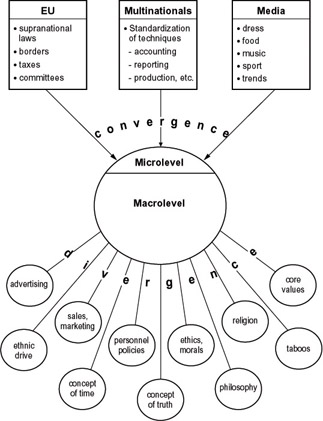
Micro- and Macrolevel Cultural Adaptation
The management of cultural diversity, in terms of sensible adaptation to others and efforts to establish common ground, faces many challenges at the practical level. The above diagram illustrates some of these.
It is tempting for huge multinational and transnational companies to seek universal management solutions that would prove acceptable and feasible in their branches and subsidiaries. Corporate policy would be strengthened, training procedures would be simplified, and standardization of many processes would decrease cost. Unfortunately (or perhaps fortunately) multinational firms cannot submerge the uniqueness of different cultures. Although the corporate culture that is imposed may be strong, local staff are reluctant to give up their background or preferred ways of doing things. They may be willing to adapt, but in moments of uncertainty they will dig in their heels and revert to their own core beliefs and cultural values.
When it comes to supranational organizations such as the EU, NAFTA, ASEAN, MERCOSUR, and so forth, there is a general willingness to accept regulation and standardization of conventions when they are clearly to our benefit. Examples of such instances are the Schengen Agreement on border controls, the substitution of identity cards for passports between certain countries, waivers of visa restrictions, lowering of tariffs, the European and International courts, the extra protection against crime afforded by Interpol, the GATT rounds, and so on. The success of numerous international student exchanges and scholarships abroad as well as the universal welcome of clubs such as Rotary and Lions in every land are further examples of people’s willingness to join international activities in certain fields. Yet there is a certain reticence about supranational control in other areas. Standardize European taxes? Ask Britons to carry identity cards at all times? Allow foreign police to chase criminals across your frontier in hot pursuit? Abandon the pound, dollar, Swiss franc? These are all questions that may well be settled sensibly in due course as Europe continues to integrate. Would Asian countries integrate likewise? And all the Americas?
Of more immediate import to the globalization of business is the extent to which large multinationals (and with the many mergers at the present time, they are getting ever larger) can effect economies of scale and ease of management through sensible standardization and the establishment of universally acceptable business models. As I have stated elsewhere, business models for the twenty-first century are not going to be national ones. Companies functioning across borders and cultures, if they wish to be successful, will have to sculpt or fashion business models that take into account the problems of macrolevel cultural divergence (see again the diagram on page 237). They will have to accept that there are contemporaneous processes of convergence and divergence in the development and restructuring of their over- seas subsidiaries. Standardization of production techniques, reporting systems, general accounting, and even R&D and IT departments pose few major hurdles. When it comes, however, to sales and marketing methods, advertising, personnel policies, pay and compensation packages, leadership initiatives, staff training, legal disputes, and relations with local authorities and government, to name but a few, cultural divergences will seriously hamper standardization, and firms will have to make unfamiliar judgments on a case-by-case basis. It is not only a matter of refraining from making drastic changes in the normal business procedures of the local company that is required but, more importantly, a matter of entering into the cultural world of the partner, with all its inherited complexity of ethics, morals, core beliefs, taboos, religious tenets, age-old philosophies, and deeply embedded concepts of time, space, truth, status, prestige, face, honor, revenge—in all, a particular worldview.
This represents an enormous challenge to chief executives and managers at policy-making and decision-making levels. The fashioning of workable multicultural models is by no means impossible and has been achieved on numerous occasions. Companies such as Unilever, ABB, Nokia, Ericsson, Hewlett-Packard, Sonera, Deutsche Telekom, Nestl, and Motorola have been both greatly concerned with and successful in international structuring and in training their managers diligently in cross-cultural issues.
Clearly, companies that are globalizing often wish to apply their worthy corporate policies and efficient business models; to them, simply “going with the flow” is neither acceptable nor advisable when entering a foreign business environment. Every model has its faults, but the local culture will have its deficiencies, too. Clearly, there must be a compromise—a harmonizing of methods and intent. Companies would do well to observe, however, that the positive qualities of head office culture may not be seen as entirely beneficial by the local society and may in fact have many negative connotations of which the head office is not aware.
Management of Cultural Values? A Different Story
People’s adaptation to an alien cultures’ concepts is deceptive. At the microlevel, for example, fashion, new styles can be adopted with ease, even enthusiasm. The same certainly applies to food, as the proliferation of French, Italian, Chinese, Indian, and Thai restaurants in London and New York demonstrates. The media influences our tastes and appetites continually, and at the microlevel we enjoy cultural diversity.
At the macrolevel, however, culture is far from being standardized. Americans, particularly, are doomed to disappointment if they think their core values, ethics, morals, and so on are being—or will be—adopted by other national cultures (see again the diagram on page 237).
The chart on the next page indicates how some American qualities (surely positive in American eyes) may be viewed quite differently in other lands; it illustrates why at the macrolevel cultural standardization is still a long way off.
|
American Qualities |
Others’ Perceptions |
|---|---|
|
Democracy and equality |
Don’t exist; impractical anyway (Asians) |
|
Individualism |
Lack of concern for others (Asians, Swedes) |
|
Competitiveness |
Aggressiveness (French) |
|
Speedy decisions |
Too rushed (Japanese, Chinese) |
|
Hard sell |
Over the top (Germans, Finns) |
|
Frank, direct |
Rude (Japanese, French) |
|
Optimism |
Lack of realism (Scandinavians) |
|
Charisma |
Charisma is suspect (Germans, Dutch) |
|
Change and improvement are good |
Doesn’t protect status quo (Saudi Arabia) |
|
Results oriented |
Lacking in people orientation (Italians, Asians) |
|
Self-confidence |
Arrogance (South Americans, Arabs) |
|
Informal, smiling |
Lacking respect, insincerity (Germans, French) |
|
Future orientation |
Lacking tradition (Chinese) |
|
Defender of democracy and free trade |
Defender of U.S. interests (Russians, Arabs) |
The chart below shows how the Germans—serious, well-meaning and worthy people—can be frequently misunderstood by other cultures!
|
Others’ Perceptions |
German View |
|---|---|
|
They complicate things too much. |
Life is not simple. |
|
They are tactless. |
The truth is always the truth, why pretend? |
|
They have no sense of humor. |
We don’t waste time wisecracking in business meetings. |
|
Their speeches are long and boring. |
We want to know all the facts. We are good listeners. |
|
They are too formal. |
Formality and use of surnames show respect. |
|
They criticize and complain. |
We are trying to help you improve. We are perfectionists. |
The last chart in this chapter is meant to bring home to you the inherent difficulty of one’s being diametrically opposed to the core beliefs of certain cultures. Try convincing these people about the following:
|
Arabs |
Religion and business should not be mixed. Forget Islam while you’re with us. |
|
Americans |
Money is not important. |
|
Germans |
Your weakness is that you get bogged down in details. |
|
Japanese |
Make decisions individually; it’s faster! |
|
Hispanics |
Maana behavior signifies laziness. |
|
Chinese |
Always be frank and tell the truth, whether anybody loses face or not. |
|
French |
You are bit-part players in world business and politics. |
|
Russians |
You need not be suspicious of foreigners—they want to help you. |
|
Koreans |
You have good neighbors. |
|
British |
Funerals are more entertaining than cricket matches. |
|
Canadians |
You are really Americans. |
The preceding charts highlight the phenomenon that different cultures perceive things firmly from their habitual standpoint, their worldview, in fact. Americans see their own qualities as obvious examples of modern progress and human advancement. Who could possibly argue against democracy, frankness, and future orientation? The answer is: most people. Germans, for their part, are honest and diligent citizens who try to lead their lives in a respectable and responsible manner. Yet many nationalities frequently mock their seriousness.
Finally, the last chart illustrates that many deeply embedded habits, like Japanese or Chinese collective behavior or Russian and Korean suspiciousness, are closely connected to the “cultural black hole” mentality, where one simply does not see a better alternative.
Preface
- From 2,000,000 B.C. to A.D.2000: The Roots and Routes of Culture
- Culture and Climate
- Culture and Religion
- Cross-Century Worldviews
- Cultural Spectacles
- Cultural Black Holes
- Cognitive Processes
- The Pacific Rim: The Fourth Cultural Ecology
- The China Phenomenon
- Americanization versus Asianization
- Culture and Globalization
- Empires Past, Present, and Future
Conclusion

EAN: 2147483647
Pages: 108
- ERP Systems Impact on Organizations
- The Second Wave ERP Market: An Australian Viewpoint
- Enterprise Application Integration: New Solutions for a Solved Problem or a Challenging Research Field?
- Data Mining for Business Process Reengineering
- Relevance and Micro-Relevance for the Professional as Determinants of IT-Diffusion and IT-Use in Healthcare
