A Conceptual Framework - Entrepreneurship
 | |
A Conceptual Framework - EntrepreneurshipEntrepreneurship is a creative process where there is a beginning (vision) and ending (living system) to the entrepreneurial act. Small business and big business are merely points reached during the process that begins with an abstract idea, which the entrepreneur commits to structure as a business venture. Along the way, the entrepreneur makes strategic decisions to meet a series of structural challenges, and in so doing, shapes the venture. For example, an early strategic challenge is identifying, evaluating, and committing to a particular opportunity. Once decided, the venture is delimited to a particular focal environment, i.e., industry/market and all that entails. Successfully meeting each of these challenges brings the venture closer to the entrepreneurial goal of developing a self-sustaining living system with the in-built capacity to innovate and grow. Each structural challenge corresponds to an attribute of a living system (Table 2).
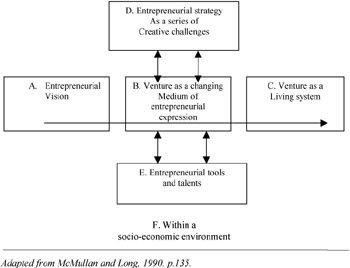
Another component of the process is the need for differing skills, knowledge and information along the way. As the venture takes shape as a small business, it may well be expected that the entrepreneur looks to IS for help with operational matters to help meet the challenge of standardizing operating performance. At another challenge point, IS may play an important role in support of strategic expansion. The finale, or end, of the entrepreneurship process is a self-sustaining living system, " no longer needing the entrepreneur's contribution to survive and prosper" (McMullan and Long, 1990, p. 138). At this juncture the entrepreneur has successfully developed the venture with the attributes common to living systems. Part D (Figure 1) refers to a series of creative entrepreneurial challenges. There are ten of these challenges, each of which corresponds to a structural attribute of a living system (Table 2). The balance of the discussion focuses on these. As we review the strategic entrepreneurial challenges, it is important to recognize that (1) their ordering is logically intuitive, (2) each independent strategic decision makes a structural contribution to the business venture, (3) structural components are dynamic and may be revisited, and (4) each decision will build on those made previously and will affect those to come.
To summarize, Figure 1 illustrates the entrepreneurship process, which begins with a vision (A) of a business opportunity. Once a commitment is made to pursue the vision, the entrepreneur undertakes to build a self-sustaining living system (business venture) (C). The venture takes shape (B) as each strategic challenge (D) is addressed. The necessary tools and talents (E) are brought to the venture by the entrepreneur, through the commitment of members, and may in part be acquired from independent consultants, mentors, etc. All of this takes place within and is influenced by a particular socio-economic environment (F). In Table 3, the ten strategic entrepreneurial challenges are restated in question form, and grouped into four broad categories. The first group of three challenges is preparatory and typically precedes the venture's launch. Second are those challenges that characterize the venture launch and search for market success and operational understanding. Some refer to this phase as the search for survival. Third are the critical challenges facing the venture's successful growth. Finally, the fourth is labelled "exiting," meaning the attributes of a living system are in place, including the capability for ongoing innovation. Exit does not imply the entrepreneur should leave the venture; rather, it suggests the entrepreneurial act is complete and he/she may comfortably leave the venture with reasonable assurance of its continued survival and growth. Each broad grouping of challenges is briefly discussed below. It is important that IS researchers and consultants recognize the context of subject businesses. This discussion presents only abstract direction IS researchers might refer to in developing a contextual map.
It is also important to note that only a small proportion of the multitude of small businesses go beyond being "small to medium-size"; a large proportion of businesses do not survive beyond the first generation entrepreneur.
Preparing the VentureThe first three challenges are preparatory and involve (1) identifying and assessing the opportunity, (2) designing the product service offering, and (3) planning for the resources necessary to actually operate the business. Which markets to serve with what product/service package and with what business competencies and structure are the major issues to be resolved. It behooves the entrepreneur to become fully knowledgeable of the industry: its practices, competitors, and markets. Planning skills are needed to articulate resource requirements and launch strategies. The entrepreneur may take advantage of the available business plan software as well as many archival and real-time sources of market, supply and competitive information.
Launching the VentureThe next three challenges relate to (1) negotiating and acquiring the necessary financial and human resources to implement the launch strategy. It is of course critical to get customer commitment, and (2) to set up production at an appropriate scale, (3) accompanied by effective distribution. Once sales begin generating cash flow it is also critical to establish and implement adequate financial controls and mechanisms to ensure the launch is progressing within plan tolerances. The emerging firm will be faced with monitoring and assuring sufficient cash flow to accommodate growing product/service demand while learning the rudiments of operational activities. The chequebook is no longer adequate financial control and visually scanning inventories will soon require at least a rudimentary inventory control system.
Growing the VentureIn a sense, the venture is now an operating prototype or small business. Whether the entrepreneur intends growth or wishes to remain small will nevertheless require that he/she attend to (1) standardizing operations to achieve certain efficiencies and to facilitate responding to environmental change. If growth is the objective, then these systems should be designed with (2) expansion strategies in mind. Growth will necessitate structuring in (3) additional levels of management, adding complexities to operating and strategic controls. As management is professionalized, information system needs will become increasingly complex. Control will move from face-to-face to performance-based. It will become more difficult to ensure the growing venture retains the entrepreneur's vision without consciously attending to the culture and building communication and feedback mechanisms. The linkages with customers and the distribution network must be tightly aligned and maintained. Formal information systems will be needed to replace what was daily face-to-face contact among members of the small firm team. Management development programs should be integrated with performance controls. In short, the entrepreneur must be prepared for rapid growth and increasing leadership demands for leadership skills.
Exiting from the VentureIn order to ensure growth potential, the entrepreneur needs to ensure the capacity to innovate is built into the venture. Effective new product development and broader research and development capacity will help to ensure continuance of the firm. The organization now exists as a professionally managed living system and the process of entrepreneurship as such is complete. The organization will now be capable of ongoing entrepreneurial behaviour as a self-sustaining living system, able to continually revisit and address the appropriateness of its structural configuration to profitably satisfy market needs and the goals of the firm. A number of alternatives exist for the founding entrepreneur, from continued active involvement to complete liquidation of the venture. No matter what direction is taken, it is important to develop a succession plan with sufficient lead-time to accommodate a smooth withdrawal of the entrepreneur at the appropriate time.
| |||||||||||||||||||||||||||||||||||||||||||||||||||||||||||||||||||
| | |||||||||||||||||||||||||||||||||||||||||||||||||||||||||||||||||||||


EAN: 2147483647
Pages: 188