Voice of the Customer (VOC)
Overview
Purpose of these tools
- To figure out what customers care about
- To set priorities and goals consistent with customer needs
- To determine what customer needs you can profitably meet
Deciding which tool to use
Customer segmentation, p. 56, principles for identifying subsets of customers who may have differing needs or requirements. Especially useful for any team dealing with a moderate to large customer base.
Types and sources of customer data, p. 58, a list of typical customer data your organization may already have or can get. Use to prompt your own thinking before a VOC effort.
Collecting VOC:
- Interviews, p. 59, guidance on conducting professional interviews with customers. Recommended for any team that wants to develop a deep understanding of customer needs and how customers use the product or service
- Point-of-use observation, p. 60, guidance for what to do if you can visit a customer' s workplace or observe the point of contact between the customer and your product/service. Use to gain greater insight or confirm interview results.
- Focus groups, p. 61, guidance on how to structure focus groups. More efficient than doing separate interviews but still time intensive. Use as needed.
- Surveys, p. 62, guidance on conducting surveys. Best used to confirm or quantify theories developed after other customer contact. Also can be used to identify most important issues to research. Good for gathering quantitative information.
Kano analysis, p. 64, a technique that helps you understand varying levels of value that customers place on different features of your product or service.
Developing critical-to-quality requirements, p. 67, instructions for converting customer need statements into product or service requirements. Use when your mission is to deliver products/services that better meet customer needs.
| Tips |
|
Customer segmentation
Highlights
- All customers are not created equal, and do not create equal value for the organization
- Customer segmentation is a way to identify and focus on the subgroups of customers who generate the highest value from the product, service, or process being designed or improved
|
Customer |
Internal or External? |
Segments/Description |
Priority |
|---|---|---|---|
|
Consumers with Children |
External |
|
|
|
Children |
External |
|
|
To use customer segmentation…
- Identify the output (product or service) being studied
- Brainstorm to identify the customers of that output
- Identify the segmentation characteristics that you think may influence how a customer or group responds to your company and its products or services
- Focus on just a few characteristics
- Develop profiles of the segments you will seek out for your projects
Ex: high-volume vs. low-volume, West Coast vs. Midwest vs. Southeast customers
- Include representatives from each segment in whatever customer contact you initiate (interviews, surveys, focus groups, etc.)
- Document the results
- In any subsequent data analysis, do separate charts for each segment to see if there are different patterns
|
Product/Service |
Customers |
Potential Segments |
|---|---|---|
Examples of segmentation criteria
- Economic: Revenue, profit, loyalty, frequency of purchase, company size, cost of doing business with them, strategic goals
- Descriptive: Geographic location, demographics, product or service feature that interests them most, industry
- Attitudinal: Price, value, service
Sources of customer data
- Existing company sales information: Product/service sales, product/service returns of refunds, sales preferences, contract cancellations, customer referrals, closure rates of sales calls, DSO
- Customer contact points (listening posts): product/service complaint or compliment mechanisms (hotlines, website links); any customer-facing staff (customer service reps, sales reps, billing/accounting staff)
- Research:
- Direct: Interviews, surveys, focus groups, point-of-use observation
- Indirect (market trends): Market share changes, industry experts, market watchers
Choosing a contact method
|
Type of Contact |
Choose if you want to get… |
|---|---|
|
Face-to-face interviews |
Unique perspectives Senior-level participation Ability to pursue unexpected lines of questioning In-depth understanding of the customer experience Insights that may lead to innovation |
|
Focus groups |
Information from customers with similar product and service needs Mid-to lower-level participation Information from many people for a single segment |
|
Telephone interviews |
Information from customers who are widely dispersed geographically Information on basic or simple issues Quick turnaround of information collection A lot of data at a low cost. |
|
Surveys |
Quantifiable and statistically meaningful responses Information from many customers Confirmation of theories you' ve developed based on other forms of customer contact |
Collecting VOC Interviews
Purpose
To learn about a specific customer' s point of view on service issues, product/service attributes, and performance indicators/measures
Why use interviews
- Establishes communication with individual customers (vs. groups of customers)
- Allows flexibility and probing of customer needs
- Customers feel "listened to"
When to use interviews
- At the beginning of a project: to learn what is important to customers (which supports the development of hypotheses about customer expectations)
- In the middle of a project: to clarify points or to better understand why a particular issue is important to customers, to get ideas and suggestions, or to test ideas with customers
- At the end of a project: to clarify findings, to validate improvement
How to do customer interviews
- Be clear about the purpose of the interviews. What role will the interviews play in the project? How will you use the information afterwards?
- Prepare a list of questions.
- Decide on interview method (face-to-face, phone).
- Decide how many interviewers and interviewees will be present.
- Do practice interviews internally to refine the script, questions and interview process.
- Contact customers and arrange interviews. Send out a confirmation letter or email stating the purpose of the interview and providing a list of general topics to be covered (no need to share specific questions unless you think it will help customers prepare).
- Decide how you will collect data from the interviews. If you plan to record them (audiotape, computer audio programs) make sure you tell customers and get their permission to do so.
- Conduct interviews.
- Transcribe notes and continue with data analysis.
| Tip |
|
Collecting VOC Point of use observation
Highlights
- The key is to watch how your customers use your product or service at their location or at any point where they interact with your company (Ex: bank lobby, retail store)
- High-impact technique for experiencing what it' s like for a customer doing business with your company, and generating insights for improving products, services, or processes
To do customer observation…
- Be clear about the purpose of the observation. What role will the observation play in the project? How will you use the information afterwards?
- Decide when and how you will observe customers (in their workplace, in a retail situation, etc.).
- Develop and test an observation form for collecting the data you desire.
- If going to the customer' s workplace, contact them and arrange the time. (See also customer interviews, p. 59, if you plan to simultaneously conduct interviews.)
- Train observers to make sure everyone will follow the same procedures and leave a good impression with customers.
- Conduct the observation.
- ALWAYS do a pilot with a few low-risk customers and tweak your methodology
- Continue with data analysis.
- Include follow-up contact with customers (thank-you note, copies of observations, updates on changes made as a result of their contributions).
Collecting VOC Focus groups
Purpose
To get feedback on existing products or services or on proposed ideas from the point of view of a group of customers
Why use focus groups
- Allows for more creativity and open-ended answers than surveys but isn' t as time-consuming as interviews
- Allows participants to play off each other' s ideas
- Lets you observe people interacting with physical items (products, prototypes, marketing materials, etc.), which you can' t get from surveys
When to use focus groups
- To clarify and define customer needs (Define/Measure)
- To gain insights into the prioritization of needs (Define, Measure, or Improve)
- To test concepts and get feedback (Improve)
- As prework for a survey or interviews to identify topics of critical interest to customers
- As follow-up to customer interviews as a way to verify lessons or information learned
How to conduct a focus group
- Identify the number and target size of focus groups
- Time and expense will limit the number you can do (but you must do more than one!)
- Each group usually has 7 to 13 participants
- Identify participants
- Your options are to mix representatives of different customer segments, or focus on a specific segment or on people known to have an interest in the topic
- Develop questions
- Do a pilot to test the ease of gathering and analyzing data
- Conduct the focus groups
- This is harder than it may seem. If no one within your organization has experience with focus groups, consider hiring out-side help.
- After the focus group, transcribe customer comments
- Select appropriate follow-up action
- Create an affinity diagram of selected customer statements to find themes in customer comments
- Use customer statements to develop product/service requirement statements
Collecting VOC Surveys
Purpose
To get quantitative data across an entire segment or group of segments on customer reactions to a product, service, or attribute
Why use surveys
- To efficiently gather a considerable amount of information from a large population
- To conduct analysis that will result in data with statistical validity and integrity (interviews and focus groups generate qualitative data only)
When to use surveys
- When you need or want to contact many customers to get quantitative information
- As prework for interviews or focus groups to identify target areas for more in-depth investigation
- As follow-up to interviews or focus group to quantify relationships or patterns identified
How to conduct a survey
- Develop survey objectives.
- Determine the required sample size (see p. 85).
- Write draft questions and determine measurement scales.
- Identify the specific information you need to collect
- Numerical scales are easier to record and compare (such as rating items from 1 to 5 in importance) but qualitative scales are sometimes more appropriate ("not at all interested" to "very interested")
- Determine how to code surveys so data can remain anonymous (if appropriate).
- Design the survey.
- Confirm that getting answers to the individual questions will meet your objectives (adjust, if not).
- Conduct a pilot test.
- Finalize the survey.
- Send out survey (mail, fax, email attachment) to selected customers. Include a means for them to respond—SASE, return fax number, email reply. Or post on your website and give participants instructions on how to access the survey.
- Compile and analyze the results.
| Tips |
|
Kano analysis
Purpose
To better understand what value your customers place on the features of your product or service, which can reduce the risk of providing products or services that over-emphasize features of little importance or that miss critical-to-quality features/attributes.
Why use Kano analysis
- Good "first cut" technique to evaluate relative importance of customer requirements
- Allows you to identify segments by the type or level of quality that customers expect
- Helps determine if there are requirements that:
- were not explicitly stated by customers
- were included in previous offerings and are still valued by the customer
- To help shape your VOC data-gathering plans
When to use Kano analysis
- Use in Define or Measure to understand scope and importance of project goals
- Use in Improve to help redesign a product, service, or process
- Use after interviews or focus groups to confirm that some needs spoken by the customer are truly critical requirements that will affect customer satisfaction or purchasing decisions
How to use Kano analysis
- Collect VOC data through as many different means as you can
- You cannot identify all customer needs through any single method
- Identify known or presumed customer needs/requirements
- For each potential need, ask the customer to assess:
- How would they feel if the need WAS addressed? (Positive)
- How would they feel if the need WAS NOT addressed? (Negative)
- The customer has four choices in response to each question:
- I' d like it
- It is normally that way (that feature is expected)
- I don' t care
- I wouldn' t like it
Based on the answers to the "positive" and "negative" questions, use the table to determine the type of need
Answers to Negative Questions
Like
Normal
Don't Care
Don't Like
Answers to Positive Questions
Like
Delighter
Delighter
Satisfier
Normal
Dissatisfier
Don't Care
Dissatisfier
Don't Like
- Based on customer responses, classify each need as a dissatisfier, satisfier, or delighter (see definitions on next page)
- Incorporate this information into product or service development efforts
- You MUST deal with any basic requirements (dissatisfiers) that your product or service does not already deliver. If you don' t do a good job on these, it doesn' t matter how well you do on other features or options.
- Do conjoint analysis or use another technique to evaluate how much of the "satisfiers" you can afford to include in your product/service.
- If you already have delighters in your product or service, strengthen support for them. If you do not yet have delighters, work with management to launch a design or redesign effort to incorporate the new features you' ve identified (after you' ve dealt with dissatisfiers and satisfiers).
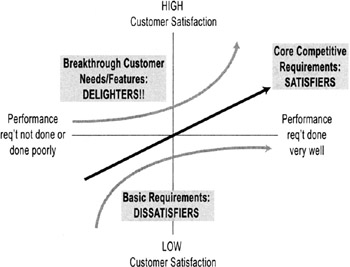
Definitions of Kano levels
- Dissatisfiers—Basic requirements: Expected features or characteristics of a product or service. If these needs are not fulfilled, the customer will be extremely dissatisfied. Satisfying basic requirements is the entry point for getting into a market.
- Customers will seldom name basic requirements when asked what' s important to them, because they take these features for granted (Ex: we expect every car to have a steering wheel). Because basic requirements are unspoken, don' t rely on interviews or surveys to identify them. Review past product/service designs and observe customers in action to see what features they use all the time.
- Satisfiers—Performance requirements: Standard characteristics that increase or decrease satisfaction by their degree (cost/price, ease of use, speed). Satisfying performance requirements will allow you to remain in the market.
- Customers will usually name features that are performance requirements when asked what' s important to them.
- Delighters—Excitement requirements: Unexpected features or characteristics that impress customers and earn you extra credit. Satisfying excitement requirements opens the opportunity to excel, to be World Class.
- Because these are often innovations that do not appear yet in the marketplace, customers will rarely tell you about delighters.
| Tip |
|
||||||||||
Developing critical to quality requirements
Highlights
- Customer comments on what they want or need are often too vague to be acted on by the team
- This process can help you make the transition from vague statement to precise functional requirement
- This process will strengthen your ability to provide products or services that meet or exceed customer needs
To develop critical to quality requirements…
- Gather VOC data relevant to the product, service, or other output you' re studying.
- Identify relevant statements in transcripts of customer comments and copy them onto slips of paper or self-stick notes. Focus on statements that relate to why a customer would or would not buy your product/service.
- Use Affinity diagrams (p. 30) or Tree Diagrams (not covered in this book) to sort ideas and find themes.
- Start with the themes or representative comments and probe for why the customer feels that way. Do follow-up with customers to clarify their statements. Be as specific as possible when identifying the why.
- Conduct further customer contact as needed to establish quantifiable targets and tolerance (specification limits) associated with the need. (How do customers define "timely?" "comfortable?" "well-organized?" "friendly?")
- When you' ve completed the work, step back and examine all the requirements as a set. It' s possible that customers simply didn' t mention something key during your data collection. Have you covered all key aspects of your product or service? Fill in gaps as needed.
Voice of the Customer
The "Why" (After clarification)
Critical Customer Requirement
"I hate dealing with your company."
Products are not delivered on time
10 day lead time (± 1 day)
Good customer requirements
- Are specific and easily measured
- Are related directly to an attribute of the product or service
- Don' t have alternatives and don' t bias the design toward a particular approach or technology
- Describe what the need is, not how it will be met
The Lean Six Sigma Pocket Toolbook A Quick Reference Guide to Nearly 100 Tools for Improving Process Quality, Speed, and Complexity
- Using DMAIC to Improve Speed, Quality, and Cost
- Working with Ideas
- Value Stream Mapping and Process Flow Tools
- Voice of the Customer (VOC)
- Data Collection
- Descriptive Statistics and Data Displays
- Variation Analysis
- Identifying and Verifying Causes
- Reducing Lead Time and Non-Value-Add Cost
- Complexity Value Stream Mapping and Complexity Analysis
- Selecting and Testing Solutions

EAN: N/A
Pages: 185
