Chapter One Solutions
One Solutions
Overview
When I ask salespeople and sales executives whether their company provides solutions, they answer yes—virtually every time. Yet when I ask these same salespeople what solution they provided for their last customer, their answers tell a different story. I hear all about their products and services, complete with dazzling brand names and mind-boggling acronyms.
My point is that everybody claims they’re in the solutions business, but for the most part it's just empty words. The word solution is used so much that no one knows what it means anymore. So, when salespeople say they are in the solutions business, buyers ignore these words, because to them it’s just more sales and marketing hype. It is important for individuals and companies to recognize this problem and change their approaches.
Most companies and salespeople who claim to provide solutions are unconsciously engaging in selling products—not solutions. This leads me to conclude that people do not understand what a solution is.
So what is the definition of the word solution? The typical response is, “An answer to a problem.” I agree with this response but feel it’s important to expand the definition. Not only does the problem need to be acknowledged by the buyer, but both the buyer and salesperson must also agree on the answer. So a solution is a mutually agreed-upon answer to a recognized problem.
In addition, a solution must also provide some measurable improvement. By measurable improvement, I mean there is a before (a baseline) and an after (the baseline plus a delta). Now we have a more complete definition of a solution: It’s a mutually shared answer to a recognized problem, and the answer provides measurable improvement.
Recently, an executive of a $13 billion company came to me and said, “We want to be in the solutions business and deliver what we’ve been promising for years. One of our marketing messages is, ‘We sell and deliver solutions,’ but we really don’t do that. Just because all our promotional literature, advertising, and messaging has been saying this for years doesn’t make it true.”
He went on to say they wanted to find a way to transform—notice the key word transform—their company from product selling to solution selling. When I asked why, the answer came back emphatically, “Because our customers are demanding it.”
I helped him realize that the transformation he was after takes time and has to occur simultaneously from the top down and the bottom up. It takes a total commitment from everyone in the company to develop, sell, market, and deliver solutions. The entire organization has to adopt a new philosophy, a new discipline—a new culture. It means that everyone involved with the customer needs to be onboard and do some things differently than they did in the past. I helped him realize that the company’s new hires and its existing salespeople need to improve their customer-interfacing skills. Specifically, the salespeople need to be able to define and diagnose customer problems and create visions biased to his company’s unique offerings and capabilities. I told him that being in the solutions business means that the company has to commit to actually solving problems and be willing to stay engaged until its customers realize measurable, positive change.
The executive convinced me that his peers could reach their transformation goal and make the difficult shift from product selling to solution selling. This is currently a work in progress, and the early results indicate very good progress on a journey that will take longer than they expected.
WHAT IS SOLUTION SELLING?
It’s a sales process. (I’ll develop this more fully throughout this book.) According to research conducted by Phillip G. Ryan Associates, it’s the most widely used sales process focused on executable selling in the world today. More than 500,000 individuals have been trained in Solution Selling.
Executable selling activities involve direct contact with the buyer. For many individuals and companies, Solution Selling is their total end-to-end sales process. For others with more complex sales situations, it’s the executable portion of their selling process. Solution Selling not only helps with what to do, but it specifically focuses on how to do it.
Solution Selling’s sales process consists of the following components: a philosophy, a map, a methodology, and a sales management system. Solution Selling does not become another thing to do (on the list of mounting chores). It becomes the thing to do for salespeople, marketers, and managers.
It s a Philosophy
The customer is the focal point. Helping customers solve their business problems and achieve positive, measurable results is the basis of all actions, therefore the steps within the Solution Selling sales process are aligned with how buyers buy.
It s a Map
Solution Selling provides a map of how to get from where you are to where you want to be. Solution Selling provides an end-to-end series of next steps to follow. End-to-end means from the beginning of a sale right through to winning it. This includes precall planning, creating interest, diagnosing the problem, vision processing, controlling the sale, closing, and postsale tracking. It includes the ability to identify, analyze, report on, manage, and coach individual opportunities using the process. In addition, it provides the ability to predict sales success or failure.
It s a Methodology
Solution Selling is a system of methods that includes tools, job aids, techniques, and procedures that help salespeople and sales teams navigate the selling steps that close more sales faster. It results in higher levels of customer satisfaction and increased sales productivity.
It s a Sales Management System
Solution Selling provides sales and executive management with a process to analyze pipelines, qualify opportunities, and coach skills, thus increasing productivity and predictability. It results in a high-performance sales culture.
WHY SALES PROCESS?
Not all salespeople are created equal. You’ve heard the clich “Some people are natural born salespeople”? They have that amazing talent that is hard to describe. We look at this group of intuitive and talented individuals, approximately 20 percent of the sales talent pool, and we call them Eagles. Sometimes these intuitive salespeople are called unconscious competents. They’re good, but if you ask them why they’re good, they’d have a hard time telling you why. That’s the classic response of the unconscious competent.
We call the second category of sales talent Journeypeople. This group makes up the balance of the talent pool, or about 80 percent of the sales talent in the marketplace today. These people are ready, willing, and able to sell, but they do it quite differently than the Eagles. Journeypeople can, and many of them do, become good salespeople. However, the real key to their success is having a process to follow and knowing what to do next.
Eagles are the high flyers, the rainmakers. They are the ones who do things independently and who generate business. But they can’t be expected to deliver all the business we need; there aren’t enough of them. The 20 percent of the revenues that the Eagles don’t deliver has to come from somewhere, and it must come from the Journeypeople. A company’s overall sales success depends on the success of its Journeypeople. We need to help them become successful. Figure 1.1 shows the differences.
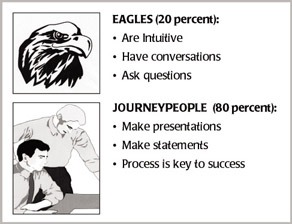
Figure 1.1: Talent Assessment
What is the typical career path of Eagles? What do most companies do with their best salespeople? If you answered, “They promote them to managers,” you’d be correct. But this creates a problem. Usually, when you promote Eagles (who don’t consciously know how or why they excel) to sales management, they can’t help the Journeypeople they now manage. Often they simply tell their salespeople, “Just watch me and do what I do.” Eagles resort to this tactic because they don’t have a sales process to follow. After all, a sales process provides both what to do and how to do it. To compound the problem, when an Eagle is promoted to management, a good revenue producer is lost from the sales force.
In the end, both management and the new sales manager become frustrated because of the lack of results. If management doesn’t end up firing them, these people usually quit and go to work for another company doing what they’re good at: selling. If you’re party to something like this in your company, stop it. The key to stop promoting the wrong kind of people to sales management is to implement a good sales process.
Eagles are an important reason why I’m so passionate about sales process. When you convince an Eagle to use an effective sales process, you have the best of all worlds—he or she is unstoppable. On the other hand, I’m equally passionate about Journeypeople and their need for sales process. Journeypeople using a proven sales process can win most of the time when competing against an Eagle without a process. A good sales process allows Journeypeople to emulate Eagle selling behavior, maximize their individual sales performance, and learn how to become tomorrow’s sales managers.
THE 64 PERCENT DILEMMA
Would you consciously assign your least-capable salespeople to your most difficult prospects? Probably not, but I find a number of companies doing exactly that. We call this challenge the “64 percent dilemma” (see Figure 1.2).
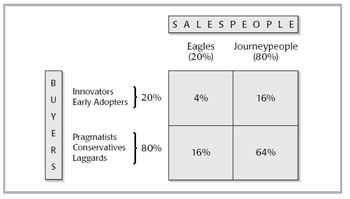
Figure 1.2: Why Sales Process?
The concept is based, in part, on Geoffrey Moore’s analysis as explained in his book Crossing the Chasm. In Moore’s book, buyers are separated into market segments based on their behavior.
Depicted on the vertical axis of Figure 1.2 is a group of buyers called innovators, or early adopters. This group makes up about 20 percent of the market. As a group, they typically want to be the first to have new things, and they’re the easiest group to sell to.
Also depicted on the vertical axis is a category of buyers called pragmatists, conservatives, or laggards They make up about 80 percent of the marketplace. These are slow-to-act, conservative buyers. They demand things such as references, proof, and ROI (return on investment) analysis before they will make a decision. As a group, they’re the most difficult to sell to.
On the horizontal axis, you have Eagles (20 percent) and Journeypeople (80 percent). When you combine the two categories of buyers with the two categories of sales talent, you have a classic matrix with some interesting findings.
Look at the 64 percent quadrant. This is the challenge, and it’s why we call it the 64 percent dilemma. This is where companies have Journeypeople selling to the most challenging and difficult-to-sell-to buyer segment. In other words, 64 percent of the time you’ve got less than your very best salespeople selling to the toughest buyer segment. Why do that? The solution is a no-brainer. Companies and individuals should stop kidding themselves and stop the insanity by putting a sales process in place to help solve this dilemma. I hope that by now you’re convinced of the importance of sales process. Just in case you aren’t, keep reading.
SITUATIONAL FLUENCY
Buyers want to do business with salespeople who understand them—their jobs and their problems. They want to do business with someone who has situational fluency—in other words, a person who has a good understanding of their situation as well as a good working knowledge of the capabilities necessary to help them solve their problems. What buyers don’t want are pushy salespeople interested only in selling their products and services. Buyers want a consultant who is going to add value to their situations. Otherwise, buyers would just go to your Web site for product information and price quotes. Salespeople must add value to the situation or they won’t survive.
Figure 1.3 illustrates the elements that help salespeople develop situational fluency and gain credibility with their buyers.
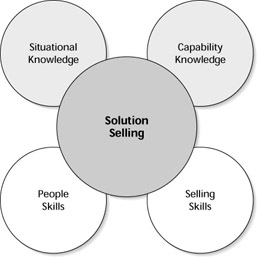
Figure 1.3: Solution Selling Situational Fluency
If situational fluency is what buyers are looking for in salespeople, what are sales managers looking for when they hire salespeople? What I hear them say is that they want salespeople with great selling skills; they want “great closers.” They look for closing skills and people with successful selling track records. Granted, success in the past is important, but I try to get them to see that success in the past doesn’t ensure success in the future. This is particularly true if it involves selling into a new industry and dealing with new products, new technologies, or new services. The good ole boy, backslapping, tongue-wagging salesperson doesn’t get the job done anymore.
I am not minimizing the importance of good people skills and good selling skills. In fact, in Solution Selling we incorporate key selling skills as a part of the overall process. Solution Selling develops situational fluency by integrating the knowledge competencies (situational knowledge and capability knowledge) with people skills and selling skills. Solution Selling is the only sales process that integrates all four of these components.
DIFFICULTIES IN SELLING SALES MANAGEMENT, AND EXECUTIVE MANAGEMENT
In addition to integrating both knowledge and skills, Solution Selling addresses specific selling, sales management, and executive management difficulties. What follows are some of the challenges we often see and hear as we begin to work with our clients. See how many of these issues resonate with you.
Typical Selling Difficulties
- “I’m having a hard time meeting, much less exceeding, my sales quota.”
- “Our product isn’t competitive anymore.”
- “Buyers say our services are too costly and can’t justify them.”
- “They wouldn’t let me in at the right level.”
- “If only my manager would have discounted.”
- “The consultant didn’t do a good job.”
- “I lose control of our prospects at the end of the sell cycle.”
- “We got in too late.”
- “The prospect didn’t know what she wanted.”
- “We missed the needs of certain committee members.”
- “I get an opportunity started and our resellers drop the ball.”
- “My manager tells me what to do, not how to do it.”
- “My competition’s Web site is great, and we get outsold before we even get started.”
- “My managers demand detailed sales forecasts—do they want me to sell or enter data into a system?”
- “Prospects can buy the same capabilities from someone else, so I have to outsell my competition to win the business.”
Typical Sales Management Difficulties
- “It’s becoming increasingly difficult to predict revenue.”
- “My salespeople are comfortable calling on technical and end users but are ineffective with executive management.”
- “Many of our salespeople wing it.”
- “We lose more to no decision than to any single competitor.”
- “Only a few of our new hires develop into top producers. There must be something wrong with our hiring model.”
- “Salespeople take sales support or technical people with them on too many calls.”
- “Marketing efforts are out of sync with our sales efforts.”
- “Salespeople blame losses on the product.”
- “As soon as the pipeline looks good, prospecting stops.”
- “We’re making our numbers but it’s too tough. Life is too short to work this hard!”
- “It’s difficult to find new opportunities, so we end up responding to RFPs or tenders wired for our competition.”
- “By the time I’m asked to get involved, it’s usually too late.”
- “Qualifying out of opportunities isn’t in our vocabulary.”
- Quarter-end fire drills have become a way of life.”
Typical Executive Management Difficulties
- “Getting accurate revenue forecast is a nightmare.”
- “All our strategic initiatives are dependent on making our revenue goals.”
- “The sales group is a mystery. Other groups in the company are much easier to hold accountable.”
- “We make great products in this company. Why can’t we sell them?”
- “Growing cost is not the problem; growing revenues is.”
- “We missed our quarterly revenue number. Fortunately, it was on the plus side. What would have happened if it had been on the negative side?”
In the next chapter, we explore the underlying principles of the Solution Selling sales process, which will serve as a springboard to each step in the process and the rest of the book.
Part One - Solution Selling Concepts
Part Two - Creating New Opportunities
- Chapter Four Precall Planning and Research
- Chapter Five Stimulating Interest
- Chapter Six Defining Pain or Critical Business Issue
- Chapter Seven Diagnose Before You Prescribe
- Chapter Eight Creating Visions Biased to Your Solution
Part Three - Engaging in Active Opportunities
Part Four - Qualify, Control, Close
- Chapter Eleven Gaining Access to People with Power
- Chapter Twelve Controlling the Buying Process
- Chapter Thirteen Closing: Reaching Final Agreement
Part Five - Managing the Process

EAN: N/A
Pages: 106
