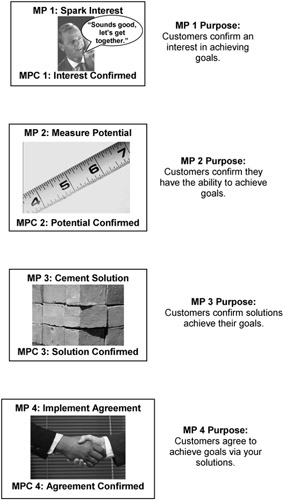
MeasureMax has four selling phases as shown in Exhibit 1-6. Unlike traditional selling stages, these Measurable Phases (MPs) include quantifiable steps that have definitive starting and
Exhibit 1-6:
The four selling phases of MeasureMax.
MPs provide the framework to measure the how:
The number of sales calls you make in each MP determines your progress and your ability to be a consistent producer.
Their sequence creates the most measurable value for customers.
The length of time it takes to complete MPs gauges your efficiency.
The sequence of the MPs, as well as the pace needed to complete them, points you toward the most productive strategies to
Their corresponding MPCs verify that the customers' pace and progress are in sync with yours.
MPs and MPCs also help you to determine whether the potential for achieving customers' goals is worth spending more time, energy, and resources. These sales mile markers ensure that you do not become lost. You know what steps lay ahead and how to stay on track. Use them to outvalue competition, earn higher profits margins, exceed customers' expectations, and retain long-
The
C
word (as in
commoditize)
is a salesperson's greatest fear and failure. Customers consider your products or services to be a
commodity.
Customers see no measurable difference between your features and benefits and those of
Why didn't the most value win? In the minds of the customers, it did. They think lowest price equals the highest value. When sales-people do not give customers the means to measure value in terms other than price, they
What one takes away, one can give back. Armed with the proper tools and knowledge of the MeasureMax selling system, you can decommoditize sales. Just make sure to contact customers who want Column 2 filled out (if given the opportunity).
| Note |
When customers' technical knowledge of your products is equal to, or better than yours, they view your products as commodities. They feel they can accurately compare products without your input. They no longer depend on you to explain the technical differences between competitive offerings. You now lost a key opportunity to justify a higher price than that of your competitors. Fortunately, you can recapture this opportunity and lost value (and then some) when you make customers rely on you as an expert in their industry as outlined in Chapter 3. |
To fill in Column 2 with measurable benefits, you must contact individuals who do not equate price and delivery with value:
In consumer or retail sales, top-down selling is easy. Consumers are the owners. In business-to-business selling, many more people are involved in purchasing decisions. Although the process is the same, finding the owners is difficult if you do not know where to look for them in organizations. Additionally, owners speak a language foreign and uncomfortable to most salespeople. Instead of speaking features and benefits, they use words associated with executive perspectives and economic value. Terms like
return on investment, corporate goals, net present value, company initiatives,
and
positive cash flow
pepper their vocabulary. Chapter 3
Once you find out owners' goals and understand how they measure value, you can help them to fill out Column 2. In addition, you ask owners what role the beneficiaries play in the decision-making process. Often, salespeople make beneficiaries more important than the owners. Let the owners decide who is important. After all, it is their money.
Most salespeople prefer to contact beneficiaries first and engage in bottom-up selling. Beneficiaries understand the technical
Problems arise when beneficiaries' goals and purchasing requirements
You depend on them to either arrange for you to meet with owners or have them sell inaccessible owners on your proposals. Bottom-up selling works well in established relationships; however, it loses much of its effectiveness with new prospects or customers that do not have proven track records. Where you start the sales process is often where you end up. Always strive to start with owners.
While relying solely on beneficiaries possesses its share of challenges, it also has its fair share of rewards. It becomes harder to make that comment about the individuals found in Column 1 opportunities.
Customers find it easy to fill in Column 1, because all they need to do is the following:
View competitive products as commodities with equal product features and benefits.
Receive proposals from at least two suppliers.
Compare price and delivery differences between suppliers.
Decide if these differences are large enough to
The people most likely to make buying decisions along these lines are purchasing
Yet, bids still
Bid documents are at the heart of the bid process. They contain specifications that describe technical or operational features or capabilities your products must meet. Some are so specific that they are difficult to
You mix these two extremes in one package and you have a lot of room for interpretations and disappointments. Yet, bid documents have a more fundamental flaw. They focus on product features (Column 1 details), not owners' measurable goals (Column 2 details). Without defined goals, it is difficult to determine whether any product meets owners' expectations. Everyone is trying to hit moving targets. Therefore, a catch-all goal surfaces in the bid process. Intermediaries award sales to companies that supply what is
However, even in a bid process, preferred salespeople exist. Intermediaries give them the inside track to help them win bids. Favored salespeople insert their products' unique strengths into the bid specifications and documents. The goal is to use their benefits to outweigh competitors' lower prices or faster deliveries. However, specifications tailored to your unique strengths can be a curse as well as a blessing for two reasons. First, you must count on competitors adhering to the bid specifications describing your unique strengths. If they choose to ignore them, ironic situations result.
Let's say you coauthored bid documents to end up as the only salesperson who can meet the specifications. This compliance raises your costs and lowers your price
Therefore, you always want to find out what penalties, if any, competitors receive for
Second, to keep unique strength specifications from becoming a negative, you must connect them to measurable goals to produce value. Otherwise, they look transparent and superficial. In bids where goals are vague, you cannot match them up. They appear to serve no purpose other than as artificial barriers to competition. This can hurt both your credibility and that of intermediaries.
Sharp-witted competitors will show owners where these so-called unique strengths only add costs, not benefits. Therefore, if comparisons between bids do not reward your unique strengths, they erode your competitiveness. They become unique weaknesses. For the most part, the bid process
Even if awarded the bid, you invest a great deal of time, effort, resources, and profits defending services or justifying costs. Thus, profit margins suffer. Still, it is not a bad outcome considering the alternative of losing the sale. However, no sale is a complete victory without compensation for the value of your unique strengths.