1.2 Example: Carlson Companies
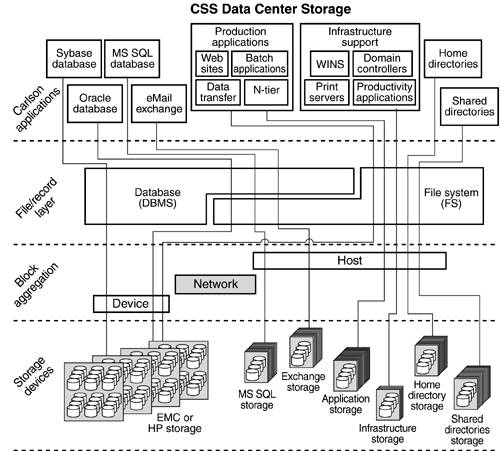
| An excellent example of this practical application of the model is provided by the IT staff of Carlson Companies. Carlson Companies is one of the largest privately held companies in the United States, with more than 180,000 employees in more than 140 countries. Its IT division, Carlson Shared Services, acts as a service provider to its internal clients and consequently must support a spectrum of user applications and services. In formulating a global IT strategy for networking and storage, the Carlson storage architects began with their current applications and the supporting server/storage infrastructure. Originally, Carlson's business applications were supported on a combination of direct-attached storage arrays and internal storage. As shown in Figure 1-7, database applications ran on servers attached to large storage arrays, and other applications ran on servers with internal storage. Figure 1-7. Carlson Companies' storage access prior to installing shared storage
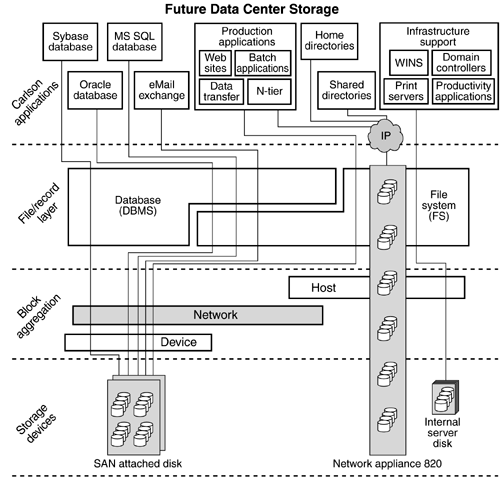
Overlaid on the SNIA Shared Storage Model, Carlson Companies' original storage configuration clearly demarcates which applications access data via records, which via files, and which via device-level block aggregation or host-supported block aggregation. The first step in determining which applications might be better served by shared storage and which shared storage technologies are most appropriate for specific upper-layer applications is to diagram the upper-layer applications and their storage access methods. By using the Shared Storage Model, the storage architects clarified the relationship between application requirements and storage resources and also revealed the administrative overhead incurred by dedicated storage units. The system required four large storage frames and six additional arrays to support Carlson's data center applications. Each storage unit required separate administration as well as maintenance contracts from the supplying vendor. Because storage consolidation is one of the key benefits of SANs, the Shared Storage Model offered a framework for modifying the components in the block subsystem to reduce the number of storage devices while still serving Carlson's business applications. As shown in Figure 1-8, analysis of Carlson's former storage deployment led to a proposed shared storage configuration that leveraged both SAN and NAS technologies to streamline storage administration and enable more efficient use of storage capacity. This design replaces the four large direct-attached storage frames with a single SAN-attached storage array supporting more than 10 terabytes of data. In this example, Oracle and other Carlson custom applications now share a single, highly available storage resource that is more easily administered and offers more economical maintenance support compared with the four direct-attached storage frames it replaced. Figure 1-8. Carlson Companies' storage access after installing SAN and NAS storage
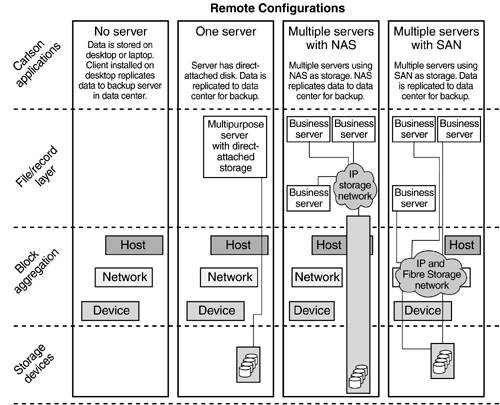
Shared directories and other internal applications have moved from direct-attached, dedicated storage to large NAS filers. In this instance, NAS was chosen for its cross-platform support and for its ability to serve remote NAS access for Carlson clients. Infrastructure applications that have no compelling reason to reside on either NAS or SAN remain on internal storage, as shown on the right side of the diagram. Remote storage access is also a significant factor for organizations with geographically dispersed sites. In Carlson Companies' global IT strategy, safeguarding corporate data generated at remote locations is essential for business continuance. Relying on each remote office to back up its own data locally offers no guarantee that backups are successfully completed or that data can be restored in the event of failure. Consequently, Carlson decided to streamline backup operations by bringing remote backup operations into its central data center. As shown in Figure 1-9, the Shared Storage Model is used to define four separate remote office backup scenarios. Remote offices with no local file servers have valuable corporate data on internal drives of laptops and desk workstations. Typically (and unfortunately) for most enterprise networks, this data is rarely backed up, resulting in loss of productivity if a laptop or desktop disk drive fails. For these sites, Carlson uses software that enables block change backup, meaning that only the data that has changed since the last backup is sent to the data center backup facility. This arrangement reduces the amount of data that must be sent across the wide area network and accomplishes the goal of securing dispersed corporate data assets. Similarly, remote sites with a local file server can be backed up using block changes, again reducing the amount of traffic generated over the WAN. Figure 1-9. Carlson Companies' remote backup scenarios
In the remaining two scenarios, a remote office may have a local NAS or SAN installed. For NAS, Carlson is leveraging vendor-supplied file backup utilities to replicate data from the remote site to the data center NAS equipment. At the data center, the NAS-based data can then be centrally archived to tape. For remote SAN installations, Carlson is using IP storage technology to transfer locally generated Fibre Channel SAN data to the corporate SAN. In Carlson's case, the data center SAN is built with an IP SAN core, thereby facilitating IP-based block backup between remote and central SANs. For Carlson Companies, the SNIA Shared Storage Model offers a coherent framework for analyzing current and future storage requirements for both the data center and its dispersed remote locations. For storage architects, the Shared Storage Model is a tool for defining application and storage relationships while enabling drill-down to more detailed storage-specific issues. For CIOs and IT executives, the model provides a basis for understanding the composition of their storage deployments and seeing how proposed acquisitions contribute to broader strategic IT goals. Additional information on the SNIA Shared Storage Model is available in Appendix E as well as the SNIA Web site at www.snia.org. |

EAN: 2147483647
Pages: 171