Flylib.com

Books Software


Creating a New Mail Memo from Quick Notes


Creating a New Mail Memo from Quick Notes

Quick Notes enables you to quickly create a new mail memo, contact, journal entry, or reminder from the Welcome page (see Figure 3.13) if you are using the Basics or Basics with Calendar Welcome page. To enable Quick Notes, click the small blue triangle on the right side of your Welcome page.

Figure 3.13. To close Quick Notes, click the small blue triangle to the left of Quick Notes. Resize the Quick Notes window by dragging the left border of the Quick Notes frame.
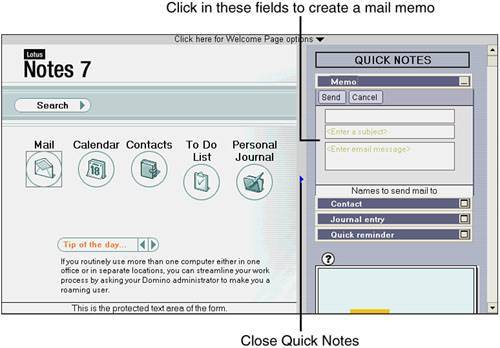

To Create a new mail memo from Quick Notes, simply place your cursor in the To, Subject, and message fields and type your information.

In this chapter, you learned how to open and close your mail database, read and navigate your incoming mail messages, and to create, reply to, and send mail. You also learned how to use Spell Check and set delivery options, as well as how to use a new feature of Lotus Notes called Quick Notes. In the next chapter you learn how to sort , manage, and print mail.


Lesson 4. Managing Mail

In this chapter, you will learn some skills that help you organize your mail and keep it up to date.


Sorting Mail

By default, the Inbox view is sorted by date in ascending order, which means that the older messages are at the top of the view and the newer messages are at the bottom. You can change the sort order of the documents in a view by clicking on the view column headers. However, not all the columns in the view can be changed. You can tell which columns can be sorted by the triangle on the column head (see Figure 4.1). The sortable column headers have triangles on them. For example, in the Inbox view, the Who column header has an up triangle that indicates that this column can be re-sorted in ascending order ( alphabetically , from AZ). The Date column has a down triangle, which means this column can be re-sorted in descending order (from most recent to oldest). The Size column has a down triangle, indicating that the messages can be re-sorted by size , with the largest messages first.

Figure 4.1. Sorting columns on-the-fly can help you find messages quickly.


If the option to sort both ways is available in a view, there are two triangles in the column headingone points up and the other points down. Once you sort columns, the columns stay in the sort order you placed them in, even if you exit Notes and open it again.

Would you prefer to have the Subject column appear right after the Who column? You can rearrange the order of the columns in your Inbox. Point to the Subject column header and drag it to the left until you see a dark vertical line at the end of the Who column header. When you release your mouse button, the Subject column header is in its new position right after Who.


Deleting Mail

To keep your Mail database manageable, make it a practice to clear out old messages when you are through with them. It helps to keep your database file at a manageable size . If you think you'll need the message again, archive it or store it in a folder. If you know that you don't need the message anymore, delete it.

You can mark messages for deletion while you're reading them, or you can do it from the View pane. Use the following steps to delete a message while you are in read mode:

1.

In the opened message, click the Delete button on the Action bar or press the Delete key on your keyboard.

2.

Lotus Notes marks your open message for deletion and closes the message; your next message appears.

3.

Continue reading the rest of your messages, deleting those that you don't want to keep.

To mark messages for deletion while you are in the Inbox or while you are in some other folder or view, you must first select the message or messages you want to delete. This can be done using one of the methods for selecting documents that were described in Chapter 3, "Email Basics." Then click the Delete button on the Action bar or press the Delete key.

When you delete mail messages, they disappear from the Inbox and move to Trash . Deleted mail messages will stay in Trash for a specified period of time, and then be permanently removed from your Mail database after the time limit expires . To see this soft deletion time limit, open your Inbox and choose Tools, Preferences on the Action bar. The Preferences dialog box opens, as shown in Figure 4.2.

Figure 4.2. The number of hours your deleted messages will stay in the Trash is specified under the Soft Delete section. Depending on how your organization has configured your mail, you may even be able to set the time period yourself.


To permanently delete a message from your Mail database, open the Trash view in the Mail Navigator pane. You'll see the messages you marked for deletion, as shown in Figure 4.3.

Figure 4.3. The Trash displays messages that are marked for deletion in the View pane.


Click the Empty Trash button in the Action bar to delete all the messages in Trash. Alternately, to delete a single item, highlight the item and click Delete Selected Item . You will be asked to confirm that you want to delete the message(s). Be careful; once you do this you won't be able to get the message(s) back!
