Crucial Product Management Concepts
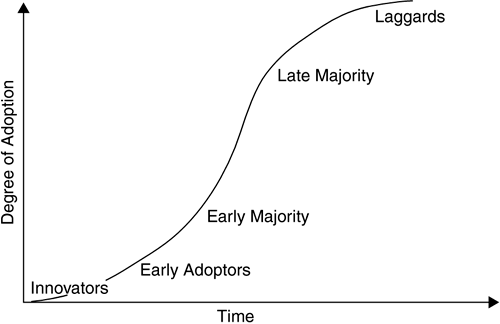
| This section addresses some vitally important concepts in product management and product marketing, some of which will be referenced in future chapters. All of them are useful because they affect, in very serious ways, your system and its architecture. The Four Ps of MarketingThe activities involved in product management are often summarized as the Four Ps of Marketing. You may encounter them when working with product management, so it is useful to understand what they mean. Product (Offering)What you're offering to your customer. It could be a product or it could be a service; most likely, it is some combination of the two. Later in this chapter, and in Chapter 3, we'll discuss the product concept in greater depth. Price (and the Business Model)Your business model is the manner in which you charge customers for your products or servicesthe way you make money. A pricing model defines how much you will charge. Selecting a business model and defining its associated pricing model are among the most challenging areas of product management. The best business models charge customers in a way that is congruent with the value customers perceive with the product. The best pricing models maximize the revenue for the company without leaving customers feeling that they've paid too much. Charge too little and you're leaving money on the table; charge too much and your product won't grow and you leave yourself vulnerable to a competitor. Pricing can also be counter-intuitive. It is not correlated to technical difficulty. Features that may be difficult to implement, like a sophisticated user interface or a report generator, are not always those that you can charge for. Pricing is not easily correlated to cost. It may cost you a lot of money to license a search engine, an embedded database, or a realtime operating system, but chances are you won't be able to pass these costs directly on to your customer. Instead, they will become buried in your pricing model. Effective pricing is related to the perceived value of your product. The implications of this are profound and deal more with psychology than technology. A complete discussion of pricing, which may or may not affect your architecture, is beyond the scope of this book. However, business models, which form the foundation of pricing, are intimately associated with your architecture and are discussed extensively in Chapter 4. Place (Distribution Channel)The manner in which your product or offering is delivered to your customer. There are several perspectives on the channel for software products. One concerns how the bits are delivered to the customer (e.g., via the Web or perhaps on a DVD). Another perspective concerns who is authorized to offer the product/service to a customer. Consider an enterprise application that can be deployed at a customer's site or through a third-party service provider. In this case, the service provider is acting as a channel for the product. All of these choices affect your system architecture. Promotion (Advertising and Marketing Communication)Promotion refers to the full set of activities associated with increasing awareness of your product within your target market. It is often easiest to think of it as just advertising, because advertising is arguably the most exciting promotional activity. When you put aside sheer excitement, however, other promotional activities are often more important. Total Available Market, Total Addressable Market, and Market SegmentationThe total available market is all of the customers who could possibly use your good or service. The total addressable market is the subset of the total available market that you can reach. An effective marketing program will further divide the total addressable market into well-defined market segments. A market segment is a group of customers who share specific characteristics, chief of which is that they must communicate with each other. A very effective marketing program may further divide market segments into niche markets, which allow for narrowly targeted promotion and sales activities. Here is an example of these concepts in action. Let's suppose you have created a Web-based self-service benefits management system that allows employees to manage their 401K, health care, vacation, and other benefits. Your total available market is all of those companies that could possibly use this system (presumably, a large one). These companies will range from extremely large (Fortune 500) to very small (less than $5M in revenue). The requirements associated with these companies are very different. As a result, you may choose to define one market segment as public companies with between $25M and $50M in annual revenue. This influences all aspects of the marketing mix, including pricing, promotion, distribution, product, and sales models. Unfortunately, this market segment is probably too large to service in the early releases of the product. Narrowing further, you might define one or more niches within it. One common approach is to divide based on vertical industries: pharmaceuticals , automotive, chemical, technology hardware, technology software, and so forth. Another is to divide based on the strengths of your product relative to your competitors'. Suppose you're creating a new e-mail client that has been extensively usability tested for novice users and that also has extensive anti-spam controls. Chances are good that your competitors are targeting this market and, by virtue of their longevity, claim that they are the most user friendly. By segmenting the market into people who care about spam, you can differentiate yourself from your competitors by promoting your anti-spam features, thereby creating and owning a market niche. Once you've achieved success in this niche, you can expand into others. The S-Shaped Curve of AdoptionCountless studies have found that the adoption of new products, generally referred to as innovations, follows the S-shaped curve shown Figure 2-2. An innovation doesn't just mean a "new" product, but also includes new releases or new versions of existing products. Parts of this curve have been labeled to reflect common characteristics of adopter categories. Understanding these categories can help product management and associated marketing functions change the shape of the curve, which varies tremendously by innovation type. Simply put, some innovations are adopted much more rapidly than others. The differences between categories are not perfectly defined, but they do represent generalizations that accurately characterize the willingness of a given person to adopt an innovation. As will be addressed throughout this book, various adopter categories place quite different demands on your system and its architecture. Understanding adopter category differences will help you meet these demands and accelerate adoption of your solution. Figure 2-2. The S-shaped curve of adoption InnovatorsThe very first individuals to adopt an innovation are known as innovators. These people are usually more technically curious and enjoy "pushing the boundary" with new products and services. They often have the necessary resources at their disposal to "make" an innovation work. Innovators are tolerant of poor installation and integration features and a lack of training, documentation, and help systems. Unfortunately, early wins with innovators may create a false sense of security that the product is "ready for prime time" when it really isn't. The early majority category is likely to demand that the same system accepted by the innovators have good installation procedures and some integration features and some training, documentation, and help. Early AdoptersFollowing the innovators are the early adopters. While they also like pushing the envelope, they are more conservative. Because they are more conservative, they expect a more "complete" product, and are more demanding on every facet of the proposed solution. Meeting these increased demands is worth the effort, as early adopters are key predictors for overall success. If they can be convinced of the innovation's merits, chances are good you've got the foundation of a winning solution. If they can't, you probably don't. Closing the gap between innovators and early adopters is referred to as crossing the chasm , which is also the title of the influential marketing book written by Geoffrey Moore. Early MajorityClose on the heels of the early adopters are the early majority. As you might expect, these individuals are considerably more conservative than the innovators and still more conservative that the early adopters. This is not necessarily bad, for this portion of the curve is often when the price/performance associated with the new product becomes most favorable. The earliest of the early majority often find the greatest competitive advantage: Most of the major kinks have been worked out, and they should be getting a fairly reliable product. From the perspective of product management, arguably the most important aspect of the early majority is that they will require references to key early adopters to be assured that the product works. This includes such things as customer success stories and ROI (return on investment) analyses. Late MajorityThe late majority are reluctant to adopt a new product, preferring tried and true mechanisms for dealing with problems. In fact, they may only adopt under significant economic pressure. Unfortunately, adopting this late in the process often results in the late majority receiving far fewer economic advantages than the early majority. LaggardsIndividuals who wait the longest to adopt an innovation are characterized as laggards. In general, they have the lowest social and economic status of all adopter categories. By adopting so late they derive little, if any, economic benefit from the innovation. These broad categories represent a relationship between an individual and a given innovation. They are not universal labels but convenient tools for understanding the behavior of key market segments. It is important to remember that innovations are adopted primarily because of their perceived effects on current problems. You might quickly adopt a new release of your favorite compiler in the middle of a project, especially if this compiler provides a much-needed bug fix or new feature. In marketing terms, you're an innovator. Alternatively, if the new release fails to address any specific problems, it is far safer and cheaper to stick with the current compiler, which categorizes you as a member of one of the other adopter categories. The categories define not only adopters but also the maturation process associated with entire markets. As of the writing of this book, the CDMA-based cell phone market is mature, while the 3G-based market is just emerging. Within these markets the adopter categories exist. In subsequent chapters I will refer to both markets and adopter categories in the context of creating and sustaining winning solutions. The Whole ProductThe concept of a "whole product" helps product managers create the full range of solutions required for success in the marketplace . Consider a common product, such as a cell phone. The generic product is the cell phone, a device that enables us to conveniently make phone calls. But, as anyone who has one knows , it must be augmented in a variety of ways before it becomes truly useful. For example, if you're unable to receive a call the cell phone service provider almost always provides you with voice mail. This is the expected product, which is commonly defined as the smallest configuration of products and services necessary to minimally meet customer expectations. Moving beyond these minimal expectations is where real value and customer loyalty can be created. An example is a cell phone that allows you to pay online with a credit card or one that has a visible indicator of how many minutes remain on your monthly plan. This is what's known as an augmented product, or one that has been designed with a variety of "extras" to provide the maximum value. These small ideas are just a few of the things I'd like in my cell phone plan. Surely you can think of others. If we enumerated these ideas, we'd have a definition of the true potential product that would exist for cell phone users: the full set of creative ideas that continues our product's growth and expands its market. The four product concepts collectively represent the "whole product." When applied to the world of technology, they reveal some surprising insights. While the generic product might be the application, we expect that it will be relatively easy to install, that it will operate in a manner that is consistent with other applications on our chosen platform, and that it will have basic online reference materials. Augmenting this product with an extensible API or including sophisticated operation and analysis capabilities may make us very happy. All of these capabilities are supported, directly or indirectly, through the choices made in the overall architecture of the system. Marketing types often use the term whole product when they should be using expected product or augmented product. Unfortunately, this can cause confusion, because the perception of the generic, expected, augmented, or potential product changes over time as technology and markets mature. To make the distinction clear, I use the term target product to define what is being created and offered to a given target market. In the early stages of the market, the target product may consist primarily of the generic product, but as the market matures the target product must evolve because the majority of customers are unwilling to accept anything less than the expected or augmented product. The target product is related to a specific release, but the terms are not synonymous. For example, it may include specific choices made regarding business models or support that do not directly relate to the system as it is delivered to your customer. Technical versus Market SuperiorityProduct managers love the idea of superiority because they can exploit it to create unfair advantages in a given market and thereby dominate it. However, there are various kinds of superiority, not all of which translate into a winning solution. Technical superiority is often easily duplicated , unless protected by patents, trade secrets, or other forms of intellectual property protection. Market superiority can be stronger, consisting of everything from a brand name to a distribution channel. A well-known example of market superiority is Microsoft's OEM contracts, which have resulted in Microsoft operating systems being installed by default in the vast majority of personal computers. Position and PositioningYour position is a sober, objective, and accurate assessment of how your customers currently categorize or perceive your product. It is their point of view, not yours. It is objective, which means that, if your customers think your product is hard to use, it is. Positioning is a strategic, managed effort to create and defend a distinctive concept that your customer can care about and remember. Unlike position, which is about the present, positioning is about the future. Marketing people care about position versus positioning because the goal of positioning is to have potential customers naturally think of your product/service before all others. Consider 7-Up, a lemon-lime soft drink. Common sense might have tried to position it as the freshest lemon-lime soft drink or the most sparkling or the first, the best, or the most lively or the lemon-lime drink for the young at heart. Uncommon sense decided to get 7-Up off that battlefield and to hitch its star to the thriving cola category: "We're not lemon-lime soda, we're the Uncola." In technical markets positioning can matter more than position, because purchasing decisions are not controlled by rational thought. Instead, most are driven first and foremost by emotions and only later backed up with objective "facts" that support the emotions. Consider your own behavior when making a purchase. Do you really go with Consumer Reports when it recommends a product or company you've never heard of? Or, like most of us, do you go with the product or company that has positioned itself as the leader?
It follows that positioning is rarely, if ever, feature based. It is far better to own a meaningful and relevant benefit in the customer's mind than to own a temporary advantage in features. Positioning is long term, strategic, defensible, and ownable. Features are short term and can be duplicated. This means that successful positioning can focus on only one concept one that is narrow enough to be compelling and broad enough to allow for the future. Once positioning has been set, you must continually create and recreate a position that moves you toward this goal. If not, your positioning quickly becomes meaningless and loses all value in the mind of the customer. BrandYour brand is the promise you make to a customerit is why people care. Everything you and your company do is reflected in it. This includes partnerships, customer support, the nature and structure of the company's Web site, the quality of the goods and services it provides to customers, and the manner in which it manages profits. To illustrate the importance of brand, consider the differences that come to mind when I compare Mercedes and Hyundai, Coke and Pepsi, or Microsoft and Sun. This is one reason that brand management is a very important part of product and marketing managers' job functions. Brands are usually represented and communicated through a number of brand elements: terms, symbols, slogans, and names . Brand elements are often protected as intellectual property, notably by trademarks and copyrights. The impact of brand elements on creating a winning solution and their effects of software architecture are discussed in Chapter 9. The Main MessageYour main message is a short (one- or two-phrase) statement that creatively captures the positioning. It should provide a continually useful bridge between your position and your positioning, reinforcing the positioning while making certain your customer "gets" what you're saying. The main message is important because it drives all creative marketing communication activities, from press releases to advertisements. The main message should be customer-centric. Unfortunately, the number of times this simple and pretty much obvious advice is not followed is surprising. Too often, messaging for technology products becomes shrouded in technical jargon, which often prevents the message from reaching its intended market. There are times when highly technical messaging does work, but like all good messaging it is what a customer "has ears to hear" that is the true foundation of a good message. Great messages express an important benefit, telling customers why they should care or how the product will solve their headaches . Finally, any specific message that is delivered to customers must be accurate and truly supported by the product. |
![Beyond Software Architecture[c] Creating and Sustaining Winning Solutions](/icons/blank_book.jpg "Beyond Software Architecture[c] Creating and Sustaining Winning Solutions")
EAN: N/A
Pages: 202