Section 3.7. Microsoft Exchange 2000 and NAS

3.7 Microsoft Exchange 2000 and NAS
Microsoft Exchange 2000 is the latest released version of the popular enterprise messaging system from Microsoft and forms a key part of the BackOffice family of products. The architecture of Microsoft Exchange 2000 is significantly different from that of Microsoft Exchange 5.5, the previous version of the product. Although Microsoft Exchange 2000 introduced a lot of new features, the one big drawback, especially from the point of view of NAS vendors , is that Exchange 2000 cannot be used with NAS storage devices. The present discussion is limited to the parts of Microsoft Exchange 2000 that directly contribute to this limitation.
Figure 3.6 shows the relevant part of the architecture for Microsoft Exchange 2000. Note that what is discussed here is a subset of Microsoft Exchange 2000. A full description is outside the scope of this discussion and would require a complete book by itself. The protocol engine shown in Figure 3.6 provides server functionality for mail- related protocols such as IMAP, POP3, and SMTP. The Exchange store (ESE) is based on the Jet database engine and provides functionality to store and retrieve various objects that collectively constitute an e-mail message. The Exchange Installable File System (ExIFS) provides some important functionality:
-
An extremely efficient interprocess communication mechanism between the Exchange store (ESE) and the Exchange protocol engine.
-
A cross-protocol Windows NT file handle cache. A handle created by one protocol (e.g., POP) can be reused by another protocol (e.g., DAV).
-
Functionality to minimize data conversion back and forth ”for example, storing messages in native MIME format.
Figure 3.6. Microsoft Exchange 2000 Storage Architecture
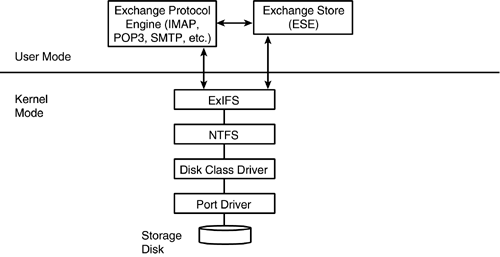
Although ExIFS provides this functionality, it is also the culprit as far as NAS vendors are concerned . The reason is that when an Exchange server uses a NAS device for the Exchange store, the ExIFS is not in the I/O path , as Figure 3.7 illustrates.
Figure 3.7. Microsoft Exchange 2000 with Local Storage and NAS Storage
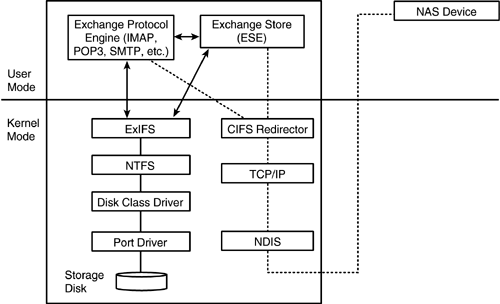
Notice in the figure that when requests from the Exchange store or the Exchange protocol engine go to some Exchange files stored on a local drive, they flow through the protocol stack on the left-hand side of the diagram. For example, a read request goes from the Exchange store to ExIFS, from there to NTFS, from there to the disk class driver, and from there to the port driver. However, when requests are made to a file stored on a NAS device, the ExIFS driver is not in the I/O path, so they flow through the network stack on the right-hand side of the diagram. Thus the flow would be from Exchange store to CIFS redirector to TCP/IP protocol stack and from there to the network card, completely missing the ExIFS driver altogether.
Note that the architecture shown in Figures 3.6 and 3.7 applies only to Microsoft Exchange 2000 and not to Microsoft Exchange 5.5. Thus the issue described here does not apply to Microsoft Exchange 5.5.
 |
| |
| Top |

EAN: 2147483647
Pages: 111