Using a Smartphone as an SMS Modem > Server Architecture
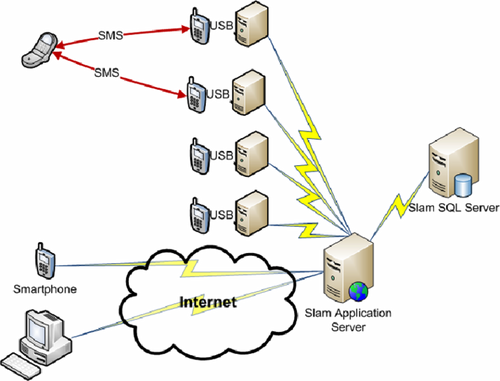
Setting up the SMS server with a smartphone is a bit of an unusual task in that you can't simply install some software on a web host's servers and be done with. You need physical access to the PC and the phone, so this will typically be run out of your home or office directly.
In addition, ActiveSync supports only one phone connection at a time. If you want to
When we built Slam, our group-centric SMS service, it was important to have multiple addressable numbers, which would allow users to have a separate number for each
By using four different phones with four different phone numbers, we could allow each user to be a member of up to four groups. Which phone number corresponded to which group would vary from person to person (even if they were a member of the same group), we simply kept a mapping of phone servers and groups for each
Using a Smartphone as an SMS Modem > Tips and Tricks
Having built several SMS services based on this architecture and operated one of them for several
Phones Leak :Microsoft is constantly improving the Windows Mobile platform, but as of Windows Mobile 5, there were still some significant memory leaks present in the OS. As a result, we typically ran into out of memory errors after several weeks of operation. Plan on rebooting the phones every week or so to ensure your service doesn't go down unexpectedly.
Scale:
Using a smartphone SMS server implementation is intrinsically limited in scale. In my experience, the smartphone was able to send and receive approximately 30 messages per minute. Because SMS is a store and forward system, if the incoming messages get
International: Sending SMS messages across national boundaries can be expensive and may not be covered by your standard SMS plan (even if it is unlimited). Save yourself an unexpected phone bill and decide whether you want to filter out international messages.
Using Email to SMS Gateways > The Basics
Because most U.S. carriers and many international
Every major U.S. carrier and most international carriers provide a gateway to the Internet so that their customers can receive SMS messages sent via email. The sender addresses the message to an email address of the form
###########@carrier-sms-domain.com
, it is converted by the carrier into an SMS and delivered. There are several lists online with the carrier to domain
NOTE
One thing you'll learn quickly is that there is very little that is "standard" whe using email to SMS gateways. Each carrier has a few idiosyncrasies in how they send and receive messages. For example, while most carriers will fill in the From address with the phone number plus their domain (e.g., 2065551212@tmomail.net), a few don't. Verizon PCS, for example, allows its users to substitute a handle instead of the number, so a message sent to a Verizon PCS
You'll want to accommodate this in your service. For example, when you user registers, have them reply to the registration mail with a unique response code that will allow you to keep track of who is sending them message, then match that up with the address it's coming from.
To allow the receiver to reply via SMS and have the email user receive the reply, the carriers will assign a temporary response code to the sender's email address, and then forward any SMS messages sent by that user to that response code back to the appropriate email address (see Figure 9-1).
For example, let's say Bob is a T-Mobile subscriber with the phone number (333) 444-5555. Suppose you were to send an email to Bob as
Bob would receive the following SMS message:
If he responded to that SMS (i.e., sent an SMS to 501), you would receive the following email:
Note that T-Mobile keeps track of the subject and copies back the text of the original message when forming a reply to a response code.This is not universal across carriers.
NOTE
Find lots more at http://www.notepage.net/smtp.htm!
The primary advantage of using an email to SMS gateway is that it's free (to you). There are some disadvantages, however.
First, you will need to know the carrier for each of your users in advance. If one of your users should change carriers, you will not be notified automatically.
Second, it may be a violation of some carrier's terms of use to
Carriers have at least two reasons to
Each carrier uses a different algorithm to detect abuse, so it is difficult to predict what will cause an interruption in your service and how to avoid it. Anecdotal evidence indicates that as few as 50 messages per day may trip the blacklist for some carriers. You may also find that sending from multiple addresses (even if it from the same mail server) is enough to mitigate this issue for some carriers.
Third, while most carriers allow their users to respond via SMS to email, many do not provide a means for a user to a conversation via email (i.e., they can only respond). This makes certain types of interactivity difficult or
It is worth noting that the Dodgeball service
NOTE
During the 2004 Republican National Convention, protestors tried to use TxtMOB, a
"I'm a network data analyst for T-Mobile. I've actually
tested the network to see why those messages were blocked, and from the response our email-to-sms gateway is giving, apparently our immensely retarded spam filter thinks that txtmob's SMTP server isspamming us. Basically, if the network sees more than about a hundred messages coming from the same SMTP server within anhour , it justblacklists it. Stupid but true."