Sams Teach Yourself Microsoft Office Excel 2003 in 24 Hours
Authors: Reisner T.
Published year: 2003
Pages: 17-19/279
Buy this book on amazon.com >>

Using Excel Menus and Dialog Boxes

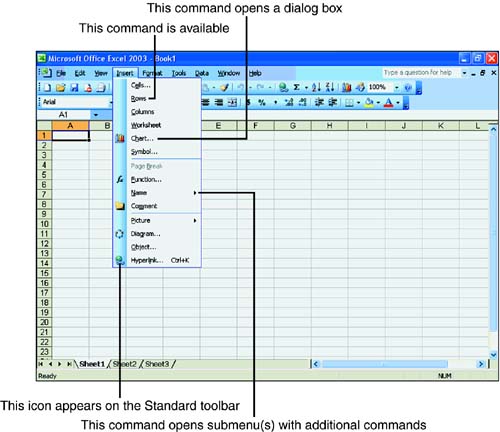
Maybe you prefer using a menu instead of a button, or the command you need isn't shown on any of the toolbars displayed on the screen. In any case, you can access Excel's commands from the menu bar. To make a selection from the menu, click a menu name in the menu bar, drag the mouse down the list until the command you want is highlighted, and click (see Figure 1.8).

Figure 1.8. A dimmed menu command means that command is not currently available.

graphics/01fig08.jpg

What happens after you click a menu command varies with each command. If an icon appears next to the menu command, the icon appears on the Standard toolbar.

If three dots (called an ellipsis) follow a menu command, a dialog box asks you to enter more information or choose from a list of options. If an arrow follows the menu command, clicking the command opens a submenu with additional commands. Sometimes, just clicking a menu command executes it. For example, clicking File, Open accesses a dialog box, and clicking File, Save saves the file that's displayed on the screen.

Just like the buttons on toolbars, menu commands can sometimes appear dimmed. A command that's dimmed means that the command is not currently available. Clicking a dimmed menu command is a waste of time ”nothing happens.


Working with Dialog Boxes

Any time you select a menu command that's followed by an ellipsis, Excel displays a dialog box. Think of a dialog box as a form that you need to complete and verify for Excel to continue. Figure 1.9 shows a dialog box and some of its standard elements.

Figure 1.9. The Print dialog box contains typical dialog box elements.

graphics/01fig09.jpg

Each dialog box contains one or more of the following elements:

  • Command buttons appear in every dialog box. OK, Cancel, and Apply are commonly used in dialog boxes.

  • List boxes provide two or more available choices. You select the item you want by clicking it.

  • Check boxes let you turn options on or off. Click inside a check box to turn an option off if it's on (and vice versa). If multiple check boxes are displayed together, you can choose more than one option.

  • Option buttons work a lot like check boxes, except that you can select only one option in a group . Clicking one option deselects the currently selected option.

  • Text boxes are "fill in the blank" boxes. Click inside a text box to activate it and replace the current text, if any, with your entry.

  • Spin boxes are used to change the contents of a text box. To change what's displayed, click the up or down arrow to change the setting.

  • Tabs appear across the top of some dialog boxes and offer selections of related options or functions. Click a tab to see a list of options relative to the specific tab.


Examining the Task Pane

Certain Excel commands display a task pane automatically. However, when you want to display or hide a task pane, you can choose View, Task Pane.

The task pane is a small separate window that enables you to perform common Excel commands more efficiently . You can use the commands on the task pane while you are working on your files.

Types of Task Panes

Table 1.2 lists the most commonly used task panes in Excel and describes their functions.

Table 1.2. Some of Excel's Commonly Used Task Panes

Task Pane

What It's Used For

Home

Includes commands for opening and creating workbooks, and searching for Excel information at the Microsoft Web site.

Help

Provides a way to get help on any Excel topic.

Search Results

Lets you search for text in the current workbook or other locations.

Clip Art

Helps you search for clip art.

Clipboard

Displays copied or cut items to paste, lets you paste all items, or clear all items.

New Workbook

Gives you commands for creating a new blank workbook, creating a new workbook based on an existing workbook, and searching for templates.

Other Excel task panes are Research, Template Help, Document Actions, Shared Workspace, Document Updates, and XML Structure. Some of these task panes are covered later in this book.

Elements of a Task Pane

By default, a task pane appears on the right side of the Excel window, as shown in Figure 1.10. However, you can drag the task pane title bar to float the pane in your work area or dock it on the left or right side of the screen.

Figure 1.10. A task pane with common New Workbook commands.

graphics/01fig10.jpg

A task bar contains the following elements:

  • Move handle ” Enables you to move or reposition the task pane so that it's in the most convenient place for you. Just like with toolbars , you point to the move handle and see a four-headed cross. Drag the cross to one of the edges of the Excel screen, the task pane docks to that edge of the screen. Releasing the mouse button in the middle of the screen floats the task pane.

  • Title bar ” Contains the move handle, the name of the task pane, and the Other Task Panes button to activate other task panes.

  • Back button ” Displays the previous task pane based on the order in which you viewed the set of task panes during the current session.

  • Forward button ” Displays the next task pane based on the order in which you viewed the set of task panes during the current session.

  • Home button ” Displays the Home task pane.

  • Other Task Panes button ” Displays a menu of task panes.

  • Close button ” Closes the task pane.

Sams Teach Yourself Microsoft Office Excel 2003 in 24 Hours
Authors: Reisner T.
Published year: 2003
Pages: 17-19/279
Buy this book on amazon.com >>