Flylib.com

Books Software


All Kinds of Publications


All Kinds of Publications

Publisher creates just about any kind of publication you can imagine. Here is just a sample:

Advertisements

Greeting cards

Banners

Labels

Business cards

Letterheads

Calendars

Newsletters

Catalogs

Postcards

Email backgrounds

R sum s

Envelopes

Signs

Flyers

Web sites

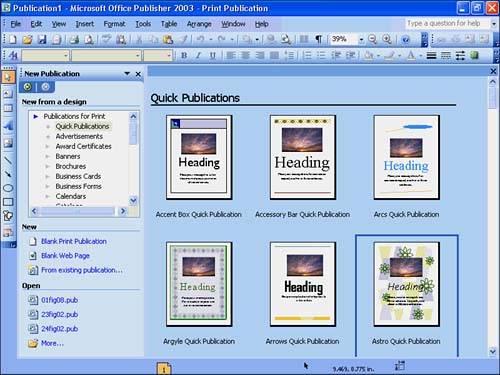
Not only does Publisher assist in the creation of all these kinds of publications and more, Publisher is one of the most graphical of all the Office programs. As Figure 23.1 shows, Publisher displays a thumbnail image of all documents from which you can choose. You'll always know in advance what your publication's general look will be.

Figure 23.1. Publisher always gives you a preview of the publication you can create.

graphics/23fig01.jpg

Publisher enables you to combine text, art, and headlines and put them together in the way you want them to look. Just a few years ago, print shops were paid big bucks to use scissors, photos, paper, and glue to do what you can make Publisher do with a mouse click!

When you want to combine text and graphics, as you'd do for a newsletter or many other publications, you work within a what-you-see-is-what-you-get environment (called WYSIWYG in computer lingo and pronounced " wizzy-wig "). It's important to get a sense of how all your publication elements fit together, and you need to see all the various elements on the screen where you can make adjustments and additions.

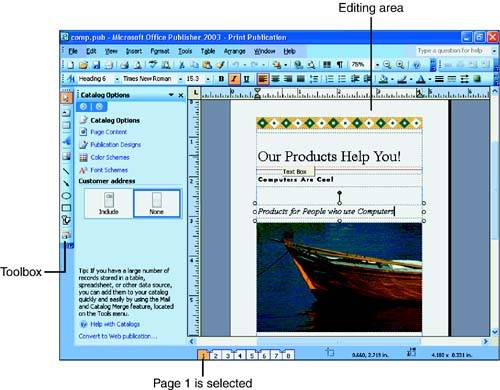
Figure 23.2 shows the early stages of an editing session for a catalog. The screen shows the first page. The margins, text, and pictures are all laid out in such a way that you can select and edit any of those elements. You can drag the sizing lines between the elements to move or resize any part of the publication. If a picture is too large, you can shrink it, and when you do, any text that might surround the picture adjusts automatically.

Figure 23.2. When you work on a publication, you see all the elements so that you can make adjustments.

graphics/23fig02.jpg

graphics/bookpencil_icon.gif

Not a graphic designer? Didn't get your typesetting degree? With Publisher's help, nobody will know because Publisher aims to keep your publication looking good and attempts to balance all the elements so that the final design will be consistent. And if you mess up the publication's margins or some other element on the pages, just adjust and reprint. Publisher makes edits simple for you, as you'll see in this and the next hour .


Why Publisher and Not Just Word?

Word is perhaps the most powerful word processor offered today. Word works with more than just words, as you learned starting with Hour 5, "Advanced Word 2003." In addition to words, Word lets you import graphics, charts , worksheets, and just about every other kind of data, including videos (represented as icons that you or the reader of your document can click to watch). As you now know, Word lets you easily create documents with multiple columns , headlines, and virtually any other kind of publication you'll need.

Publisher differs from Word in several fundamental ways. First and foremost, Publisher focuses more on your publication's design, whereas Word focuses more on your publication's words. Despite the fact that you can create publications with Word, and quite powerful publications at that, Word's strengths do lie in its ability to manage the words you type. To complement Word (instead of competing with Word), Publisher lets you manage the layout of those words, along with graphics and the other design elements you want to put in your finished publication.

Microsoft includes both Word and Publisher in some versions of Office because these two products work so well together. If you want to create attention-getting publications that contain exactly the information that's important to you, first write your publication's text (perhaps more than one article if your publication requires multiple articles) with Word's powerful word-based editing tools. Hone your words to perfection in Word. Once you are satisfied with your writing, import that Word document into Publisher. Publisher then takes over and, with Publisher's help, you can turn your words into a publishable product.

graphics/bookpencil_icon.gif

Of course, Publisher imports files from Office programs other than Word. For example, you can import an Excel worksheet to use as a table in your publication.