Flylib.com

Books Software


preview your movie


preview your movie

Let's play the movie to see how it's flowing so far. This gives us a chance to get familiar with the Monitor in Timeline view.
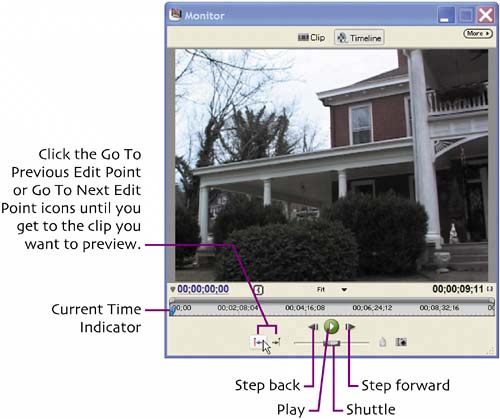
Use these buttons to control playback.

After Premiere Elements plays the selected clip, it will play subsequent clips until you pause playback or it reaches the end of the project.

Note that you can also use the spacebar on your keyboard to start and pause playbackdefinitely one of the most useful keyboard shortcuts in the program.


save your project

Like what you just saw? Great, now save the project to make sure you don't lose it.


add clips between clips

One of Premiere Elements' best features is the ability to add clips anywhere in the project, not just at the end. For example, in my movie, I will show clips of people arriving at the party, and then, in the next scene, meeting and greeting before the entertainment started.

When shooting the video, however, these scenes were intermixed; some folks arrived, then mingled, then more arrivals, then more mingling. During editing, I'll group all the arrival shots first, then the meeting and greeting shots. This means that I'll have to insert some clips in between others already on the Timeline. Here's how it's done.

If you release the cursor in the middle of a clip, Premiere Elements will split the clip on the Timeline and insert the new clip, which is generally not what you want. To help make sure you're between two clips, the cursor " snaps " to the intersection of the clips.


arrange clips

Here I inserted the clip "More arrivals" between "First arrivals" and "Even more arrivals." Note that after inserting the clip, Premiere Elements automatically pushed back all clips located after the insertion point.

If you don't like the current clip order, you can click and drag the clip to the new location.


ripple delete

Yikes! Premiere Elements left a huge gap in the Timeline after the move. Let's close it up with the Ripple Delete command.

Click the gap.

Right click.

Choose Ripple Delete.

Gap gone.


insert music files

Now you'll start the slide show component of the movie. Here you'll add a music file to the Timeline and then your pictures. Movie Maker will convert this content to video when rendering the final movie. You'll use the still pictures and a music file that you imported in Chapter 2.

You can add a slideshow anywhere in the production, though I usually add mine to the end, after all the trimmed video clips.

Release the mouse button.

Premiere Elements inserts the song into the Audio 1 track.


add a picture

You can add one or more pictures to your production simply by dragging them to the Timeline. Here's how.

Release the mouse button.

Premiere Elements inserts the image, using the default duration selected in Set Preferences in Chapter 1.

Once on the Timeline, you can click the edge of an image and drag it to any duration.


create a slideshow

Dragging works fine for single images here and there, but Premiere Elements has a great feature for easily creating slideshows, complete with transitions, in just a couple of clicks. Start by switching to Icon view and arranging your pictures in the desired order.

Select the images to include in your slide show. As with most Windows programs, you can press and hold down the shift key and select sequential images, or press and hold down the Ctrl key and select random images.

If you select your images in the desired order, use the other option, Selection Order (not shown).

When selecting digital images, your only Media option is "Take Video Only" since there is no audio. This changes if you use this tool to create slides from videos , which is beyond the scope of this book.

The default values of five seconds per image and 30 frames (one second) per transition are good starting points. Try a shorter image duration if your music is fast-paced. For slower music, you can extend image duration, especially when adding pan and zoom effects as discussed in Add Motion to Images in Chapter 5.
