IP Storage Networking Straight to the Core
Authors: Orenstein G.
Published year: 2003
Pages: 41-42/108
Buy this book on amazon.com >>

4.6 Balancing Multivendor Configurations

Customers intent on influencing long- term decisions for their storage networking configurations must adapt to technology changes and understand the control points of the infrastructure. The networking shifts represent two parallel changes to traditional concepts of storage. First, the ability to place intelligence within the network, as opposed to hosts or targets, provides an alternate control point to balance traditional vendor lock-in. For example, target-based mirroring and replication functions may now reside within the network, offering a choice to conventional host-based or target-based implementations .

The other change underway relates to the shift from conventional Fibre Channel “only storage networks to those that involve a combination of Fibre Channel and Ethernet networks. Consider the following scenario. With Fibre Channel “focused configurations, subsystem vendors were largely beholden to work with the relatively few number of Fibre Channel switch vendors in order to deploy complete end-to-end solutions. The introduction of IP and Ethernet as an alternate storage interface removes the need for such a partnership. For example, a large subsystem with an iSCSI interface need no longer connect to a Fibre Channel switch.

The implications of these choices have ripple effects for large configurations, particularly in the case where value-added storage services make up a significant portion of the complete solutions. As mentioned earlier, with multiple vendors grappling to sustain profit margins, each will attempt to bundle more and more storage services into their offerings. Therefore, it is likely that a customer would be able to install replication technology across host, fabric, and subsystem platforms. The collection of available choices will force price erosion across storage services and also drive a combination of competition and "co-opetition" among storage vendors.

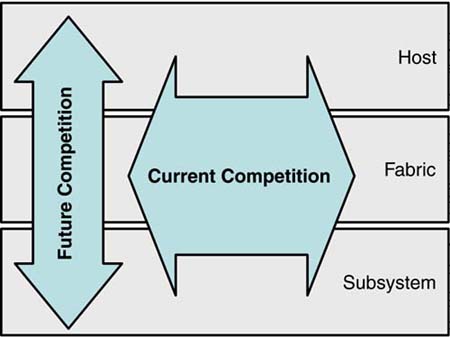
To date, most of the discussion about competition in the storage networking industry has taken place within each layer of the configuration ”for example, host-based software (Veritas and Legato), fabric (Cisco, Brocade, and McDATA), or subsystems (EMC and HDS). In these scenarios, seemingly organized industry partnerships have emerged only to be split at a later date when the participants could not bring the partnership to fruition.

Additional partnerships have been formed across layers of the storage chain, but these too are in jeopardy as storage services and intelligence migrate between layers and put virtually all alliances at risk. For example, vendors that previously focused only on storage interconnects within the fabric will likely expand to offer storage services such as replication. This will put them in direct contention with vendors offering target-based replication services. How these alliances evolve is open for debate, but no one can deny that market forces will expand future competition between storage vendors across host, fabric, and subsystem layers. These forces are outlined in Figure 4-16.

Figure 4-16. Balancing multivendor configurations.

graphics/04fig16.jpg


4.7 Chapter Summary

Storage System Control Points

  • Storage networks allow the movement of storage intelligence across the entire infrastructure.

  • Storage intelligence or services act as solution control points.

  • Historical architectures help present a picture of the future.

  • There are pros and cons for storage services residing within host, fabric, and subsystem layers .

  • Networking plays a crucial role and should not be relegated to plumbing.

4.1 Storage Service Deliverables

  • Storage services fit into the overall framework for storage software, including infrastructure, transactions, and disaster recovery.

  • Services include

    • Manageability (e.g., simplified administration)

    • Capacity (e.g., virtualization)

    • Recoverability (e.g., point-in-time copies)

    • Performance (e.g., increases I/O performance beyond single-disk performance)

    • Security (e.g., access control)

    • Availability (e.g., beyond disk failure with mirroring)

  • Categorization helps clarify locations.

4.2 Brief History and Evolution of Storage

  • A broad historical perspective across compute and storage platforms reveals a trend toward distributed systems.

  • The mainframe era represented high-cost, single-vendor, centralized storage.

  • The minicomputer and clustering era delivered multinode storage access for decentralized storage.

  • The client-server era led to split storage architectures between data centers, departmental servers, and desktops.

  • Distributed Web, application, and database servers require distributed storage in virtualized storage pools.

  • All storage services must scale in terms of

    • Size (e.g., number of nodes)

    • Speed (e.g., throughput or I/Os per second)

    • Distance (e.g., geographic reach)

  • First-generation single-table routers were replaced with more scalable, higher performing distributed systems.

  • A router is essentially a network within a chassis.

  • Similar design principles of distributed services apply to storage.

  • Intelligent nodes with distributed storage services facilitate scalable, high-performing systems.

  • An intelligent storage network leaves options for storage services locations.

4.3 Placing Storage Intelligence

  • Storage services locations depend upon application requirements, cost points, network utilization, and preferences.

  • No hard and fast guidelines apply; however, certain storage services make sense in some areas over others.

  • RAID 0/5 as compute- intensive operations tend to do well when located within the subsystem.

  • RAID 1 (mirroring) is similar to network multicasting.

  • Multicasting algorithms suggest replication as close as possible to the receiving nodes to minimize network utilization.

  • With RAID 1, network-based mirroring is the optimized deployment for the best network utilization.

  • Additional network ports can offset server HBA or subsystem controller ports.

  • Network ports are often less expensive than end system HBA or controller ports.

  • Attribute-based storage is best delivered by network-based storage services.

  • Network location for storage services allows for

    • Visibility

    • Access and Topology

    • Reactive Capability

4.4 Building Blocks of Distributed Systems

  • Distributed systems have proven to be the most scalable solutions.

  • Core computing functions include memory, CPU, I/O, and networking.

  • Traditionally, memory and CPU functions outstripped I/O and networking.

  • I/O and networking advances put building blocks on even ground.

  • Interconnect advances (Fibre Channel and Gigabit Ethernet) allow I/O and networking to keep up with memory and CPU performance gains.

  • I/O and networking similarities converge, leading to architectural overlap and consolidation.

4.5 Network Control Points

  • Storage network or fabric is the disintermediary between traditional host and target storage services implementations .

  • Interconnects have traditionally been separated by bandwidth, node scalability, and throughput.

  • Gigabit Ethernet, 10 Gigabit Ethernet, and iSCSI allow Ethernet and IP to encroach on the storage-dominated interconnect landscape.

  • Ethernet also is moving into the MAN and WAN.

  • Cost and management advantages will force network consolidation.

4.6 Balancing Multivendor Configurations

  • Fluid, services-based storage networks allow for easy migration of storage services across host, fabric, and subsystem layers.

  • Conventional view of competition focused within each layer.

  • New competition is across each layer where host, fabric, and subsystem will compete to offer value-added services and a broader product portfolio.

  • Users can balance both within and across layers.

IP Storage Networking Straight to the Core
Authors: Orenstein G.
Published year: 2003
Pages: 41-42/108
Buy this book on amazon.com >>