Flylib.com

Books Software


Getting a Visual Reference with the Grid Mode


Getting a Visual Reference with the Grid Mode

If you're a CAD user , chances are you've used grid paper to help sketch an idea for one design or another. Grids can help you get an idea of proportion or approximate distances when you don't have a scale.

AutoCAD's Grid mode displays an array of nonprinting dots within the drawing area. These dots can give you a reference for distance or location. You can set the spacing of the dots and easily turn them on or off using one of the following methods :

  • Click the Grid button in the status bar.

  • Press F7 or Ctrl+G.

You can also enter Grid on . An array of dots appears in the drawing area, as shown in Figure 2.11.
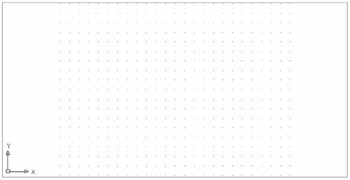
image from book
Figure 2.11: An AutoCAD grid

You can turn off the grid by repeating the operation you used to turn the grid on, or you can enter Grid off at the command prompt.

You might also see a grid that appears only in a small area, as shown in Figure 2.12. This happens when the Display Grid Beyond Limits grid setting is turned off. You'll learn about the grid settings in the next section.
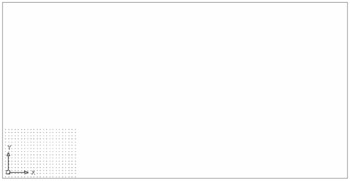
image from book
Figure 2.12: The grid as it appears when the limits of the drawing are smaller than the current display

As described in "Using Limits to Set Up the Drawing Area," you can choose View Zoom All to adjust the display so that the limit of the drawing roughly equals the display area. If parts of the drawing are outside the limits of the drawing, choosing View Zoom All displays the limits of the drawing and any parts of the drawing that fall outside the limits.

You can make a wide range of settings for the way grids display. See "Changing the Grid and Snap Settings" later in this chapter for more information.


Snapping to the Grid or Other Regular Intervals

Depending on the type of drawing you are doing, it can be helpful to have the cursor "snap" to the grid. Snap mode in AutoCAD forces the cursor to "snap" to regular intervals. For example, if you are drawing an object whose dimensions fall exactly within 1-unit increments , you can turn on Snap mode and set it to 1 unit. When you then start to draw, the cursor jumps to 1-unit increments.

Units can be inches, metric measurements, or any unit of measure you choose.

To control Snap mode, do one of the following:

  • Click the Snap button in the status bar.

  • Press F9 or Ctrl+B.

You can also turn on Snap mode by entering Snap on at the command prompt.

To turn off the Snap mode, repeat the operation you used to turn it on. You can also enter Snap off at the command prompt.

By default, the grid and snap spacing are the same; so if you turn on the grid and snap at the same time, the cursor appears to snap to the grid points. It is possible to set the grid and snap spacing to different values. For example, you might want the grid to show at a 12-inch interval while the snap spacing is set to 1 inch.

If Snap mode does not seem to have an effect, the snap spacing might be set to a value too small to be noticeable in relation to your current view. For example, if your view encompasses an area the size of a football field and your snap spacing is set to ½ inch, you won't notice the effects of the Snap mode.

In a new drawing, the snap interval is set to 0.5 units. (This is 0.5 inches if you are using the Architectural or Engineering unit type in the Drawing Units dialog box.) The snap spacing can be anything you want, plus you can rotate the snap interval orientation, have a different X and Y snap spacing, or set the snap intervals to align with a specific location such as the corner of a box or the center of a circle. You'll learn how to make these adjustments in the next section.