Flylib.com

Books Software


Task 3: Opening the My Pictures Folder


Task 3: Opening the My Pictures Folder

graphics/03inf03.jpg

graphics/one_icon.jpg

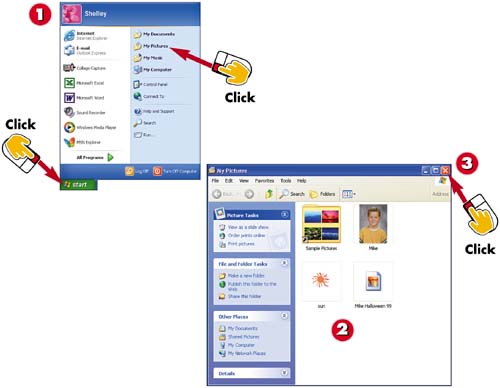
Click Start and then click My Pictures .

graphics/two_icon.jpg

You see the contents of this folder. If Windows can display the image file type, you see the picture in thumbnail form. If not, you see an icon.

graphics/three_icon.jpg

Click the Close button to close the window.

INTRODUCTION

Windows also sets up special folders within the My Documents folder. One folder is the My Pictures folder which you can use to store graphic images. These might be pictures taken with a digital camera, images created with a scanner, or images you have created with a drawing or paint program. New with Windows XP is a Picture Tasks list with commands for handling pictures.

TIP

Thumbnail View

You should see the contents in Thumbnail view, which shows miniature pictures of each graphic file. You can change to another view (or switch to Thumbnail if you don't see this view) using the Views command or button.

Task 4: Opening the My Music Folder

graphics/03inf04.jpg

graphics/one_icon.jpg

Click Start and then click My Music .

graphics/two_icon.jpg

You see the contents of this folder including any music files you have stored here.

graphics/three_icon.jpg

Click the Close button to close the window.

INTRODUCTION

Within the My Documents folder, you see special folders set up by Windows to store particular types of content. For instance, you can use the My Music Folder to store music files. You not only see the contents when you open this folder, but new with Windows XP, you see a Music Tasks list with commands for working with music files.

TIP

My Videos

Windows XP also includes a My Videos folder within the My Documents folder. You can use this folder to store video files. To open My Videos, open My Computer and then double-click the icon for the My Videos folder.


Task 5: Selecting a Folder

graphics/03inf05.jpg

graphics/one_icon.jpg

Click the folder you want to select.

graphics/two_icon.jpg

In the File and Folder Tasks list, you see folder- related tasks. Click graphics/03inl01.jpg to display Details about the folder.

graphics/three_icon.jpg

Click the Close button to close the folder window.

INTRODUCTION

When you are working with folders, you start by selecting a folder. You can then rename, delete, copy, or move the folder. When you select a folder, you see commands for all the folder-related tasks. You can also view detailed information about the selected folder.

TIP

Hide and Display Panes

You can hide or display any of the areas in the Explorer Bar of a window. Click the Expand button graphics/03inl01.jpg to display the area. Click the Hide button graphics/03inl02.jpg to collapse and hide the area.


Task 6: Navigating Folders

graphics/03inf06.jpg

graphics/one_icon.jpg

Click the Back button to go back to a previously viewed page.

graphics/two_icon.jpg

If you have clicked Back , you can click Forward to return to a previously viewed page.

graphics/three_icon.jpg

Click the Up button to display the next level up in the folder structure.

INTRODUCTION

Each folder window includes a toolbar that you can use to navigate from folder to folder. You can go back and forth among previously viewed content windows . You can also move up one level in the folder structure to the containing folder. For instance, you might move up to the desktop level and then open drives and folders to move to another branch of the folder structure.

TIP

Search and Folders Button

You can find information on searching for a file in Part 4, "Working with Files." For help on displaying a Folders List with the Folders button, see Task 11, "Displaying the Folders List," in this part.