Screen Synch-Secure Voice Cord Board
Screen Synch
A colloquial term for sending an telephone service agent a phone call together with a screen of information about the incoming call, e.g. the customer's purchasing record or experiences with your product (if you're a help desk, for example.)
Screened Dual- Homed Gateway
A screened dual-homed gateway is a dual-homed gateway that is guarded by a packet-filtering router.
Screened Subnet
Also referred to as the demilitarized zone, a screened subnet is a collection of computers that are shielded from both the trusted network and the untrusted network by packet-filtering routers and gateways. See also DMZ.
Screened Transfer
You are transferring a call from your phone to your boss. You dial a code for transfer, then dial your boss. The caller you're transferring is automatically put on hold. You speak to your boss, tell her who you're putting through. She okays the transfer, then you hit another digit and the call goes right through. This is called screened transfer. An unscreened transfer occurs when you simply dial your boss' office and send the call through without announcing it. Most PBXs have the ability to do both screened and unscreened calls.
Screened Twisted Pair
ScTP. A type of cabling similar to UTP but ScTP has a foil shield between the conductors and the cable jacket. It also has a drain wire (a bare conductor). ScTP is used when ordinary UTP might pick up interference that would interfere with transmission. See UTP Cable.
Screening Router
A device that, in addition to routing network traffic, is configured to reject packets which are not in keeping with the organization's policy. Screening routers are often deployed at the outer perimeter of a network and, therefore, serve as the first line of defense against network-oriented attacks; a.k.a filtering router.
Screening Telephone Number
The telephone number used by the phone company to bill, regardless of the number of phone lines associated with that number.
Screw Post
Also called binding post. Screw posts are still used on many residential jacks . A conductor is installed on a screw post by stripping the insulation from the conductor to a half inch from the end, unscrewing the post to loosen it, wrapping the bare copper end of the conductor around the screw post between the washers and then re-tightening the screw. This doesn't make a very reliable connection, and it's easy for an installer to break the copper conductor by tightening the screw too tightly.
Script
A type of computer code than can be directly executed by a program that understands the language in which the script is written. Scripts do not need to be compiled into object code to be executed.
Script Files
Some communications programs had script files that automate logging onto communications services, such as MCI Mail. The files are saved on your disk and read by your communications software when connecting to a remote service. Newer communications programs will "write" their own scripts by recording what you do in response to what questions from the remote service. This typically happens using a program feature called "Learn."
Script Kiddies
Aspiring young hackers, usually teenagers or curious college students, who don't yet have the skill to program computers but like to pretend they do. They download ready-made scripts, languages, techniques and viruses written by more experienced crackers. They claim to have written them themselves and then set them free in an attempt to assume the role of a fearsome digital menace . Script kiddies often have only a dim idea of how the code works and little concern for how a digital plague can rage out of control. Script kiddies are also aspiring hackers who use their ready-made software to break into online distant computer sites, usually via dial-up phone lines. Script Kiddies, in the genre of computer hackers, are the lowest form of life, as they don't have the skills to develop their own techniques, and often don't understand the havoc they wreak. See also Cracker, Hacker, Phreak, and Sneaker.
Script Language
A software language that contains English-statements for commands. A statement might be as simple as WrapPara() for wrap paragraph. Typically a script language contains commands that are specific to the type of task it's doing. For example, VOS from Parity Software in San Francisco is a script language for voice processing using Dialogic voice processing cards. A script language is more flexible than an Applications Generator, but is more difficult to program.
Scripting Engine
A program that interprets and executes a script. See also script.
Scroll Bar
A bar that appears at the right and/or bottom edge of a window or list box whose contents are not completely visible. Each scroll bar contains two scroll arrows and a scroll box, which enable you to scroll through the contents of the window or list box.
Scrolling
Browsing through information at a video terminal. Scrolling is the continuous movement of information either vertically or horizontally on a video screen as if the information were on a paper being rolled under it.
Scruple
The scruple was a unit of weight equal to 20 grains, used by apothecaries in olden days. Apprentices were supposed to always use these weights to measure out prescriptions. However, this was very tedious and many times the apprentice would just take a pinch of whatever was supposed to go into the prescription, without weighing it. If caught by the apothecary the apprentice was often scolded, "What is the matter with you? Have you no scruples?"
SCS
Structured Cabling System. See Structured Wiring System.
SCSA
Signal Computing System Architecture. SCSA is a comprehensive architecture that describes how both hardware and software building blocks work together. It has now been absorbed by S.100, but the following words still apply: It focuses on "Signal Computing" devices, which refer to any devices that are required to transmit information over the telephone network. Information can be transmitted via data modems, fax, voice or even video. SCSA defines how all these devices work together. Signal computing systems combine three major elements for call processing. Network interfaces provide for the input and output of signals transmitted and switched in telecommunications networks. Digital signal processors and software algorithms transform the signals through low-level manipulation. Application programs provide computer control of the processed signals to bring value to the end user .
SCSA is the common set of standards that telecommunication system manufacturers and computing system manufacturers can use to create computer telephony systems. The theory is no single company today can create the total solution for all customers. SCSA represents the common ground between the two fields so that manufacturers from each area can safely develop products that will work with other manufacturers. SCSA's coverage extends from low-level bus and hardware interfaces, like the inter-board switching bus that enables boards from different suppliers to work together, to high-level application programming and software interfaces, so that software designed to work with one set of hardware products, will work with different hardware. Dialogic Corporation of Parsippany, NJ announced SCSA in the Spring of 1993. Dialogic said that SCSA was defined and created with input from a number of leading computer and switch manufacturers, call processing suppliers, and technology developers. In many cases, SCSA has drawn on existing standards, like the T.611 fax standard endorsed by the European Computer Manufacturers Association, and in other cases SCSA has extended standards to make them more useful for call processing suppliers and users.
SCSA describes all elements of the system architecture from the electrical characteristics of the SCbus and SCxbus to the high level application programming interfaces (APIs). According to TELECONNECT Magazine, this SCSA standard (and now, by extension, the S.100 standard) is remarkable for several things:
-
On the day of its announcement over 60 telecom and voice processing companies publicly endorsed SCSA. In early 1994, over 150 companies public endorsed it.
-
With SCSA ” a standard for PC/LANs and VME-backplaned computers ” you can build much larger telecom switches and much larger call and voice processing boxes. Previous standards, like AEB, PEB and MVIP, were basically limited to what you could do with one PC. Now PCs can be joined together. With SCSA, you can put 16 T-1 lines, or 512 voice lines in one PC and join together 16 PCs, for a total of 16 x 16 x 24 = 6,144 lines! That's a central office built out of networked PCs. A mainframe built out of a LAN. The SCSA joining is not via LAN or LAN-emulation. That would be too slow and the transmission too bursty (great for data, lousy for voice). It's via an SCbus ” something that looks and works like a PBX backplane.
-
SCSA incorporates virtually every other standard in PC-based switching ” including the most popular ones, Mitel's ST-Bus, MVIP, Siemens PCM Highway, AEB and PEB.
-
It's a lot faster and more reliable. All signaling is out of band . There's clock fall back and time slot bundling. It's more modular, meaning you can start with one PC and grow one at a time. That makes it more "modular" (scaleable is the new word). It's also hot pluggable. You don't have to turn off to upgrade.
-
It has applications portability. Tandem, the highly-successful fault tolerant minicomputer maker, has an SCSA application in a call center. They call it the Tandem Non-Step Call Center. It uses the Tandem 2400 VRU and the 4800 VRU.
SCSA is open, truly open . All its specs and all levels of its specs are available. To that extent, SCSA represents a remarkable gamble by its creator, Dialogic, a telecom/voice processing hardware company. It is encouraging competing manufacturers to build hardware to its specs and gambling that it won't be left in the dust, as IBM was with its PC. (Compaq, not IBM, built the first '386 PC.)
SCSA, as an idea, is revolutionary (for telecom). No one in telecom has ever promulgated an open standard everyone can adopt ” hardware and software vendors . Write one application, create one applications generator, design one piece of hardware. Erector set telecom/voice processing! Build small. Build large. Just join the bits and pieces together. See also AEB, ECTF, PEB, MVIP, Signal Computing (for a differently-worded definition), S.100 and TAO.
SCSA Call Router
An SCSA definition. A system service of SCSA which provides the basic necessities of inbound and outbound call processing and call sharing to client applications, without those applications needing to be aware of the underlying telephony interface operations. See ECTF, SCSA and TAO.
SCSA Compatible
An SCSA term. Able to function in an SCSA environment in its native mode.
SCSA Hardware Model
An SCSA definition. The hardware layers of the SCSA specification. The SCSA Hardware Model defines an open architectural specification for a digital intra-node communication bus (SCbus), a switching model (SCSA Switching Model), and an multimode expansion capability ( multimode Network Architecture, or MNA). The SCSA Hardware Model may be implemented independently of the SCSA Telephony Application Objects Framework. See TAO.
SCSA Message Protocol
The open communications protocol by which entities communicate with one another in an SCSA system. The SCSA Message Protocol (SMP) is independent of the transport layers it is built upon, computer hardware, operating system, network topology (or lack thereof), and technology vendor. All SCSA-compliant AIAs will translate the functions called by client applications (via the API) into SMP messages; these are transmitted to service providers regardless of their location. Therefore, applications written to the API will be portable from one call processing environment to another. See TAO.
SCSA Message Protocol Interface
The message presentation format required by, and used by, the service provider in delivering SPM information. Contrast with Service Provider Messages. See TAO.
SCSA Server
A collection of service providers (objects) which in the aggregate implement the minimum set of services required for SCSA system conformance. The assumption is that these services are at a minimum provided to remote hosted client applications via common transports such as LANs, but may also be provided to client applications which are hosted on the SCSA server itself. Note that this is a logical image which may be implemented through multiple nodes (machines). See TAO.
SCSA Telephony Application Objects Framework
The SCSA Telephony Application Objects (TAO) Framework originally defined the software layers of the SCSA open computer telephony specification. The SCSA TAO Framework defined a hardware-independent, open software architecture that simplifies design of distributed computer telephony systems. The SCSA TAO Framework includes a suite of interoperable, vendor- independent application programming interfaces (SCSA APIs), a set of System Services for handling various server management functions, and a set of messages and a standard transport for communication among various technology resources and system service providers (Service Provider Messages and SCSA Message Protocol). In 1995, TAO's development was taken over by a new organization ECTF ” the Enterprise Computer Telephony Forum. The ECTF expanded the idea of TAO to make it the open software framework for the whole computer telephony world ” to encompass hardware conforming to all major specifications, including SCSA and MVIP. Towards the end of January, 1996, ECTF promulgated TAO (now under a different name ) as the software standard for the new computer telephony industry.
SCSI
Small Computer System Interface. (Pronounced Scuzzie.) SCSI is a way for a devices such as magnetic hard disks, optical disk drives, tape drives, CD-ROM drives , printers and scanners to communicate with the computer's main processor. SCSI is a bus and an interface standard. SCSI has improved over the years . Here how:
| Standard | Better Known As | Bus Width | Through-put | Max Devices On Chain | Cable-Type |
|---|---|---|---|---|---|
| SCSI-1 | Asynchronous | 8-bit | 4MB/sec | 7 | 50-pin |
| SCSI-1 | Synchronous | 8-bit | 5MB/sec | 7 | 50-pin |
| SCSI-2 | Wide SCSI | 16-bit | 10MB/sec | 15 | 68-pin |
| SCSI-2 | Fast SCSI | 8-bit | 10MB/sec | 7 | 50-pin |
| SCSI-2 | Fast Wide | 16-bit | 20MB/sec | 15 | 68-pin |
| SPI/SCSI-3 | Ultra SCSI | 8-bit | 20MB/sec | 7 | 50-pin |
| SPI/SCSI-3 | Ultra Wide | 16-bit | 40MB/sec | 7 | 68-pin |
| SPI-2/SCSI-3 | Ultra2 | 8-bit | 40MB/sec | 7 | 50-pin |
| SPI-2/SCSI-3 | Ultra2/Wide | 16-bit | 80MB/sec | 15 | 68-pin |
| SPI-3/SCSI-3 | Ultra3/Ultra160 | 16-bit | 160MB/sec | 15 | 68-pin |
The brains of a computer is its microprocessor. That microprocessor (i.e., computer on a silicon chip) does the computer's primary work (i.e., calculations). There must be a way for information to get into and out of the microprocessor. The history of computers could be written as a continuing race to figure new, faster and more efficient ways of getting information into and out of the microprocessor. The obsession with input/output (I/O) stems from the fact that the microprocessor can work much faster than you can get information in and out and out of it. SCSI is a way for a devices such as magnetic hard disks, optical disk drives, tape drives, CD-ROM drives, printers and scanners to communicate with the computer's main processor. SCSI is a bus and an interface standard. The theory is that if you buy a SCSI device you can plug it into your computer's SCSI port and it will work, just as a parallel or serial port device will work. There are two good points about the SCSI interface, especially the newer SCSI-2 interface. First, it's fast. Second, one SCSI bus allows you can daisy chain up to seven different devices, so long as you remember to terminate the end of the chain. (In reality, you rarely have more than four devices hooked up on one SCSI link, since protocol overhead and other factors begin to degrade system performance.) Each device will work quickly and each won't siphon excessive power from the computer's main processor. That's because the SCSI bus typically has its own controller/microprocessor which takes care of the SCSI I/O workload. SCSI disk drives work faster than a "normal" IDE hard drive, which is why many new computers are coming with SCSI drives, not IDE drives. ANSI (American National Standards Institute) has set several guidelines for SCSI connection. There is SCSI-1 and SCSI-2. The SCSI specifications are available from www.ansi.org. See also iSCSI.
All Apple Macintosh computers come with built-in SCSI ports to which you can daisy chain one SCSI peripheral after another, until you have a total of seven. This is a fairly easy job, since Macintosh SCSI ports are standard and manufacturers of Macintosh SCSI peripherals will certify that their product works with the Macintosh SCSI standard. They wouldn't sell it if it didn't. One point: If you've removed the hard drive in your Macintosh and replaced it with one or more SCSI-attached drives, your Macintosh may require a hard disk terminator. Some Macintoshes require a hard disk terminator (a $5 device) if their hard disk has been removed.
To add SCSI devices to a MS-DOS machine, you must first place a SCSI adapter card in your PC's bus or your MS-DOS laptop's PCMCIA slot and connect the SCSI devices to that card. Sadly, for MS-DOS machines, SCSI is not a universal plug-n-play standard. According to Keith Comer of Toshiba, when asked why Toshiba's computers didn't come with SCSI ports as they came with parallel and serial ports, said, "I an unconvinced of SCSI's universal compatibility. It's a nontrivial task to connect SCSI devices. All devices need their own drivers. And each need to be configured for the particular SCSI card you have. Further, many of the SCSI drivers are incompatible with memory managers. In short, for us as manufacturers it would be a support nightmare."
The problem is lessening slowly. Corel (Ottawa, Canada) and others are creating "standard" SCSI Interface kits (software and/or hardware). These make connecting things less of a pain. But your desired-to-connect SCSI device (e.g., CD-ROM or magnetic optical drive) must be on the Corel list of approved devices. And ” this is the Catch 22 of SCSI ” if your SCSI device is new, you can be sure it will not be on Corel's list and probably will not work. In short, do not even bother trying to connect your "standard" SCSI device ” unless someone has assured you that they have seen it work and it is on someone's list of approved SCSI devices. Yours truly has failed to connect many new SCSI devices using "standard" SCSI software. And when I asked the manufacturers (Corel, etc.) why they didn't work, I was told that my devices were too new and they hadn't released the necessary device driver software. But it's worse . Fingerpointing prevails. Manufacturers of SCSI deny responsibility for making SCSI device drivers to make their hardware work. And manufacturers of SCSI software and SCSCI adapter cards say they haven't been able to obtain/acquire/buy one of the new devices and figure out how to connect it. Further, there's no assurances that they will ever bother to figure out how to connect that particular device. As I write this entry, I have two SCSI devices on my desk which I cannot connect through several "standard" SCSI adapter cards I am testing. I am able to connect them through a SCSI cable connected to my computer's parallel port. The throughout is very slow, . An example: Using a parallel cable, I was able to transfer a 1-Megabyte file in 21 seconds. Using the only PCMCIA SCSI adapter card I could coax to work, I was able to transfer the same file in 12.3 seconds. See also Geoport, iSCSI, SCSI-2, SCSI Transfer Rate and USB.
SCSI-2
SCSI-2 (pronounced Scuzzie-Two) is a 16-bit implementation of the 8-bit SCSI bus. Using a superset of the SCSI commands, the SCSI-2 maintains downward compatibility with other standard SCSI devices while improving upon reliability and data throughput. SCSI-2 is capable of transferring data at rates up to 10 megabytes per second, twice as fast as SCSI-1. SCSI-2 defines more than a speed. It defines a command set and electrical characteristics. See also SCSI, SCSI-1 and SCSI Transfer Rate.
SCSI Transfer Rate
SCSI transfer rate is the speed of moving data between the SCSI adapter board and the SCSI device. Host transfer rate is the speed of moving data between the adapter board and the host PC. See SCSI and SCSI-II. Some hard disks come as SCSI. One way of distinguishing between these SCSI disks is to look at at the pinning on the SCSI hard disks. There are three basic varieties of SCSI hard disks:
-
50-Pin. Ultra SCSI, 20 megabyte per second transfer rates, standard 50-pin cable which is backwards compatible with previous SCSI connections. Maximum cable length is 4.5ft.
-
68-Pin. Ultra Wide, 40 megabyte per second transfer rate, 68-pin Wide Cable requires Ultra Wide Controller for maximum transfer rates and optimal performance.
-
80-Pin. Ultra Wide SCA, 40 megabyte per second transfer rate, Single connector Drive designed to plug into systems with 80 pin back plane. Thus no controller Card and no Cable.
SCTE
Society of Cable Telecommunications Engineers, Inc. A not-for-profit professional organization organized in 1969 to promote the sharing of operational and technical knowledge in the field of cable TV and broadband communications.
ScTP
-
Screened Twisted Pair. A type of Shielded Twisted Pair (STP) cable which employs a braided screen shield to protect the signal-carrying conductors from EMI (ElectroMagnetic Interference). See also FTP and UTP.
-
Simple Computer Telephony Protocol. SCTP is an Internet protocol authored by Brian McConnell (PhoneZone.Com) and Paul Davidson (Nortel). The protocol, modeled after other Internet application protocols (such as HTTP (worldwide web), SMTP (email), etc), creates a simple, cross-platform interface for building computer telephony applications. Unlike APIs such as TAPI and TSAPI, SCTP can be implemented on any machine which is capable of talking to TCP/IP networks. APIs, on the other hand, are operating system specific. The protocol is primarily intended for use in call control and system administration software. It is not used to create interactive voice response applications. Several vendors, such as Nexpath, a PC PBX manufacturer, have used the protocol to create cross-platform Java CTI applets which will run on virtually any operating system. SCTP is public domain, meaning the specification is public, and that anybody can use the protocol freely . www.phonezone.com/sctp
ScTP RJ-45 Plug
These are used to terminate four pair ScTP patch cords. They have metal areas to connect the cable's foil shield with the equipment that it is plugged into.
Scurvy
Captain Cook lost 41 of his 98 crew to scurvy (a nutrition deficiency disease caused by a lack of vitamin C) on his first voyage to the South Pacific in 1768. By 1795 the importance of eating citrus was realized, and lime and lemon juice was issued on all Royal Navy ships. This is the reason British people are known as "limeys" in Australia. I was born in Australia.
SCVF
Single Channel Voice Frequency.
SCWID
Spontaneous Call Waiting Display.
SCxbus
An SCSA term. The standard SCSA bus for communication between nodes. The SCxbus features the same architecture as the SCbus. See SCxbus Adapter.
SCxbus Adapter
Inter-box expansion adapter for the SCbus.
SD
-
Starting Delimiter.
-
Secure Digital. See next definition.
SD Memory Card.
PC Magazine called Secure Digital memory card the floppy disk of the mobile age. It is a stamp- size piece of flash memory developed by Matsushita, SanDisk and Toshiba. it lets you easily transfer data between between handheld devices such as cell - phones, PDAs, MP3 players, digital cameras , digital video camcorders and laptops.
SDARS
Satellite Digital Audio Receiver Services. See XM for a full explanation.
SDE
-
Synchronization Distribution Expander.
-
Secure Data Exchange as defined by the IEEE 802.10 security committee.
SDF
Sub Distribution Frame. Intermediate cross connect points, usually located in wiring or utility closets. A trunk cable or LAN backbone is run from each SDF to the MDF (Main Distribution Frame).
SDH
Synchronous Digital Hierarchy. A set of international fiber- optic transmission standards planned developed by the CCITT. SDH was based on the North American SONET standards, which now are considered to be a subset of SDH. See SONET for a much fuller explanation.
SDK
Software Development Kit.
SDL
-
Specification and Description Language. A language defined in ITU-T Z.100 for telecommunication.
-
Signaling Data Link.
SDLC
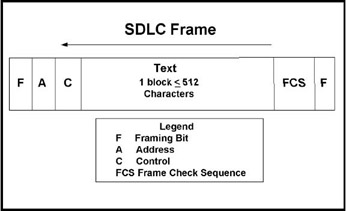
Synchronous Data Link Control. A bit-oriented synchronous communications protocol developed by IBM, SDLC is at the core of IBM's SNA (System Network Architecture). Intended for high-speed data transfer between IBM devices of significance (read mainframes), SDLC forms data into packets known as frames, with as many as 128 frames being transmitted sequentially in a given data transfer. Each frame comprises a header, text and trailer. The header consists of Framing bits (F) indicating the beginning of the frame, Address information (A), and various Control data (C). The data payload, referred to as Text, consists of as many as 7 blocks of data, each of as many as 512 characters . The trailer comprises a Frame Check Sequence (FCS) for error detection and correction, and a set of Framing bits (F) indicating the end of the frame. SDLC is a protocol which supports device communications generally conducted over high-speed, dedicated private line, digital circuits. SDLC can operate in either point-to-point or multipoint network configurations. See also HDLC and IBM. Contrast with Binary Synchronous Communications.
SDLC-To-Token-Ring LLC Transformation
A technique to integrate SDLC link-attached SNA devices into a LAN/WAN internet. A modified remote polling process is used to make the link-attached devices appear to be LAN-attached.
SDM
-
Subrate Data Multiplexing. A European term. In North America, it's called SRDM.
-
DMS SuperNode Data Manager.
SDMA
-
Station Detail Message Accounting. See Call Accounting.
-
Space Division Multiple Access.
SDMF
Single Data Message Format. See Caller ID Message Format.
SDMI
Secure Digital Music Initiative. Backed by the Recording Industry Association of America (RIAA), this initiative is working on a standard which can be built into digital music files and players to prevent illegal copies from being made.
SDN
Software Defined Network. See Software Defined Network, SDN Serving Office, Virtual Network, VPN and the Appendix.
SDN Serving Office
One of many AT&T-supplied switching nodes in an SDN network. See also Software Defined Network and the Appendix.
SDR
-
Session Detail Record. Data records generated by LAN-attached devices (e.g., switches and routers) that are captured, compressed, and stored on a central repository for purposes of developing various reports that are used by a network accounting system to ensure that data network resources are being used properly and effectively. Network accounting systems use SDR in the data domain much as call accounting systems use CDR (Call Detail Records) output by a PBX or Centrex system in the voice domain. See also Call Accounting and Network Accounting.
-
See Software Defined Radio.
SDRAM
Synchronized Dynamic Random Access Memory. SDRAM largely has replaced DRAM (Dynamic RAM) as the most common main memory for PCs. SDRAM's memory access cycles are synchronized with the CPU clock in order to eliminate wait time associated with memory fetches between RAM and the CPU. Data bursts as high as 150 MHz are supported. PC100 and PC133 are Intel versions for SDRAM motherboards running at 100 MHz and 133 MHz, respectively, and intended for PC with faster processors running at up to 600 MHz and 1 GHz, respectively. SDRAM's leadership is being challenged by DDRSDRAM (Double Data Rate-SDRAM) and RDRAM (Rambus DRAM), both of which are faster.
| Memory Type | Actual Clock Clock Speed | Effective Clock Speed | Year Released | |
|---|---|---|---|---|
| 66-MHz SDRAM | 66 MHz | 66 MHz | 0.528 GB/sec | 1996 |
| PC100 SDRAM | 100 MHz | 100 MHz | 0.8 GB/sec | 1998 |
| PC133 SDRAM | 133 MHz | 133 MHz | 1.064 GB/sec | 1999 |
| DDR200 SDRAM | 100 MHz | 200 MHz | 1.6 GB/sec | 2001 |
| DDR266 SDRAM | 133 MHz | 266 MHz | 2.1 GB/sec | 2001 |
| DDR333 SDRAM | 166 MHz | 333 MHz | 2.7 GB/sec | 2002 |
| DDR400 SDRAM | 200 MHz | 400 MHz | 3.2 GB/sec | 2003 |
| QBM/DDR400 | 200 MHz | 800 MHz | 6.4 GB/sec | 2003 |
| QBM/QDR/DDR400 | 200 MHz | 1600 MHz | 12.8 GB/sec | 2004 * |
| QBM/QDR/DDR400128-bit 200 MHz | 3200 MHz | 25.6 GB/sec | 2004 * | |
| [*] Estimated | ||||
See also DDR-SDRAM, DRAM, EDO RAM, Flash RAM, FRAM, Microprocessor, RAM, RDRAM, SRAM, and VRAM.
SDRM
Sub-rate Data Multiplexing. Refers to a service where a DSO (64 Kbps) channel may contain one 56 Kbps signal, five 9.6 Kbps signals, ten 4.8 Kbps signals or twenty 2.4 Kbps signals. Although speeds may be mixed, the highest speed determines the number of signals supported.
SDP
-
Session Description Protocol. Specified in the IETF's RFC2327, SDP is intended for the description of multimedia sessions over IP-based networks. SDP is used for session announcement, session invitation , and other forms of session initiation. Session Initiation Protocol (SIP) relies on SDP. See also SIP. See TAPI 3.0 for a full description.
-
Service Delivery Point. The Minimum Point Of Entry (MPOE), where the commercial carrier establishes a demarc ( demarcation point). The demarc draws the line between the local loop, which is the responsibility or the carrier, and the inside wire and cable system, which is the responsibility of either the end user or the building owner. See also MPOE.
-
A Bluetooth term. Service Discovery Protocol.
SDP client
A Bluetooth term. The SDP in a Local Device (LocDev). The SDP client requests service information from SDP servers.
SDP server
A Bluetooth term. The SDP in a Remote Device (RemDev). The SDP server responds to requests made by SDP clients .
SDP Session
A Bluetooth term. The exchange of information between an SDP client and an SDP server. The exchange of information is referred to as an SDP transaction.
SDP Transaction
A Bluetooth term. The exchange of an SDP request from an SDP client to an SDP server, and the corresponding SDP response from an SDP server back to the SDP client.
SDS
Short Data Service. A data transmission service for the transmission of short alphanumeric data messages in the European TETRA (TErrestrial Trunked RAdio) mobile radio system. SDS is much like SMS (Short Message Service) in cellular networks. See TETRA.
SDSAF
Switched Digital Services Applications Forum, a group of manufacturers and carriers whose objective to standardize the interconnection of switched 56 kilobit and n x switched 56 channel local and long distance services. The group is based in Reston, VA. Today a switched 56 Kbps "phone" call between multiple carriers probably wouldn't get through. In short, this group is trying to bring the simplicity of the voice dial up phone system into the switched data world.
SDSL
Symmetrical Digital Subscriber Line, also sometimes referred to as Single-line DSL. SDSL is a proprietary version of symmetric DSL versions such as HDSL and HDSL2. SDSL technology offers digital bandwidth of up to 2.3 Mbps both ways (that's why it's called symmetrical) over a single twisted-pair copper phone line, over distances up to about 10,000 feet on an unrepeatered basis. SDSL is aimed at the corporate and SOHO markets that require high upstream and downstream traffic rates. SDSL uses the same 2B1Q modulation scheme used in ISDN BRI. In February 2001, the ITU-T standardized on G.shdsl, which largely obsoleted SDSL. See also xDSL, ADSL, G.shdsl, HDSL, HDSL2, IDSL, RADSL, SHDSL, and VDSL.
SDT
Structured Data Transfer: An AAL1 data transfer mode in which data is structured into blocks which are then segmented into cells for transfer.
SDTV
Standard Definition TV. A set of standards for DTV (Digital TV) approved by the FCC in December 1996, SDTV offers about the same definition as current conventional analog TV. There really are two SDTV versions. The first calls for 480 vertical lines, 640 horizontal pixels, an aspect ratio of 4:3, and a frame rate of 24, 30, or 60 fps (frames per second). The second is much the same, but increases the number of horizontal pixels to 704, and supports aspect ratios of both 4:3 and 16:9. See also DTV and HDTV.
SDU-SMDS Data Unit
The user payload in an SMDS L3PDU packet. The SDU can contain up to 9,188 bytes.
SDU
An ATM term. Service Data Unit: A unit of interface information whose identity is preserved from one end of a layer connection to the other.
SDV
Switched Digital Video.
SDVN
Switched Digital Video Network.
SE
-
Systems Engineering
-
An ATM term. Switching Element: Switching Element refers to the device or network node which performs ATM switching functions based on the VPI or VPI/VCI pair.
SEA
Self Extracting Application. You buy a piece of software. It comes delivered as one file with the extension .exe. You click on the file, bingo it executes its one main function, namely to extract the various files that go into making up the software and save those files to somewhere on your hard disk. It may then ask you if you'd like to install the software on your PC.
Seagull Manager
A manager who flies in, makes a lot of noise, is critical of everything, then leaves . The seagull metaphor comes from the activity that seagulls are most known for, i.e. defecating. See also Albatross Manager.
SEAL
Simple and Efficient Adaptation Layer: An earlier name for AAL5.
Sealed Case PC
A fancy name for a PC that never needs to be opened up.
Sealing Current
A designation for a powering situation that consists of a wet loop without span power.
Sealink
Sealink is an error-correcting file transfer, data transmission protocol for transmitting files between PCs. It is a variant of Xmodem. It was developed to overcome the transmission delays caused by satellite relays or packet-switching networks.
Seals
A way of telling if a device has been tampered with.
Seamless
The word seamless means " perfectly smooth, without awkward transitions." In software, it means that what takes place between the user and the application accessed by the user is perfectly smooth to the user and the software being used by the used will work easily with other software the user is also using. On a LAN accessing "seamless" applications, the user doesn't perceive he's on a network because his programs run as though they were on his personal computer. In fact, the word "seamless" is a very vague term, meaning now that the "seamless" software you're about to use will work easily with other software you're using. But no one knows exactly what easily is, not how easy seamless is. And no one has a technical definition of seamless. Originally, the word meant "without the stitches showing." The 15-century word got a boost from the phrase seamless stockings which filled a brief period between silk stockings ” which had seams that always needed straightening ” and panty hose that don't, sadly. In short, when any vendor says they offer "seamless integration" with something else, don't believe them. Check.
Seamless Messaging
Seamless Messaging is a new phone service that will allow subscribers, according to Lucent, to send and respond to messages across a service provider's entire network. This will make it possible for subscribers to communicate with large groups of people such as community interest groups, athletic teams or family and friends located in different states within a service provider's region ” reducing the time and effort needed to place individual calls. Single Number Retrieval will allow service providers to provide quick and easy access to voice mailboxes by assigning a single, memorable number to all of their voice mail subscribers.
Search Drive
A drive that is automatically searched by the operating system when a requested file is not found in the current (default) directory. A search drive allows a user working in one directory to transparently access an application or data file that is located in another directory.
Search Engine
An Internet World Wide Web term. A search engine is a program that returns a list of Web Sites (URLs) that match some user-selected criteria such as "contains the words cotton and blouse." Basically, the procedure is simple. You surf to the search engine's site. You click a couple of times and type in what you're looking for. A few seconds later you get choices. You finally make your selection and you get instantly hotlinked over to that site. Search Engines are the most useful thing to come along in years. I use them daily to find everything from information on a company I'm looking for to new definitions to fill this ever-expanding dictionary. Here are the main Internet search engines and their addresses.
ALTA VISTA
www. altavista .com
EXCITE
www.excite.com
www.google.com
HOT BOT
www.hotbot.com
LYCOS
www.lycos.com
INFOSEEK
www.go.com
OPENTEXT
http://pinstripe.opentext.com/
PROFUSION
www.profusion.com
WEBCRAWLER
www.webcrawler.com
YAHOO
www.yahoo.com
Search Expression
See query restriction.
SEAS
Signaling Engineering and Administration System.
Seasonality
The month-to-month fluctuation in call volume that can be expected to recur each year in a call center. For example, a call center might always have peak months in the spring and early summer and slow months in the late fall and winter.
Seated Agents
A call center term. See Base Staff.
SEB
Site Event Buffer. Another name for a modem typically used for relaying error codes on PBX and voicemail systems. An SEB is primarily used for dialing into, in order to protect the PBX and voicemail with another layer of security and also so you only need one line to access both devices. We have both Nortel and Octel/Avaya equipment and this device allows for that interface. I do not think that it is vendor specific. We also get alarms from this device if there is a power failure or if it loses connectivity to the PBX or Voicemail system. What does the SEB dial its error messages into? It connects to another modem that is serially connected to a special application that decifers the error codes that are transmitted from the SEB. The SEB has a serial interface to a TTY port on a PBX or Voicemail system that captures error codes from those devices. It is all in ASCII.
SECABS
Small Exchange Carrier Access Billing Specifications
SECAM
Acronym for Systeme Electronique Couleur Avec Memoire or SEquential Couleur Avec Memoire. A television signal standard used in France, eastern European countries, Russia, the former Soviet Union and some African countries . SECAM uses an 819-line scan picture which provides a better resolution than PAL's 625-lines and NTSC's 525-lines (the US standard). All three systems are not compatible. You cannot view an Australian, English or French videotape or through-the-air broadcast on a US TV. See NTSC.
Second Dialtone
-
Dialtone given to the caller, on a phone system (e.g. PBX, Centrex or hybrid), after dialing an access code (e.g. 8 or 9) to make a call out of the system (e.g. a local or long distance). Sometimes referred to as outside dialtone.
-
Dialtone returned to a caller after they've dialed a local or long distance number and reached some type of switching device. That switching device might allow you to dial into a fax machine, a modem, a phone or an answering machine. It might allow you to dial into one of several cash registers or soda machines (to check if they need being refilled). It might even allow you to dial long distance through a voice mail system or through a long distance phone company. As you dial through networks you might encounter not only second, but also third and fourth dialtones.
Second Level Domain
In the Domain Name System (DNS) of the Internet, the second level domain is the next lower level of the hierarchy underneath the top level domains. In a domain name, the second level domain is that portion of the domain name that appears immediately to the left of the top level domain. For example, the technologyinvestor in technologyinvestor.com. Second level domain names are often descriptive and have come to be used increasingly to represent businesses and other commercial concerns on the Internet. See also: Domain Name System. DNS.
Second Marriage
A triumph of hope over experience.
Second Mover Advantage
The theory of second mover advantage is that market dominance hardly ever goes to the plucky startup that first releases a product or service. Rather, it does to the second company, sometimes an established company that most effectively markets and sells the product and service.
Second Order Harmonics
The second multiple of a specific frequency or a specific frequency multiplied by two.
Second Source
When you make things that your suppliers build into other things, they prefer that they had a second place to buy things you supply. They clearly have fears that your factory will burn down, be flooded, be blown away, etc. They don't want to put out of business because something horrible happens to you. They want a second source. Some manufacturers specifically license their products to other manufacturers ” so their customers will have a second source.
Second Time
The second time you do something is always much much faster than the first time. So when your phone company tells you it'll only take you three minutes to move an extension on your PBX, they mean the second time you do it.
Secondary Carrier
A customer can override their primary carrier selection on a call by call basis and select another long distance telephone company to carry their long distance traffic in equal access areas. See also 101XXXX and Primary Interchange Carrier.
Secondary Channel
A low-speed transmission channel provided in many dedicated line data modems to permit simultaneous control and network management transmission to coexist with the main higher-speed data channel; actually a form of FDM (Frequency Division Multiplexing) of a voice channel for use by two modems.
Secondary Equipment
Used telecommunications equipment. See also Used, Certified, Refurbished and Remanufactured.
Secondary Market
The market for used business telecommunications and computer equipment.
Secondary Protection
Primary protection is a device that sits at your building entrance between your phone line coming in from outside and your line going into and up your building. The phone company is responsible for installing primary protection. Secondary protection sits on your floor just next to your phone system. Secondary protection is designed to protect your phone equipment from spikes, surges and high electricity that might affect your phone lines between the primary protection downstairs and the secondary protection upstairs. Secondary protection typically costs $20 to $30 a line. It's worth every penny.
Secondary Radar
A radiodetermination system based on the comparison of reference signals with radio signals retransmitted from the position to be determined.
Secondary Radiation
Particles (such as photons , Compton recoil electrons, delta rays, secondary cosmic rays, and secondary electrons) that are produced by the action of primary radiation on matter.
Secondary Resource
An SCSA definition. Any resource that is attached to a Group after the Group has been created around a primary resource. See SCSA.
Secondary Ring
One of the two rings making up an FDDI ring. The secondary ring is usually used in the event of failure of the primary ring.
Secondary Server
Under NetWare, the secondary server is the SFT III NetWare server that is activated after the primary server that receives the mirrored copy of the memory and disk from the first server activated. The secondary server mirrors the disk and memory image of the primary server. Though it cannot be used to do additional work (because it uses all of its CPU cycles keeping up with the primary server), the secondary server can act as a router for the local network segments to which it is directly attached. In addition to mirroring the primary server, the secondary server provides split seeks. Either SFT III server may function as primary or secondary, depending on the state of the system. You cannot permanently designate which server is primary or secondary. System failure determines each server's role, that is, when the primary server fails, the secondary server becomes the new primary server. When the failed server is restored, it becomes the new secondary server. See also Server Mirroring.
Secondary Service Area
The service area of a broadcast station served by the skywave and not subject to objectionable interference and in which the signal is subject to intermittent variations in strength.
Secondary Station
In a data communication network, the secondary station responsible for performing unbalanced link-level operations, as instructed by the primary station. A secondary station interprets received commands and generates responses.
Secondary Winding
The minor winding on a relay having two windings. The winding on a transformer that is not connected to a AC source.
Secondhand Speech
The noise people make when they talk publicly into cell- phones. Secondhand speech is the cellphone equivalent of secondhand smoke.
SECORD
SEcure voice CORD board. Now extinct.
Secretarial Hunting
The secretary's station number is programmed as the last number in one or more hunt groups. If all phones within a hunt group are busy the call will hunt to the secretary.
Secretarial Intercept
A PBX feature. Causes calls for an executive to ring his/her secretary ” even if the executive's direct extension number was dialed. The exec - utive's phone will ring only if the secretary's phone is placed on "Do Not Disturb" or the secretary transfers the call in.
SECTEL
Acronym for SECure TELephone.
Section
In Sonet, a section refers to an optical span and its equipment.
Section 251
See Telecommunications Act of 1996, U.S.
Section 254
See Telecommunications Act of 1996, U.S.
Section 271
See 271, Telecommunications Act of 1996, U.S.
Section 271 Relief
The local Bell operating companies are allowed to sell long distance phone service. See 271 and 271 Hearings.
Section 706
See Telecommunications Act of 1996, U.S.
Sectional Center
A control center connecting primary telco switching centers. A Class 2 office. The next to the highest rank (Class 2) Toll Switching Center which homes on a Regional Center (Class 1).
Sectional Parabolic Antenna
A parabolic antenna which consists of only a slice or part of a complete parabolic dish.
Sector
A pie-shaped portion of a hard disk. A disk is divided into tracks and sectors. Tracks are complete circuits and are divided into sectors. Under MS-DOS a sector is 512 bytes.
Sector Rotation
Sector rotation is a stockmarket term. Investors sell out of networking stocks and they move into health care stocks. Sector is a stockmarket term for industry.
Sectoring
The process of dividing a mobile cellular radio cell into sectors, or smaller patterns of coverage. Traditionally, all cell antennas were omnidirectional; that is to say that they provided coverage in a 360-degree pattern. Sectoring is applied when either the capacity of the cell site is insufficient or when interference becomes a problem. Sectoring divides the number of channels assigned to the cell into smaller groups of channels, which are assigned to a sector through the use of directional antennas. Commonly, the cell antenna is divided into three sectors, each with a 120-degree coverage pattern. You probably have noticed that many contemporary cell site antennas are very tall for better coverage and triangular in shape for purposes of sectoring.
Secure Channel
A technology that provides privacy, integrity, and authentication in point-to-point communications such as a connection on the Internet between a Web browser and a Web server. You can tell if you have a secure channel with Netscape by checking out the key on the bottom left hand side of your screen. If the key is broken, your connection is insecure . If it's together in one piece, then your Internet conversation is secure, which means it's encrypted and therefore hard for someone to break into and make sense of. See Internet Security, which details the problem of security on the Internet.
Secure Electronic Transaction
SET. A system designed for electronic commerce over the Internet that promises to make stealing credit card numbers much more difficult. See Digital Cash.
Secure Kernel
The core of a secure operating system.
Secure Hash Algorithm 1
See SHA-1.
Secure Phone Lines
There is no such animal as an absolutely secure phone line. There are only degrees of security. Think of a continuum. At one extreme is a normal analog phone line. It's totally unsecure. Anyone can attach a couple of alligator clips, join the circuit to a telephone and listen in on the call. At the other end of the continuum is a totally digital circuit (end to end digital) which is being encrypted by the topmost military encryption technology. In between, with varying degrees of security, are phone calls that start as analog and then change to digital, e.g. those that pass through a digital PBX, those that pass over the Internet or a private IP network.
Secure Public Dial
A security term. Secure Public Dial is dialup switching functionality that allows the service provider to offer customers the security of a private connection with the economics of public dial. Also referred to as Virtual Private Networking (VPN) allows the service provider to support multiple enterprises ' dial-in requirements, securely from the same dialup switch. Each separate customer has access to their own virtual network although they may share physical ports and access paths. The service provider manages the multicustomer net with the same ease as if it were one internetwork.
Secure Shell Protocol
Protocol that provides a secure remote connection to a router through a Transmission Control Protocol (TCP) application.
Secure Sockets Layer
SSL. SSL is the dominant security protocol for Internet / Web monetary transactions and communications. Information being transmitted is encrypted, and only the user's Web browser and the computer server at the other end running the Web site have the key, and thus can understand what each other is saying. But no one else can. Most reputable Web sites use SSL for credit card transactions on the Web. For a longer explanation, see SSL.
Secure Telephone Unit
STU. A U.S. Government-approved telecommunication terminal designed to protect the transmission of sensitive or classified information ” voice, data and fax.
Secure Voice
Voice signals that are encoded or encrypted to prevent unauthorized listening.
Secure Voice Cord Board
SECORD. A desk-mounted patch panel that provides the capability for controlling 16 wideband (50 Kbps) or narrowband (2400 bps) user lines and five narrowband trunks to AUTOVON or other DCS narrowband facilities.
![Newton[ap]s Telecom Dictionary](/icons/blank_book.jpg "Newton[ap]s Telecom Dictionary")
- Enterprise Application Integration: New Solutions for a Solved Problem or a Challenging Research Field?
- Data Mining for Business Process Reengineering
- Intrinsic and Contextual Data Quality: The Effect of Media and Personal Involvement
- Relevance and Micro-Relevance for the Professional as Determinants of IT-Diffusion and IT-Use in Healthcare
- Development of Interactive Web Sites to Enhance Police/Community Relations