Test-Driven Development in Microsoft .NET
Authors: Newkirk J.W. Vorontsov A.
Published year: 2004
Pages: 35-37/85
Buy this book on amazon.com >>

Almost Done

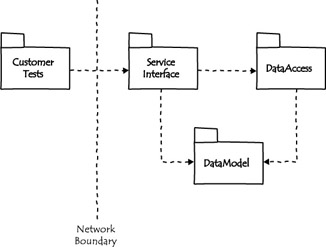
One last thing we will do here is clean up some of the dependencies we have introduced. Our package structure has emerged as we were building up the Web service and integrating it with the data access. We have enough code written now to help us see the dependencies between the modules. We will be moving the classes around between assemblies and namespaces to better reflect the emerged architecture. This is an important step of the test-driven development process; we are in fact exposing our architecture by clarifying the packaging boundaries.

We want to be able to distribute our production code without our test code, which necessitates the separation of the service interface tests into a separate assembly just as we did in the previous chapter with the data access tests. The second restructuring we want to do is move the definition of the typed DataSet , RecordingDataSet into a separate assembly and into a separate namespace: DataModel .

Figure 6-2 represents the emerged architectural packages.
click to expand
Figure 6-2: Package structure

The Bad News

Unfortunately, manual refactoring of the code of this scope is quite difficult and can be time-consuming ; however, it is no less important. Of course, the tests give us the confidence that after the refactoring everything still works, but the process of moving classes between namespaces and assemblies is not as simple as it could have been if there were tools that better supported such activity. The process is not complicated ”in fact, it is very mechanical and repeatable; but when we have many classes to move around, it quickly becomes annoying. The build process and the source control system also lag in support of such activity. This is not some fundamental limitation of the approach; it is the lack of adequate tool support that makes it harder.


Summary

When you look over the implementation, a number of things stand out. We use a common design pattern named service interface to separate the aspects of the Web service from the rest of the application s functionality. We introduced a stub class to separate the logical functionality from the database and the Web service. This stub allows us to work on the logical functionality without having to worry about the complications that the database and the Web service add to the problem.

For interoperability purposes, we developed a DTO, defined in XML Schema, to ensure the maximum amount of interoperability for the return type of the Web service.

Emerging Architecture

We have written a set of both integration and isolation unit tests. Having built a substantial portion of our application infrastructure, we started to recognize the emerging application architecture. Seeing the coupling between the classes and test code made it easier to recognize the packaging boundaries. We have refactored our application structure to reflect the emerging architecture.


Chapter 7: Customer Tests: Completing the First Feature

In this chapter, we develop a set of customer tests for retrieving recording information via the Web service we wrote in the previous chapter. The intent of the customer tests is different from that of the programmer tests. Customer tests confirm how the feature is supposed to work as experienced by the end user . Because most customers might not feel comfortable coding their tests in NUnit, we need to provide a tool that makes writing tests as easy as editing a document. The goal is to enable the customer to write a specification as a series of automated tests. The tool that we will use to facilitate the automation of customer tests is an open -source tool called FIT. You can download it from http://fit.c2.com .

Are We Done?

This is an age-old problem in software development: many times, we have been on projects in which we thought we were 80 or 90 percent complete, only to have it take much more time than we thought it would to complete the last 10 or 20 percent. One of the main reasons for this problem is having ambiguous or contradictory requirements. We don t mean to imply that requirements in general are poorly written ”only that when things are written down by people and read by other people, there will be different interpretations of what is written. These different interpretations can lead you to believe that you are finished when you are not.

So, how do you drive ambiguity out of this process? Clearly, during the writing of the software, we used programmer tests to ensure that various programming- related assumptions were correct. However, the scope of these tests is such that they could be written perfectly with 100-percent coverage and still could miss a critical function. So, this is a necessary step, but it is not sufficient to indicate completion. Although we also worked very hard to eliminate code duplication in the implementation, this duplication issue is not something that the customer is primarily concerned with, at least at the start.

Programmer tests and good software structure are useful metrics from the programming perspective because they give the programmers an indication of how well the software implements its intended functionality. It is really up to the customer to indicate whether the software serves its intended purpose because he is primarily concerned with what the software does and how this particular functionality relates to a business value. So, the determination of completion is related to these values. What is lacking in many cases is a means for the customer to indicate with precision whether or not the software works as it was expected to.

Customer Tests

What is needed then is a mechanism for the customer to write tests that are used to determine completion. These tests are a direct interpretation of the requirements, but they are written by the customer to ensure that their perspective is verified . Therefore, these tests should be in a form that is familiar to the customer, so this leaves out tests implemented with NUnit because most customers won t want to (or can t) write tests in a programming language.

Also, to facilitate the type of feedback that we get from programmer tests, these customer tests need to be automated to enhance reliability and improve response time. Rapid response time allows the development team to better associate a failure with the code change that caused it. For example, let s say it takes two weeks to run acceptance tests and get the results. Because it takes two weeks to do so, we will not do this very often. In fact, we will build up a list of changes to make the most appropriate usage of the testing resources. In addition, the development keeps moving when the tests are being run, so the software could be very different when the results are returned. If there were problems, the development team must now attempt to fix them. Some of the problems may have already been fixed; some may no longer be reproducible, and so on. For the sake of argument, let s say that it takes five minutes to run the customer tests and get the results. This time is so short that you want to add running these tests in addition to the programmer tests for each build of the software. Given this immediate feedback when a test fails, it is much more likely that the person who made the change in the software can go back and fix it without a great deal of time spent wondering what caused the problem. This rapid turnaround yields very large productivity gains for the team.


Test-Driven Development in Microsoft .NET
Authors: Newkirk J.W. Vorontsov A.
Published year: 2004
Pages: 35-37/85
Buy this book on amazon.com >>

Similar books on Amazon