The map is not the territory.
” Alfred Korzbyski
Take a minute and answer the questions to the quiz in Figure 1.1. Then, once you ve finished reading this chapter, take the quiz in Figure 1.7 ” What Did You Learn? What Will You Do ” to find out how much this information has helped you with your own CMMI-based process improvement.
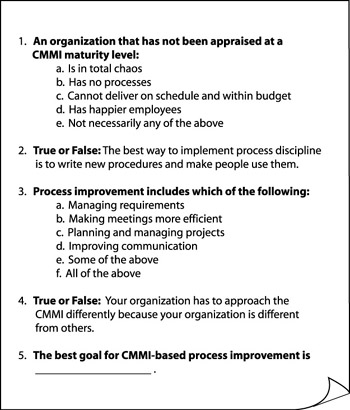
Figure 1.1:
Chapter 1: What Do You Think? What Do You Believe?
As you read this chapter, you ll discover that definitive answers to questions about CMMI-based process improvement can be evasive. When asked questions, seasoned instructors at SEI have learned to answer with it depends or you decide and they are wise to do so. When it comes to cultural or technological change, which encompasses process improvement, the right answer is the one that most benefits your organization and its business needs.
The Staged Representation of CMMI identifies five levels of capability maturity and defines process areas (PAs) for Maturity Levels 2 through 5. Why are there no PAs in Level 1? And if there are no PAs in Level 1, why is it called Level 1 and not Level 0 (zero), and why doesn t the maturity scale go from zero to four instead of one to five? And can an organization really make the quantum leap from mastering no practices or process areas to many?
|
|
If you read nothing else in this entire book,
As an executive or senior manager of a software or systems organization undergoing CMMI-based process improvement, you need to be aware of and supportive of the fact that people in your organization have already developed good engineering and management practices. Do not automatically assume that people need to change what they re already doing. Encourage your process focus people (SEPG, EPG, or whatever they call
An effective way to determine your organization s current process capability or organizational maturity is to conduct some type of process appraisal such as a Standard Capability Appraisal Method for Process Improvement (SCAMPI
SM
).
[3]
However, the type (and relative cost) of appraisal you conduct to figure out your organization s starting point for process improvement should be based on business decisions and an understanding of the organization s recent history. Don t let this important decision be based on what some consultant wants to sell you. For more information on
Finally, since the success of your organization s CMMI effort is critically dependent on your leadership, you should read Chapter 7 ” Effective Change Leadership for Process Improvement.
|
|
{% if main.adsdop %}{% include 'adsenceinline.tpl' %}{% endif %}
|
|
Very soon after you hear that your organization is going to do some process improvement or CMM or CMMI stuff, the people responsible for process in your organization may come around asking people like you questions about how you do your work. What they re trying to do is find out what the organization is doing well and what can be improved in terms of software development and management processes. (If no one comes around asking such questions, find out why not.)
It is very much to your benefit to be cooperative and help the process people gather this information and here s why: If the process people (i.e., the SEPG) cannot find out what procedures people are currently using to do their work, they might go off and invent procedures which you won t like but will have to follow. If you speak up and let them know what you re doing, how you re doing it, and that things are working just fine thank you, then the process people will use your existing procedures (the ones that you re used to and like) as the starting point. They may make some incremental changes to these procedures down the road, but your contributions to the start-up of the process improvement initiative will probably keep management from thinking that a
|
|
The reality of life in modern business is that organizations don t really leap from zero to six or more PAs in a single bound and there really are process areas in a Level 1 mature organization. They are not defined in the CMMI, but they can be found in the larger universe of process improvement.
This situation ” the concept of a Level 1 organization existing with Level 1 being
undefined
” always reminds me of the 1984 Rob Reiner film,
This Is Spinal Tap.
[4]
There s a scene in the film in which the
NIGEL: This is a top to a, you know, what we use on stage, but it s very very special because if you can see
MARTY: Yeah
NIGEL: the
MARTY: Ahh oh, I see .
NIGEL: Eleven eleven eleven .
MARTY: and most of these amps go up to ten .
NIGEL: Exactly.
MARTY: Does that mean it s louder? Is it any louder?
NIGEL: Well, it s one louder, isn t it? It s not ten. You see, most most blokes, you know, will be playing at ten. You re on ten here all the way up all the way up .
MARTY: Yeah .
NIGEL: all the way up. You re on ten on your guitar where can you go from there? Where?
MARTY: I don t know .
NIGEL: Nowhere. Exactly. What we do is if we need that extra push over the cliff you know what we do?
MARTY: Put it up to eleven.
NIGEL: Eleven. Exactly. One louder.
MARTY: Why don t you just make ten louder and make ten be the top number and make that a little louder?
NIGEL: these go to eleven.
This wacky little scene mirrors the strangeness of the CMM and CMMI maturity levels. Why not make it four levels ” one to four ” and have process areas and practices defined for Level 1 and not have a Level 5? The only answer I ve ever been able to deduce is this one goes to five.
In reality, there is a Level 1; it s just not defined in CMM or CMMI. Business organizations can be
But first, let s take a look at the biggest mistake organizations make right after they first get the idea to implement process improvements based on CMMI. I call this really commonplace, really bad idea Slash-and-Burn.
[3] Standard CMMISM Appraisal Method for Process Improvement (SCAMPISM), Version 1.1: Method Definition Document (MDD), CMU/SEI-2001-HB-001, Carnegie Mellon University, December 2001.
[4] Reiner, Rob, This Is Spinal Tap, Metro-Goldwyn-Mayer. 1984. Script downloaded from http://www.krug.org/scripts/tap.html.

CMMI Survival Guide: Just Enough Process Improvement

CMMI for Development: Guidelines for Process Integration and Product Improvement (3rd Edition) (SEI Series in Software Engineering)

CMMI for Services: Guidelines for Superior Service (2nd Edition) (SEI Series in Software Engineering)

Integrating CMMI and Agile Development: Case Studies and Proven Techniques for Faster Performance Improvement (SEI Series in Software Engineering)