4.10 Appendix
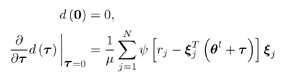
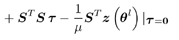
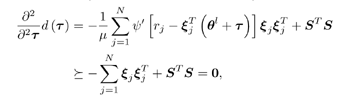
4.10.1 Proof of Proposition 4.1 in Section 4.4We follow the technique used in [203] by defining the function Equation 4.184 Notice that Equation 4.185 Equation 4.186 Equation 4.187 Equation 4.188 where (4.188) follows from the assumption that y '( x ) Equation 4.189 we obtain Equation 4.190 Assume that the penalty function r ( x ) is convex and bounded from below; then the cost function C ( q ) is convex and has a unique minimum C ( q *). Therefore, q * is the unique solution to (4.15) such that z ( q *) = . Since the sequence C ( q l ) is decreasing and bounded from below, it converges. Therefore, from (4.190) we have Equation 4.191 Since for any realization of r , the probability that z ( q l ) falls in the null space of the matrix ( SR -1 S T ) is zero, then (4.191) implies that z ( q l ) 4.10.2 Proof of Proposition 4.2 in Section 4.5 Denote Equation 4.192 Denote Equation 4.193 Using (4.192) and (4.193), we obtain Equation 4.194 Equation 4.195 Equation 4.196 where in (4.194) Equation 4.197 It follows from (4.197) that the k th diagonal element Equation 4.198 |



 denotes that the matrix (
  0, for any t
 . Now on setting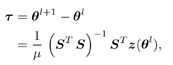



 .
.  . Then (4.75) can be written in matrix form as
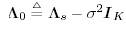 . Then from (4.73) and (4.74) we obtain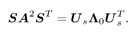



 denotes the Moore “Penrose generalized matrix inverse [189]; in (4.195) we have used the fact that
  , which can easily be verified by using the definition of the Moore “Penrose generalized matrix inverse [189]; in (4.196) we have used the facts that
  ; and (4.196) is the matrix form of (4.76). Finally, we notice that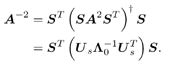
 of the diagonal matrix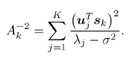

EAN: 2147483647
Pages: 91