MISCELLANEOUS
| < Day Day Up > |
Keep Those Cards at HomeThe Annoyance:I just bought a new microwave oven. Inside the box was a product registration card saying that if I wanted warranty protection I'd need to fill out the card and mail it within 10 days. The card asked all sorts of nosy questions like my annual income, marital status, ages of my children, and the types of credit cards I own. Do I have to give them any of this information? The Fix:No. In fact, you don't have to fill out a registration card to qualify for warranty protection. In most cases all you need is a receipt indicating when and where you bought the product and how much you paid for it. These cards are really just marketing surveys in disguise. Most go directly to data mining companies, who use the info you provide to send you more junk mail, telemarketing pitches, and spam. One exception to this rule is software. If you purchase software from a major vendor like Microsoft or Symantec, you may be compelled to register your copy online or it will stop working. Such procedures are used to combat software piracy (as well as compel users to renew their software subscriptions). If you must register, give the bare information necessary to activate your software, and be sure to opt out of any offers to add you to their mailing lists (unless you really want more junk in your life). Get Debt Collectors Off Your BackThe Annoyance:For six months I've been getting calls from a collection agency for a debt owed by John J. Johnson. As I've explained to them many times, my name is John Q. Johnson, and I live in an entirely different city than John J. Yet the calls keep coming. What can I do to stop this harassment? The Fix:Write the collection agency a letter asking them to stop dunning you, and explain why. Under the Fair Debt Collection Practices Act, after an agency receives such a request it can only contact you to say that the matter has been dropped, that it's planning to sue you, or to send proof of your debt, such as a copy of an unpaid bill. This written notice doesn't relieve you of an obligation to pay legitimate debts, it just stops the agency from nagging you about them. The FDCPA has a number of other provisions to shield your privacy:
If you feel a collection agency has violated the law, you can report it to the Federal Trade Commission's Consumer Sentinel (http://www.consumer.gov/sentinel/). For more information, see the FTC's FAQ on fair debt collection practices (http://www.ftc.gov/bcp/conline/pubs/credit/fdc.htm). While you're at it, order a copy of your credit report to make sure that the other John Johnson's records aren't mixed up with yours. A June 2004 study by the Public Research Interest Group found that more than half of all credit reports contained personal information that was misspelled, outdated, or belonged to someone else. Hello, My Name Is Brad, and I'll Be Your Thief This EveningThe Annoyance:I hand my credit card to a waiter, he disappears for a few minutes, then comes back with a slip for me to sign. A few months later mystery charges start showing up on my bank statement. Is there a connection? The Fix:That waiter might have done more than stick his thumb in your soup; he may have also put his hand in your pocket. In a scam known as skimming, credit cards are swiped twice once in the normal card scanner, and once in a pager-sized device that captures your account information. Skimming can happen anywhere cards are accepted, but it seems to be most widely reported in restaurants, most likely because the swipe usually occurs out of sight of the card holder. In February 2004, San Jose police busted two credit fraud rings operating in Bay Area restaurants. College-age waiters were paid $10 for every card they skimmed. That information was used to create counterfeit or clone cards, which the ringleaders used to buy swag to then sell over the Internet. Skimming accounts for an estimated $1 billion worth of losses each year, though the biggest danger for individuals is identity fraud. The only solution is to keep a close eye on your credit accounts and challenge any unusual charges. If you dispute charges within the time period specified by your bank (usually 60 days), you'll only be liable for $50 of it. These days most banks will absorb the entire charge if fraud is involved. You might also want to keep a close eye on your waiter, or consider taking your credit card to the cashier yourself. Get Ready for Your Close-UpThe Annoyance:I've never considered myself telegenic until I walked down a busy street and noticed a video camera perched above the sidewalk every 10 feet or so. Where I live it's too hot to walk around wearing a ski mask, so how do I handle this constant videotaping? The Fix:Well, you could break into a song and dance routine. That's what the New York City Surveillance Camera Players do to publicize the pervasiveness of hidden cameras. (Another troupe has formed in San Francisco you can find them at http://www.survile.org.) Bill Brown, who founded the SCP back in 1996, says the first thing people need to do is figure out where the cameras are. He conducts periodic tours of camera sites in different New York neighborhoods. You'll also find maps showing camera locations in Boston, Chicago, New York, Washington, DC, and other cities on his site at http://www.notbored.org/maps-usa.html (see Figure 5-4.) But besides trying to avoid streets where cameras are placed (virtually impossible in some cities) or becoming a street performer, there's not much ordinary citizens can do except lobby for laws that restrict the use of camera footage.
What's the big deal? While cameras are theoretically placed in public spaces to deter crime, many are also used for more covert purposes such as recording the images and license plate numbers of political protestors. Over the last two years police have videotaped protests in Denver, San Francisco, Milwaukee, and Washington, DC, according to EPIC's Protestor Privacy Page (http://www.epic.org/privacy/protest). Cameras are also abused for more personal reasons (see "Privacy in Peril: Entertaining the Troopers"). For more information on pervasive (and invasive) surveillance, see Privacy International's site (http://www.privacy.org/pi/activities/cctv) and EPIC's Observing Surveillance site (http://observingsurveillance.us). annoyances 5-4. Want to be seen in DC? This map will show you where to mug for the police cameras. Though the map shows only 16 locations, there are likely to be hundreds more private security cameras aimed at unsuspecting pedestrians.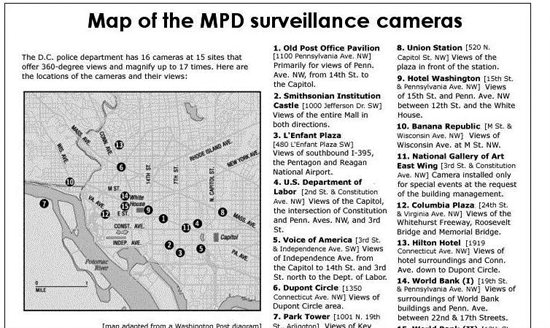
|
| < Day Day Up > |
