Chapter 5. The eXtreme Project Management Model
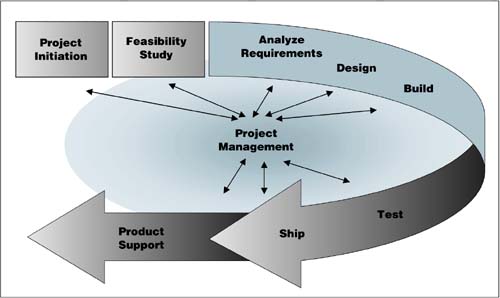
The general structure of projects is shown in Figure 5.1. There is a complex interaction between the project development processes such as feasibility study and analyzing requirements and the project management processes. Figure 5.1. Generic project model
Of course, the development of projects,
|
Project Management ProcessesAs shown in Figure 5.2, there are four major processes in the activity of project management:
Figure 5.2. Overall project management process
Project Justification, Approval, and ReviewThis activity is typically undertaken by senior management. It involves the evaluation of potential projects (projects identified via the strategic planning process and new initiatives), the approval of the undertaking of a project feasibility study, the review of the project's business case (including cost “benefit), and the regular review of the progress of the project in achieving the business case. It is often called project governance.
This is a very complex process and few organizations have really managed to implement it successfully. As we discuss later, the senior management
Project justification and approval are supported by the strategic planning process and by the feasibility study activity. The strategic planning process is critical in ensuring that the IT and business projects being undertaken are designed to assist the organization in achieving its desired
In most organizations, the strategic planning process is undertaken by business and IT people trained in strategic planning techniques such as value chain analysis, market research, information engineering, and problem-solving techniques. Given that the turbulence of the business and legislative environment is increasing, the strategic planning process has also evolved from a process undertaken yearly to an ongoing process similar to the real-time planning concept that applies to project management. The Critical Information for Project ApprovalTypically, the organization's strategic plan forms the framework within which an IT strategic plan can be developed to ensure that the requisite information systems (data and function) and IT infrastructure (technology architecture) are developed and deployed (see Figure 5.3). Figure 5.3. Project approval: Detail
In addition, there is a policy framework, which would include new organization policy as well government regulatory changes, occupational health and safety, government and stakeholder reporting requirements, and other mandatory projects. Finally, the executive team undertaking the project approval process should have access to a project portfolio that contains details of all current projects (e.g., resources, major events, etc.).
The projects identified in these four sets of information are as
These projects must be evaluated and "ranked" using a common set of information such as the project business case. The relationship between project prioritization and project management is revisited throughout the rest of this book. Most organizations have a senior management team that includes representatives from all major business groups and IT that drive the strategic planning process and the approval and review of major projects. The interrelationships between strategic plans, feasibility studies, and project justification are covered in more detail in the following chapters. Project Planning
Project planning is the key to effective project management. Detailed and accurate planning of a project produces the
As discussed earlier in this book, traditional project planning tended to focus on a one-off production of a project schedule. The emphasis in eXtreme project management is on the business and stakeholder issues (risk, strategy, service agreements, etc.) that provide the context for the schedule. Project planning involves 10 interrelated activities:
These 10 activities are undertaken in a structured manner using the RAP sessions and team-driven approach introduced in the
Project TrackingThis process involves the monitoring of project success, including actual project progress as compared to the planned progress, the collection of key project metrics (risks, costs, defect levels, etc.), and the monitoring of overall team performance.
It should be driven by the use of PC-based project management tools such as Microsoft Project
Project Reporting and Change ControlThis process involves the aggregation of detailed project tracking information into the project reporting system and back into updates of the business case. This system is designed to provide project status, cost, and other relevant information to the proj ect's sponsor, stakeholders, and project managers of related projects. The project review process also involves the approval of major deliverables and, if required, the approval for the undertaking of further planning sessions. This process is also explored in Chapter 16. Postimplementation ReviewsThere are additional project management processes that occur at the end of the proj ect development process. Following implementation of the product, the processes of postimplementation review, benefits realization reviews, and system support reviews should be undertaken. In many organizations, these processes are not undertaken by the person who managed the development of the product, but instead by some independent team. However, the design and conduct of these reviews are critical to successful project management and are covered in Chapter 17, "Project Tracking and Reporting." A Note on the Project Initiation and Feasibility StudyAs shown in Figure 5.4, the process of project initiation is often simply the process of a person developing an idea and, with little effort, a project is started to fully develop the idea. In fact, the more senior the person is, the easier it is for him or her to be able to do this. Figure 5.4. The initiation process
In reviewing many failed projects for
eXtreme project management requires an investment of effort before the project
A feasibility study is a hybrid process. It is
The technical activities undertaken in a feasibility study would involve analysis of the current business and system environment and situation,
The managerial activities would be analysis of the scope, objectives, and stakeholders of the project; identification of expected quality requirements; examination of alternative project development strategies; and, using the technical detail being produced in the feasibility study, the development of estimates, costs, risks, and benefit analyses. In summary, the feasibility study is a critical project management process that involves technical experts (business or system analysts) working with the project manager. In many cases, it involves time, effort, and commitment from senior management. |

Decision Making in Systems Engineering and Management (Wiley Series in Systems Engineering and Management)

The Checklist Manifesto: How to Get Things Right

Project Management That Works: Real-World Advice on Communicating, Problem-Solving, and Everything Else You Need to Know to Get the Job Done

The Power of Scrum