Six Sigma Tool Navigator(c) The Master Guide for Teams
Authors: Michalski W. J. King D. G.
Published year: 2005
Pages: 179-180/326
Buy this book on amazon.com >>

Tool 93: Idea Advocate

AKA 

N/A

Classification 

Evaluating/Selecting (ES)

Tool description

First used by the Battelle Institute of Frankfurt, Germany, the idea advocate is an excellent idea-evaluation tool. The team assigns the role of idea advocate to a participant who promotes a particular idea as the most valuable from a list of previously generated ideas. The more an idea advocate promotes different ideas, the more powerful the selection process, since every idea is fully examined by the evaluating team.

Typical application

  • To ensure fair examination of all ideas.

  • To give every presented idea equal chance of being selected.

  • To uncover the positive aspects of every idea presented.

Problem-solving phase

Select and define problem or opportunity


Identify and analyze causes or potential change

Develop and plan possible solutions or change


Implement and evaluate solution or change


Measure and report solution or change results


Recognize and reward team efforts

Typically used by


Research/statistics

1

Creativity/innovation


Engineering

3

Project management


Manufacturing

4

Marketing/sales


Administration/documentation


Servicing/support


Customer/quality metrics

2

Change management

start sidebar
links to other tools

before

  • Phillips 66

  • Presentation

  • Basili Data Collection Method

  • Rating Matrix

  • Buzz group

after

  • Problem selection matrix

  • Different point of view

  • Barriers-and-aids analysis

  • Run-it-by

  • Needs Anaylsis

end sidebar

Notes and key points

  • Consideration should be given to also assigning a devil 's advocate for a more balanced assessment of certain proposed ideas.

Step-by-step procedure

  • STEP 1 The team reviews a list of previously generated ideas.

  • STEP 2 The next task is to assign idea advocate roles to: (a) the person who proposed the idea, (b) the person who will implement the idea, and (c) the person who strongly argues in support of selecting the idea.

  • STEP 3 The team examines each idea as it is presented by an idea advocate who explains why selecting the idea makes sense and why the idea would indeed be the best among all others.

  • STEP 4 After all idea advocates have presented their ideas, the team reaches consensus on which idea has the highest potential to solve a problem or improve a process.

Example of tool application
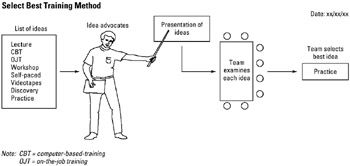
click to expand


Tool 94: Idea Borrowing

AKA 

N/A

Classification 

Idea Generting (IG)

Tool description

The idea borrowing technique allows team participants to bring to the surface ideas from inside and outside the organization or through their own creativity. Team-established criteria is used to rate and select the top-rated ideas considered for implementing.

Typical application

  • To surface best practices, technological innovations, and perceived good ideas.

  • To supplement brainstorming and benchmarking activities.

  • To stimulate the creativity of employees .

Problem-solving phase

Select and define problem or opportunity


Identify and analyze causes or potential change

Develop and plan possible solutions or change


Implement and evaluate solution or change


Measure and report solution or change results

Recognize and reward team efforts

Typically used by


Research/statistics

1

Creativity/innovation

2

Engineering


Project management


Manufacturing

4

Marketing/sales


Administration/documentation


Servicing/support


Customer/quality metrics

3

Change management

start sidebar
links to other tools

before

  • Information Needs Analysis

  • Benchmarking

  • Fresh Eye

  • Wildest Idea Technique

  • Mental imaging

after

  • Idea Advocate

  • Run-it-by

  • Creativity assessment

  • Why/how charting

  • Presentation

end sidebar

Notes and key points

  • Suggested idea selection criteria and scales :

    Source of Idea

    Potential Use

    Estimated Implementation Costs

    3 = Self (original)

    5 = High

    3 = Acceptable

    2 = Internal

    3 = Medium

    2 = Marginal

    1 = External

    1 = Low

    1 = Unacceptable

  • To select the best idea, multiply columns Source × Potential × Costs. Rank ideas: highest total = best idea.

Step-by-step procedure

  • STEP 1 The team facilitator reviews the idea borrowing technique with the team and answers any questions participants may have at this point.

  • STEP 2 Participants silently list their ideas on provided paper. Ideas may be best practices, innovations, untried employee suggestions, benchmarking discoveries, and so forth.

  • STEP 3 After some predetermined idea-generation time, the facilitator asks participants to share their ideas. All ideas are listed on a whiteboard or flip charts .

  • STEP 4 The team discusses all ideas and, through consensus, identifies the top 15–20 ideas. The facilitator prepares a matrix containing this final list of ideas. See example List of Ideas to Upgrade Employee Training.

  • STEP 5 Next, the team decides on a set of criteria and associated scales to be used to rate all ideas.

  • STEP 6 All ideas are rated and ranked in accordance with the established criteria, as shown in this example.

  • STEP 7 Finally, the team prepares a presentation for presenting the ideas to upper management.

Example of tool application

List of Ideas to Upgrade Employee Training

Description of Ideas

Source of Idea

Potential Use of Idea

Estimated Implementation Costs

Idea Selection

Total

Rank

Exchange and/or share trainers with other organizations

3

1

2

6

3

Ask employees to review the literature and present on contemporary topics

2

3

3

18

1

Make available internet access for technology update

1

5

1

5

4

Contract university faculty for special topic sessions

1

3

1

3

6

Engage recognized company subject matter experts to present on specific skill areas

1

5

3

15

2

Ask employees to team-develop their own training modules

2

1

2

4

5

Note: (1) Source

Potential

Cost

3 = self

5 = High

3 = acceptable

2 = internal

3 = medium

2 = marginal

1 = external

1 = low

1 = unacceptable

(2) Multiply columns: Source × Potential × Costs

(3) 18 highest total is best idea.


Six Sigma Tool Navigator(c) The Master Guide for Teams
Authors: Michalski W. J. King D. G.
Published year: 2005
Pages: 179-180/326
Buy this book on amazon.com >>

Similar books on Amazon