Approaching Design as an Artist
Character design is a very creative process andas with any creative processyou can approach it from a number of directions. Your particular approach will depend a lot on your strengths as an artist. Some people like to sketch, some like to sculpt, and some prefer to design directly on the computer. Each method has its advantages, but you do need to keep in mind that your final product will be modeled in 3D.
However it's created, a well-designed character oozes personality. Your characters should be well proportioned and appealing to the eye. Even the villain should be appealingparticularly if it is in a delightfully gruesome way. If the audience doesn't identify with the character in some way, they'll lose interest.
Character design can be done for its own sake, or it can be done to meet a specific need. Many artists design characters simply to create interesting images, often without a story or a purpose for the character in mind. Because a great character can inspire all sorts of stories, design sometimes precedes all other elements of a project.
In other situations, you'll have a specific reason to design a character: to work within an existing story or sell a product, for example. In these cases, it's best to learn a bit about the character that you'll be designing before you start brainstorming.
When you're working within the constraints of an existing story, form should follow function. Understanding your character's function in the story will help you decide what form it needs to take. You might want to write down some of the distinguishing characteristics of your characters. What's the character's age? Personality? Size? How does your character relate to the other characters in the story? Is there an existing style? All of these factors play a role in the character's final design.
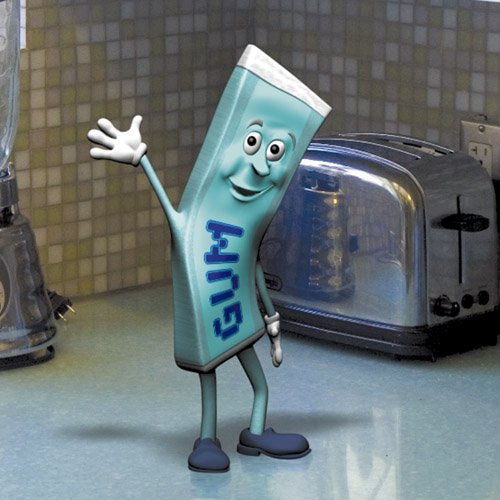
A character designed to sell a product may use the product itself as the starting point, such as this package of chewing gum.
The Creative Process
The design process always starts with creative inspiration, which is then refined and developed into a full character design. This design is typically a drawing or sculpture that describes the character in detail so it can be modeled digitally in 3D.
An explanation of the creative process could easily fill a separate book, but there are a few simple things you can do to tap into the creative side of your brain. Creativity is a flow of ideas that your brain connects in unexpected ways to form new ideas, and keeping these ideas flowing can be tricky. Any critique shuts down the creative flow, so try to avoid criticizing your work during the creative process. Critique is important, but should happen during revision, not creation.
Working in a medium you're comfortable with also helps. Sketching works well for me because it feels natural and I don't have to think about it. When I'm on the computer, things can get technical very quickly, which breaks the creative flow. Besides, pencils are fast and paper is cheap. It's much faster and more economical to generate ideas on paper than using a technical 3D application.
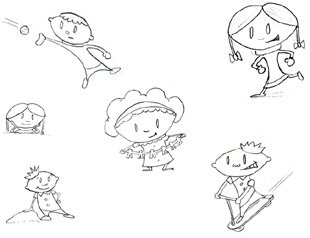
Idle sketches can inspire new character designs. Always be on the lookout for new ideas for characters.
Technical Considerations
As you design, you do need to keep technical considerations in mind. Someone designing for a game, for instance, will need to limit designs to a specific number of polygons so the game engine doesn't choke. This technical limitation fundamentally affects the design and forces it to stay simple. Adding details like realistic hair and clothing will create additional work, increasing the production budget and extending the schedule.
Use the strong points of your software to your advantage, and design around its limitations. Make sure your character is easy to deform and animate; a character that's hard to animate can blow a budget very quickly.
A solid understanding of the technical issues involved in 3D animation is gained through experience. When you're starting out, you'll probably need to ask a lot of questions of more experienced animators. For your own initial projects, it's best to keep your designs simple so you don't get bogged down in technical problems.
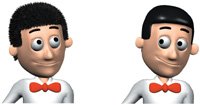
The simple hair on this character took a few minutes to render. These minutes can add up significantly when rendering a long scene. Changing the hair to a stylized design cut the render time down to a few seconds.
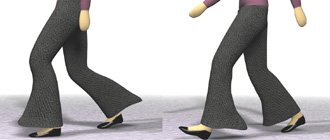
Realistic clothing can be another big technical challenge.
Using Reference
Good reference is always handy during the design process. Get outside into nature or look at other design, art, and film for inspiration. If you're designing a creature, you may want to take a trip to the zoo to find animals to use as reference. The Internet is also a terrific resource. A Google image search, for example, can produce all sorts of great reference images to use as inspiration.
Refining Your Design
Once you hit upon a good idea, you'll need to refine it into conceptual art, which then needs to be refined further into a final character design. You may need to redraw or resculpt the character many times before it works for the production. This is also the point where you need to ask whether the design is feasible in terms of budget and technical requirements.
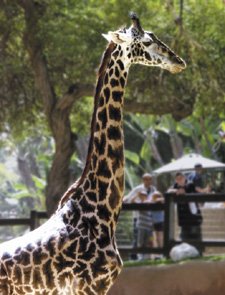
Designing a giraffe? A trip to the zoo with your camera or some Internet research can get you plenty of inspiration.
Chapter One. Basics of Character Design
- Chapter One. Basics of Character Design
- Approaching Design as an Artist
- Design Styles
- Designing a Character
- Finalizing Your Design
Chapter Two. Modeling Characters
Chapter Three. Rigging Characters
- Chapter Three. Rigging Characters
- Hierarchies and Character Animation
- Facial Rigging
- Mesh Deformation
- Refining Rigs
- Conclusion
Chapter Four. Basics of Animation
- Chapter Four. Basics of Animation
- Understanding Motion
- Animation Interfaces
- The Language of Movement
- Secondary Action
- Conclusion
Chapter Five. Creating Strong Poses
- Chapter Five. Creating Strong Poses
- Posing the Body Naturally
- Creating Appealing Poses
- Animating with Poses
- Conclusion
Chapter Six. Walking and Locomotion
- Chapter Six. Walking and Locomotion
- The Mechanics of Walking
- Animating Walks
- Beyond Walking
- Adding Personality to a Walk
- Transitions
- Conclusion
Chapter Seven. Facial and Dialogue Animation
Chapter Eight. Animal Motion
Chapter Nine. Acting
- Chapter Nine. Acting
- Acting Vs. Animating
- Acting and Story
- Acting Technique
- Acting and the Body
- Other Techniques
- Conclusion
Chapter Ten. Directing and Filmmaking

EAN: 2147483647
Pages: 84
