Codes, Standards, and Safety Practices
Codes, Standards, andSafety Practices
In this chapter, you will learn about the following
- The organizations that develop and publish residential wiring and safety standards.
- Residential wiring and safety standards and guidelines.
To protect a home from fire or other dangers related to its electrical and structured wiring, a variety of product, installation, and safety standards, guidelines, and practices are published by a number of trade, industry, and specialty organizations and associations. Many of these standards have been incorporated into local building codes, so they aren’t something that can be ignored.
In this chapter, I discuss the standards that impact the design and installation of structured wiring systems, including audio, speaker, video, and control wiring, as well as the safety practices that should be followed on a job site.
Residential Standards Organizations
The materials and practices used when installing structured wiring in a residential setting are developed by a group of industry, governmental, and trade organizations. The standards produced by these organizations are adopted to ensure the success and performance of electrical and communication systems and the safety of the technicians and the residents and occupants of buildings.
In this chapter, we first look at the organizations publishing residential system standards and then at the standards that govern the materials and practices that should be used when installing structured wiring and devices in a house. The organizations that develop and publish standards that cover the specification and installation of residential system wiring are
- American National Standards Institute (ANSI)
- Electronic Industries Alliance (EIA)
- Institute of Electrical and Electronic Engineers (IEEE)
- International Organization for Standardization (ISO)
- National Fire Protection Association (NFPA)
- Telecommunications Industry Association (TIA)
- Underwriters Laboratories, Inc. (UL)
- Occupational Safety and Health Association (OSHA)
American National Standards Institute (ANSI)
ANSI, pronounced “ann-see,” is an agency of the United States federal government that is charged with the responsibility of developing and approving standards that cover a variety of technology, including computers and data communications, and weights and measurements. ANSI is the U.S. representative to the International Organization for Standardization (ISO) that is the worldwide standards authority.
ANSI works with several other agencies to develop and publish (for a fee) its standards, including the Electronic Industries Alliance (EIA) and the Telecommunication Industry Association (TIA), and often publishes standards in conjunction with these independent trade organizations. Examples of jointly issued standards are the ANSI/TIA/EIA 568, 569, and 570 wire and cabling standards.
Electronic Industries Alliance (EIA)
EIA (“ee-eye-aa”) is an alliance of trade and industry associations that work together to sponsor and promote data communication standards. The member associations of the EIA are
- Consumer Electronics Association (CEA)
- Electronic Components, Assemblies, and Materials Association (ECA)
- Government Electronics and Information Technology Association (GEIA)
- National Science and Technology Education Partnership (NSTEP)
- Solid State and Semiconductor Technology Council of the Joint Electron Devices Engineering Council (JEDEC)
- Telecommunications Industry Association (TIA).
Most of the EIA standards that apply to residential wiring are issued jointly with ANSI and TIA, including the ANSI/EIA/TIA 568 and 570 standards.
Institute of Electrical and Electronic Engineers (IEEE)
The IEEE (“eye-triple-ee”) is a worldwide, technical, professional association of engineers that is a leading standards authority in a variety of technical areas that includes aerospace, biomedical, computer, electrical power, telecommunications, and consumer electronics engineering, and more. The IEEE has over 900 published standards with several hundred more in development.
The IEEE standards that most impact residential systems are its 802 computer networking standards. The number 802 refers to February 1980, which is when the committees working on networking standards were first organized. The IEEE 802 committees are numbered to differentiate their responsibilities and the standards each committee develops. Table 4-1 lists the committees of the IEEE 802 project and the networking specification associated with home networking each is charged with defining.
|
IEEE 802 Committee |
Responsibility |
|---|---|
|
802.1 |
Overall specification for a local area network (LAN) and LAN connectivity. |
|
802.2 |
Logical Link Control (LLC) standards that define the transmission of data from one device to another. |
|
802.3 |
Media Access Control (MAC) standards that define the control of access to a network – commonly referred to as the Ethernet standards. |
|
802.7 |
Defines broadband LANs, common to home networks. |
|
802.9 |
Defines the integration of voice and digital data on a network. |
|
802.10 |
Defines the standards for security between networked devices. |
|
802.11 |
Defines the standards for wireless infrared (IR) or radio frequency (RF) networks. |
|
802.15 |
Defines personal area networks (PANs) |
International Organization for Standardization (ISO)
The ISO (“eye-ess-oh”) is an international, non-treaty organization of voluntary members that develops and maintains a variety of technology standards, including standards governing computers, networking, and communications. In fact, the ISO’s Open System Interconnect Reference Model (the OSI model for short) is the globally accepted international networking standard model. The ISO is organized as a working network of the national standards authorities of 147 countries, including ANSI from the U.S.
An emerging standard of ISO is the residential gateway, which defines a network interface device that provides service access to a home for such services as telephone, cable television, and Internet access. The ISO standard defines a residential gateway (RG) as the physical devise that terminates all external access networks to a home and also serves to terminate all internal networks as well. The ISO’s RG Group sees a residential gateway as a single device that consolidates, coordinates, and integrates communication signals from both internal and external networks. The development of the RG standard by ISO and the International Electrotechnical Commission (IEC) is in conjunction with the proposed Home Electronic System (HES), also called HomeGate, now under development. The IEC is an international organization that publishes electrical and electronic compatibility, design, and safety standards.
National Fire Protection Association (NFPA)
The NFPA is an international association with well over 75,000 members representing more than 80 national trade and professional organizations that are focused on the development and publishing of fire safety codes, standards, and research to minimize the possibilities and impact of fire and other safety risks. In terms of home automation projects and structured wiring, the NFPA’s most important standard is the National Electrical Code (NEC), which was last published in 2002 and is scheduled for revision in 2005.
The NEC (also known as NFPA 70) is the most widely adopted building code component in the world, including the United States, for electrical installations. The NEC covers the installation of electrical conductors, including the wiring used in structured residential wiring systems.
Telecommunications Industry Association (TIA)
TIA is a trade organization of telecommunication product and service providers that among other industry activities, develops and publishes a variety of wire and media specifications and testing standards, including those for commercial and residential applications.
TIA is organized into five product-specific divisions: User Premises Equipment, Network Equipment, Wireless Communications, Fiber Optics, and Satellite Communications. The primary TIA standards that apply in home networking situations are those that govern Cat 5 wiring connections and testing, which are TIA/EIA 568 and 570.
Federal Communications Commission
The U.S. Federal Communications Commission (FCC) oversees the telecommunications industry through the issuance of regulations and operating rules. Two FCC rules apply to the installation of a home communication system:
- FCC Part 68This FCC rule (actually 47 C.F.R Part 68) governs the connection of terminal equipment, such as the network interface device (NID), to the Public Switched Telephone Network (PSTN) or other Telco facilities or equipment involved in providing private wire line services, as well as the technical rules for inside telephone system wiring. Although the technical and administrative activities of Part 68 have been delegated to the telephone service providers, the FCC still has the authority and responsibility to enforce these rules.
- FCC Docket 88-57These rules allow non-Telco companies or contractors to connect wiring and other devices to the Telco’s network. Before 1980, only Telco employees were permitted to service any lines connected to a Telco’s equipment or network, including inside wiring and jack. However, since the FCC issued Docket 88-57, customers and non-Telco contractors are permitted to connect to Telco lines and equipment. In fact, this rule transferred the responsibility for customer premise inside wiring (CPIW) from the Telco to the customer. As it stands now, unless otherwise contracted, the Telco’s responsibility ends at the NID or demarc.
Underwriters Laboratories (UL)
Perhaps the best known for product testing, UL is an independent, nonprofit product safety testing organization. Most cable and wire manufacturers voluntarily submit their products to UL for fire and electrical safety testing against the NEC and other NFPA standards.
Primarily, the testing performed by UL on cable and wiring is for compliance with Articles 725, 760, 800, and 820 of the NEC, which define the standards for communications, fire protection, and cable television wiring, respectively. A cable or other electric or electronic device bearing the UL logo is certified to meet the requirements of the applicable standards.
UL issues a variety of certification labels to certify conformance of wiring and electrical products to a variety of national and proprietary standards, including:
- “Listed” wire and cable productsWire and cable that are intended for use in residential, commercial, and industrial buildings and aren’t a part of another manufactured product and conform to the National Electrical Code (NEC) standards are classified as “listed” products by the UL. The marking used with this certification is shown in Figure 4-1, above.

Figure 4-1: The UL “Listed” product mark - Appliance Wiring Material (AWM) recognized wiring componentsThis certification indicates wire or cable that can be used for either internal or external wiring as a component of a product. The marking used with this certification is shown in Figure 4-2.

Figure 4-2: This UL mark on a cable certifies that it is in compliance with the AWM standards.
The UL also issues Canadian versions of these certifications that are based on the Canadian Standards Authority (CSA) using the C-UL recognized component mark. The CSA is a nonprofit, independent testing laboratory that performs essentially the same services in Canada as the UL provides in the U.S. An important wire and cable certification issued by the CSA is the vertical flame testing (FT1/FT4) certification that specifies the flame resistance of wire and cable. Conforming products are marked with the symbol shown in Figure 4-3.

Figure 4-3: The CSA certified product mark
Another standards testing certification is the Conformity to European Directive (CE) that covers virtually all of the same standards used by UL and CSA for products sold in the European Economic Community (EEC). Figure 4-4 shows the mark carried by CE certified products.
Figure 4-4: The CE certified product mark
Residential Systems Standards
There are several construction, safety practices, materials, and wiring standards that govern how a house is built, including wiring the house for electrical and communications systems. The primary standards a home technology technician should be familiar with are
- ANSI/EIA/TIA wiring standards
- IEEE Ethernet wire standards
- National Electrical Code (NEC)
- OSHA job safety practices
- International Building Code (IBC)
ANSI TIA EIA Standards
The standards that are jointly sponsored by ANSI, the TIA, and the EIA cover a variety of cabling and cable installation requirements. However, the specific standards that come into play in home systems are those dealing with data, audio, video, and other cabling and termination, particularly ANSI/TIA/EIA 568a and 568b and ANSI/TIA/EIA 570.
ANSI/TIA/EIA 568
The 568 standard is the Commercial Building Telecommunications Cabling Standard. Although this standard was initially developed for commercial building telephone and data cabling systems, it is also the accepted standard for data cabling in a home setting as well.
The purpose of these standards is to provide the specification for generic telecommunication cabling and to assist technicians with the planning and installation of telecommunication cable. These standards also prescribe the performance testing criteria for standard system configurations and their components. Specifically, the 568 standards specify the component elements used in designing and installing the following home cabling types:
- Horizontal cableThe 568 standards call for cabling running horizontally through a building to be installed using a star topology (see Chapter 10) with each room cable connected back to a central distribution facility or distribution panel. Horizontal cabling runs should not exceed 90 meters (approximately 295 feet), which should be adequate for virtually any home network requirements. An additional 10 meters (just under 30 feet) can also be used for patch cabling and connector cords.
There are other horizontal cabling requirements as well. At least two connector outlets should be installed in each work area (room). In addition, Cat 5 wire should not be untwisted (for termination purposes) more than one-half inch and the bend radius of the cable should never be less than four times the cable’s diameter.
- Central distribution facility or telecommunications closetA distribution or integration device, if used, must conform to ANSI/EIA/TIA 569, which virtually all distribution devices do. The distribution panel’s function is to terminate and interconnect the horizontal cabling.
UTP Cabling Systems
The 568 standards also specify the UTP cabling categories that are acceptable for use as horizontal cabling and patch cords. Table 4-2 lists the characteristics for the UTP cabling that is acceptable for use as horizontal cabling.
|
Category |
Bandwidth |
Wire Pairs |
Maximum Segment Length |
LAN Applications |
|---|---|---|---|---|
|
Cat3 |
16 MHz |
2 |
100 meters |
10BaseT, 4 Mbps |
|
Cat4 |
20 MHz |
2 |
100 meters |
16 Mbps, Token Ring |
|
Cat5 |
100 MHz |
4 |
100 meters |
100BaseT, ATM, CDDI |
|
Cat5e |
100 MHz |
4 |
100 meters |
1000BaseT |
Cat 5 wire is the most commonly used cabling on Ethernet and Token Ring networks. However, while Cat 5 wiring is required for 100 Mbps networks, how the cable is installed can have a huge impact on whether or not the cable will actually support that much bandwidth.
Three specific and very important guidelines are as follows:
- Only 0.5 inch of untwisted wiring at each end of the cable (to avoid near and far near crosstalk)
- No bends in the cable in excess of a 1.25-inch bend radius (in other words, no kinks)
- Cable was not stressed beyond 25 pounds of pull during installation (stretching the cable removes twists)
568a and 568b Standards
Within the 568 standard are two separate cable termination standards for UPT cabling: 568a and 568b. Each of the termination standards prescribes the wires in a UTP cable that are to be connected to specific pins on an RJ-45 connector. Which of the two termination standards are used depends on the intended use of the cable. The basic difference between these standards is that the 568a specification can be used for both voice and data transmission and 568b is more suitable for data transmission only.
Tables 4-3 and 4-4 show the RJ-45 plug pin and wire match-ups for 568a and 568b, respectively.
|
End 1 Pin |
Wire |
End 2 Pin |
|---|---|---|
|
1 |
White green |
1 |
|
2 |
Green |
2 |
|
3 |
White orange |
3 |
|
4 |
Blue |
4 |
|
5 |
White blue |
5 |
|
6 |
Orange |
6 |
|
7 |
White brown |
7 |
|
8 |
Brown |
8 |
|
End 1 Pin |
Wire |
End 2 Pin |
|---|---|---|
|
1 |
White orange |
1 |
|
2 |
Orange |
2 |
|
3 |
White green |
3 |
|
4 |
Blue |
4 |
|
5 |
White blue |
5 |
|
6 |
Green |
6 |
|
7 |
White brown |
7 |
|
8 |
Brown |
8 |
The 568 standards also specify IDC (Insulation Displacement Connector) connectors at the distribution or telecommunications center and an 8-position modular jack in the work area (rooms of the house), which means an RJ-45 connector. These standards also specify two distinct wire/connector pinouts, which are identified as 568a and 568b. The primary difference between the two is that 568a supports telecommunications (meaning voice telephone signals) and 568b doesn’t. Figures 4-5 and 4-6 show the pin/wire pattern (pinout) for these two standards.
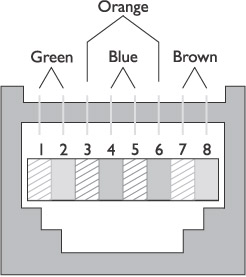
Figure 4-5: The pinout (wire and connector pin pattern) defined by ANSI/EIA/TIA 568a for UTP cabling
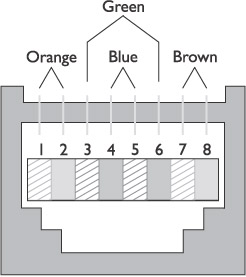
Figure 4-6: The pinout defined by ANSI/EIA/TIA 568b for UTP cabling
ANSI TIA EIA 569
The 569 standard deals with telecommunications design and installation of devices used inside and between buildings and for rooms or work areas where cable media and equipment are installed. This standard applies to home networking situations where a central distribution facility is installed and defines the construction and termination method used for horizontal cabling connected into distribution panels.
TIA EIA 570A
The 570 standard defines the basic requirements for residential structured wiring. This standard was developed by a panel of cabling experts that included cable professionals, telephone companies, cable system manufacturers, and the like. It is the nationally accepted standard covering the design and installation of low voltage wiring in residential dwellings.
However, the primary achievement of the 570 standard is that it consolidates the specifications, installation practices, and performance criteria for the media used in audio, control, data, and video systems into a single conformance standard.
The 570 standard defines the following specifications:
- Grades of houses and residential buildings
- Wiring topologies
- Twisted pair, coaxial, and fiber optic cabling
- Termination and connector jacks and plugs
- Installation and testing procedures and performance criteria
One of the specific areas of specification in the 570 standard is in communication outlets. The 570 standard defines two standard grades for communication outlets:
- Grade 1This grade specifies a cable that combines UTP Cat 3 with an RG6 coaxial cable for providing basic telephone and video services to each outlet.
- Grade 2This grade specifies cabling that combines two Cat 5e UTP with two RG6 coaxial cables and an optional two-strand fiber optic cable for providing enhanced voice, video, and data services to each outlet.
IEEE Ethernet Cable Standards
The IEEE 802 standards designate cabling standards for use on an Ethernet network with a special coding scheme that generally describes a cable’s characteristics. The most common of the Ethernet cable specifications are listed in Table 4-5.
|
Ethernet Cable Standard |
Cable Defined by Standard |
Minimum Cable Type |
|---|---|---|
|
10Base2 |
10 Mbps thin coaxial network cable |
50-ohm RG-58 coaxial cable |
|
10BaseT |
10 Mbps unshielded twisted-pair network cable |
Cat 3 unshielded twisted pair (UTP) |
|
100BaseT |
100 Mbps unshielded twisted-pair network cable |
Cat 5 UTP |
|
100BaseF |
100 Mbps fiber optic network cable |
Single-mode optical fiber |
|
1000BaseT |
1Gbps copper cable |
Cat 5e UTP |
|
1000BaseF |
1Gbps fiber optic cable |
Multimode optical fiber |
The coding scheme shown in Table 4-5 has three parts to it: a number (10/100/1000), the word “Base,” and a number or letter indicating the media type (2, T, F, and X). For example, 10BaseT, 100BaseT, and 1000BaseT all specify cables that carry 10 Mbps, 100 Mbps, and 1 Gbps (1,000 Mbps) of bandwidth, respectively.
The word “Base” indicates that baseband signaling is used to transmit the data, as opposed to narrowband or broadband. Baseband is a network technology that sends its data over a single carrier frequency. Baseband networks require all nodes to participate in every message sent over the network.
The final part to the cable specification designator is one or two characters that indicate a variety of information, depending on the cable and its speed. In the case of 10Base2, the “2” indicates a maximum segment length of approximately 200 meters (actually it’s 185 meters). Cables may also have a T or an F, which refer to twisted-pair wire and fiber optic cable, respectively.
The IEEE 802 specification includes standards for wireless networking media as well. The primary two standards in the IEEE 802 are 802.11, which deals with wireless Ethernet, and 802.15, which deals with wireless personal area networking (PAN). I discuss the wireless media standards later in the chapter.
National Electric Code (NEC)
The National Electric Code, or NEC, is a trademarked standard. It is also known as NFPA 70 and is published by the National Fire Protection Association (NFPA) as a guideline to avoid and prevent electrical shock and fire hazards from residential wiring systems. The NEC is published periodically and the current (at the time of this writing) version of the standard is 2002, with the next updated version due in 2005.
There is essentially an NEC standard for every electrical circuit in a home. Most of the NEC standards cover electrical power circuits, but there are also sections that govern communications media and the transmission of electrical signals over that media. To give you an idea of the extensiveness of the NEC standards, we have listed a sampling of the NEC standards that could impact a structured wiring system in Table 4-6.
|
NEC Section |
Applies To |
|---|---|
|
250-104 |
Using water pipes as grounding conductors |
|
300-4 |
Size of bored holes in joists, rafters, or wall studs |
|
300-15 |
Wire splices |
|
300-22 |
Type NM cable used in HVAC cold air returns |
|
336-18 |
Non-metallic cable (Type NM) |
|
370-16 |
Outlet box volume and size |
|
370-23 |
Electrical boxes |
|
370-25 |
Outlet box covers |
|
410-8 |
Lighting fixtures in clothes closets |
Job Safety Regulations
Virtually every industrialized country in the world has a governmental agency that creates, publishes, and administers job safety and health codes and regulations. In the United States, the agency is the Occupational Safety and Health Administration (OSHA) of the U.S. Department of Labor. In Canada, the Human Resources Development Canada (HRDC) has this responsibility; in England, the government’s Health and Safety Executive (HSE) oversees job safety; and in Japan, the Japan Occupational Safety and Health Office (JOSHO) administers worker safety issues.
Working in an alliance with the National Home Builders Association (NHBA), OSHA has developed and published a Code for Federal Regulations (CFR) specifically addressing job safety issues for construction trades, entitled “Selected Construction Regulations (SCOR) for the Home Building Industry (29 CFR 1926).” Table 4-7 lists a few of the section titles included in this section of the OSHA codes.
|
Section |
Topic |
|---|---|
|
1926.20 |
General safety and health provisions |
|
1926.23 |
First aid and medical attention |
|
1926.24 |
Fire protection and prevention |
|
1926.28 |
Personal protective equipment |
|
1926.55 |
Gases, vapors, fumes, dusts, and mists |
|
1926.102 |
Eye and face protection |
|
1926.302 |
Power-operated hand tools |
|
1926.400 |
Electrical – General |
|
1926.404 |
Wiring design and protection |
|
1926.405 |
Wiring methods, components, and equipment for general use |
|
1926.417 |
Lockout and tagging of circuits |
OSHA and NHBA Job Safety Standards
The National Homebuilders Association (NHBA) in conjunction with OSHA publishes the Jobsite Safety Handbook, something that all home automation professionals should be very familiar with. In fact, if you are considering CEDIA certification, it is a must-read before taking the exams.
The portion of the handbook that relates directly to the work of a home technology integration or home automation professional is the “Electrical” section, which includes safety guidelines that cover how to work with electrical and electronic systems safely. The safety guidelines cover the following:
- Working on new or existing electrical circuits only after all power is shut off
- Maintaining electrical tools in a safe working condition that is free of defects
- Using a Ground Fault Circuit Interrupter (GFCI) with all temporary power sources and connecting cords
- Being aware of all overhead and underground electrical power lines and handling tools and equipment around them
Building Codes
In the not-so-distant past, many countries had their own version of a national or uniform building code aimed at protecting the health, safety, and welfare of the public, which means homeowners or occupants. Prior to 1999, the International Conference of Building Officials (ICBO) published the Uniform Building Code (UBC). However, in 2000, the ICBO joined with the International Codes Council to publish a single guideline called the International Building Code (IBC).
The intent of the IBC is to ensure that a building’s occupants are protected from fire and structural collapse by developing construction material and practice guidelines that provide for proper design, construction, and code compliance. Another important part of the IBC is to provide uniformity in the construction industry worldwide, including consistent minimum quality, durability, and safety in constructed buildings.
Local Building Codes and Standards
Each state, province, county, parish, shire, city, town, and township can, and most do, develop local building codes that incorporate or extend the national and international building, product, and safety codes and regulations.
For example, in its “Computing and Telecommunications Architecture Standards for Building Wiring,” the State of Washington includes the standards listed in Table 4-8, among others, as the basis for its regulations.
|
Wiring Standard |
Description |
|---|---|
|
TIA/EIA-568A |
Commercial Building Telecommunications Wiring Standard |
|
TIA/EIA-569A |
Commercial Building Standard for Telecommunications Pathways and Services |
|
TIA/EIA-570A |
Residential and Light Commercial Telecommunications Wiring Standard |
|
TIA/EIA 594 |
Private Digital Network Synchronization |
|
TIA/EIA 596 |
Network Channel Terminating Equipment for Switched Digital Devices |
|
TIA/EIA-606 |
Administration Standard for Telecommunications Infrastructure of Commercial Buildings |
|
TIA/EIA TSB 67 |
Transmission Performance Specifications for Testing UTP Cabling Systems |
|
TIA/EIA TSB 75 |
Additional Horizontal Cabling Practices Open Offices |
|
TIA/EIA TSB 95 |
Additional Transmission Performance Guidelines for 4-pair 100 Ohm Category 5 Cabling |
Powerline Standards
The term “powerline” is used frequently to describe the electric lines inside the walls of a home. Technically, “powerline” refers to the system used by most electric utility companies to transmit information across their electrical power grid using narrowband communications. The powerline technology is now available for use with home networks to transmit data across the existing electrical wiring.
When you think about it, powerline technology makes a lot of sense. If you are introducing a network into a home, there are already more electrical outlets installed than the number of Ethernet jacks you’d need to install. Powerline technology is a very low-cost alternative to wiring a home with Cat 5 wiring.
There are three primary standards for powerline technology:
- CEBus (Consumer Electronic Bus)This media standard is defined in the EIA 600 standard and provides for communication and control networks using powerline and also for a variety of media, including UTP, coaxial, fiber optic, infrared, and radio frequency. The CEBus standard is implemented through devices that have adopted the CEBus Home Plug and Play standard that allows CEBus devices to communicate directly with each other without the need for a separate controller.
- HomePlugThis powerline technology is the result of an association of networking manufacturers (The HomePlug Alliance) wishing to perform Ethernet functions over the electrical lines in a home. HomePlug is not technically a certified standard, but almost 100 manufacturers now support it, including some heavies such as Linksys and NetGear. HomePlug operates at a maximum of 14 Mbps currently, but development is underway to increase the data speed of this system.
- X-10This powerline technology has been around for some time and is available from a variety of home automation vendors. X-10 uses a controller device to signal a remote device, such as a PC sending a signal over the electrical wiring of a home to a particular electrical outlet to turn on the power to a lamp. X-10 supports baud rates (yes, just like older modems) of 1200 to 38400. X-10 is a full-duplex system, which is actually bad news. Any X-10 device can send a signal at any time, which means that collisions do occur and on occasion, control signals or responses can be lost, without a recovery methodology. X-10 technology is typically used only for residential control networks and is not commonly used for data networking.
Phoneline Standards
In a similar manner to the way that powerline technologies use the existing electrical lines in a home to transmit data, phone line communications technologies use the existing telephone wiring in the walls of a home to communicate.
The leading technology of phone line communications is the standard developed by the Home PhoneLine Networking Association (HPNA). Many vendors, including several also supporting powerline communications, are supporting this standard as well. HPNA currently operates at 10 Mbps and can coexist with DSL systems that may also be on the phone lines.
Wireless Media Standards
Another network media choice available is wireless networking and it eliminates the concern for wiring altogether. However, there are pros and cons for each media so each should be carefully considered before choosing it as a networking solution. The primary wireless media standards are as follows:
- IEEE 802.11aThis wireless networking standard defines a radio frequency technology in the 5-gigahertz (GHz) band that offers very high bandwidth (as much as 54 Mbps) over short distances, which makes it a good choice for home audio/video networks.
- IEEE 802.11bThis is the most common of the wireless networking standards in use today. Virtually every wireless network gateway, access point, or PC Card produced is based on one variation of 802.11b or another. This standard defines a 10 Mbps Ethernet network operating over a radio frequency technology in the 2.4 GHz band.
- IEEE 802.11gThis standard complements the 802.11a standards by adding an additional three channels in the 2.4 GHz band to increase bandwidth.
- BluetoothBluetooth is a radio frequency personal area networking (PAN) standard emerging from the cellular telephone industry. The benefit of Bluetooth, named after an ancient warrior king of Sweden, is that it is self-discovering and self-configuring among Bluetooth-capable devices, which means that you can roam freely within a Bluetooth area, and when you leave one server’s range, another automatically picks you up. At the present, this is not a totally viable option for whole-house networking due to the lack of compatible products. However, as products are developed, its 10-meter range limit seems to be well-suited for many home networks.
- HomeRFThis is a radio frequency technology developed specifically for use in wireless home networking. The recently announced HomeRF 2.0 standard has received some strong support and products may soon be available, something that has hindered its adoption in the past.
Other Standards
In the preceding sections, I discussed the primary standards that cover the design, installation, termination, and testing for the media included in a home’s structured wiring. However, there are several other standards that apply to the applications and technologies implemented across the wiring. Table 4-9 lists a sampling of other standards and standards organizations that could apply to a whole-house networking implementation, depending on the applications it supports.
|
Organization |
Standard |
Description |
|---|---|---|
|
EIA |
EIA-600 |
CEBus powerline networking |
|
CIC |
HomePnP |
Home Plug-and-Play |
|
Cable Labs |
DOCSIS |
Data Over Cable Service Interface Specification |
|
TIA |
TR41.5 |
Residential Gateway |
|
IEEE |
IEEE 1394 |
Standard version of high-speed interface, implemented by Apple Computer as FireWire |
|
VESA |
VESA Home Network |
High-speed whole-house baseband networking using IEEE 1394 |
|
HAVi Consortium |
Home Audio Video interface |
Digital AV networking interface standard |
|
HomeAPI Working Group |
HomeAPI |
Programming routines for residential control systems |
Review
The organizations that develop and publish the primary standards covering the specification and installation of residential system wiring are: ANSI, EIA, IEEE, ISO, NFPA, TIA, UL, and OSHA.
ANSI is an agency of the United States federal government that is charged with the responsibility of developing and approving standards that cover a variety of technology, including computers and data communications, and weights and measurements. ANSI works with other agencies to develop and publish standards. Examples of jointly issued standards are the ANSI/TIA/EIA 568, 569, and 570 wire and cabling standards.
EIA is an alliance of trade and industry associations that work together to sponsor and promote data communication standards. Most of the EIA standards that apply to residential wiring are issued jointly with ANSI and TIA, including the ANSI/EIA/TIA 568 and 570 standards.
The IEEE is a worldwide, technical, professional association of engineers that is a leading standards authority in a variety of technical areas. The IEEE standards include the 802 computer networking standards.
The ISO is an international, non-treaty organization of voluntary members that develops and maintains a variety of technology standards, including standards governing computers, networking, and communications. An emerging standard of ISO is the residential gateway, which defines a network interface device that provides service access to a home for such services as telephone, cable television, and Internet access.
The NFPA is an international association focused on the development and publishing of fire safety codes, standards, and research to minimize the possibilities and impact of fire and other safety risks. The NFPA publishes the National Electrical Code (NEC), which includes coverage for the installation of electrical conductors, including the wiring used in structured residential wiring systems.
TIA is a trade organization of telecommunication product and service providers that develops and publishes a variety of wire and media specifications and testing standards for residential applications. The TIA/EIA 568 and 570 standards govern Cat 5 wiring connections and testing for home networking installations.
UL is an independent, nonprofit product safety testing organization that tests cable and wire products for fire and electrical safety testing against the NEC and other NFPA standards.
The primary home technology standards are ANSI/EIA/TIA wiring standards, IEEE Ethernet wire standards, the NEC, the OSHA job safety practices, and the International Building Code (IBC).
The ANSI/EIA/TIA 568 standard provides specification for generic telecommunication cabling that prescribe the performance testing criteria for standard system configurations and their components. The 568 standards specify horizontal cable, work area or room cabling, and central distribution termination. The 568 standards also specify the UTP cabling categories for use as horizontal cabling and patch cords.
The 568 standard defines two separate cable termination standards for UPT cabling: 568a and 568b. The 568 standards also specify IDC (Insulation Displacement Connector) connectors at the distribution or telecommunications center and the use of the RJ-45 connector.
The EIA/TIA 570 standard defines the basic requirements for residential structured wiring and is the nationally accepted standard covering the design and installation of low voltage wiring in residential dwellings.
The IEEE 802 standards designate network media standards for use on an Ethernet network with a special coding scheme that generally describes a media’s characteristics. The National Fire Protection Association (NFPA) publishes the National Electric Code (NEC) as a guideline to avoid and prevent electrical shock and fire hazards from residential wiring systems.
Each country has a governmental agency that publishes job safety and health codes and regulations. In the United States, it’s the Occupational Safety and Health Administration (OSHA); in Canada, it’s the Human Resources Development Canada (HRDC); in England, it’s the Health and Safety Executive (HSE); and in Japan, it’s the Japan Occupational Safety and Health Office (JOSHO). OSHA publishes the “Selected Construction Regulations (SCOR) for the Home Building Industry (29 CFR 1926).”
The term “powerline” describes the use of the electrical lines inside a home’s walls to transmit information. The three primary standards for powerline technology are CEBus, HomePlug, and X-10. Phoneline communications technologies use the existing telephone wiring or coaxial cable in the walls of a home to communicate. The leading phoneline standard is the Home PhoneLine Networking Association (HPNA) standard. The primary wireless media standards are IEEE 802.11a, IEEE 802.11b, Bluetooth, and HomeRF.
Questions
- Which of the following is not a standards organization listed in this chapter?
- ANSI
- EIA
- NEA
- NFPA
- Which of the IEEE 802 standards is considered to be the Ethernet standard?
- IEEE 802.1
- IEEE 802.3
- IEEE 802.5
- IEEE 802.15
- What organization publishes the NEC?
- ANSI
- ICC
- EIA
- NFPA
- What is the EIA/TIA standard that governs Cat 5 wiring connections?
- 232
- 402
- 568
- 570
- Which of the UTP cable categories is recommended as 100BaseT media?
- Cat 2
- Cat 3
- Cat 4
- Cat 5
- Which of the following lists the 568b pinout sequence of the wire colors from Pin 1 to 8?
- White green, green, white orange, blue, white blue, orange, white brown, brown
- White green, blue, white blue, green, white orange, orange, white brown, brown
- White orange, orange, white green, blue, white blue, green, white brown, brown
- White green, blue, white blue, green, white brown, brown, white orange, orange
- What is the TIA/EIA standard that specifies residential structured wiring?
- 568a
- 568b
- 570
- 802
- In the term 10BaseT, what does the “Base” refer to?
- Broadband
- Baseband
- Narrowband
- Base rate interface
- Which of the IEEE 802 network standards defines wireless Ethernet standards?
- 802.3
- 802.10
- 802.11
- 802.15
- What government agency publishes the “Selected Construction Regulations (SCOR) for the Home Building Industry (29 CFR 1926)”?
- Occupational Safety and Health Administration (OSHA)
- Department of Agriculture
- Housing and Urban Development (HUD)
- American National Standards Institute (ANSI)
Answers
- D. The National Education Association doesn’t publish home wiring system standards.
- B. The other standards listed are for LAN connectivity, Token Ring networks, and personal area networks, respectively.
- D. The National Fire Protection Association publishes the NEC approximately every 3-4 years.
- C. Actually there are two standards, the 568a and the 568b.
- D. Cat 2 isn’t used for networking. Cat 3 and Cat 4 are recommended for 10BaseT and Token Ring networks.
- C. The difference between the 568a and 568b is the placement of only one pair.
- C. The 568 standards deal with UTP cable and its termination, and the 802 standards are published by IEEE.
- B. Baseband refers to the fact that the cable media is able to carry only a single signal.
- C. The other 802 standards deal with Ethernet media access, metropolitan area networking (MAN), and personal area networking (PAN), respectively.
- A. This agency is charged with issuing worker and workplace safety standards and practices.
Part I - Home Technology Installation Basics
- Wire and Cable Basics
- Connector Types and Uses
- Wiring Installation Practices
- Codes, Standards, and Safety Practices
Part II - Structured Wiring
- Infrastructure Wiring Basics
- Planning a Structured Wiring Installation
- Rough-In Installation
- Trim-Out Installation
- Troubleshooting Structured Wiring
Part III - Home Computer Networks
- Computer Network Basics
- Computer Network Hardware
- Computer Network Software
- Designing and Installing a Computer Network
- Troubleshooting a Home Network
Part IV - Audio/Video Systems
- Distributed Audio System Basics
- Designing and Installing Distributed Audio Systems
- Distributed Video Basics
- Designing and Installing Distributed Video Systems
- Troubleshooting Audio Systems
- Troubleshooting Video Systems
Part V. Home Lighting Management Systems
- Home Lighting Basics
- Home Lighting Devices
- Designing a Home Lighting Control System
- Installing a Home Lighting Control System
- Troubleshooting and Maintaining Lighting Control Systems
Part VI - Telecommunications
- Home Communication System Basics
- Designing and Installing a Home Telephone System
- Troubleshooting a Home Communication System
Part VII - HVAC and Water Management
Part VIII - Security System Basics
- Security System Basics
- Designing a Home Security System
- Installing a Home Security System
- Troubleshooting and Maintaining a Home Security System
- Home Security Surveillance Systems
- Home Access Control Systems
Part IX - Home Technology Integration
- Defining Users Needs and Desires
- User Interfaces
- Home Automation Controllers
- Programming
- Integrating the Connected Home
- Other Home Technology Integration Devices
Part X - Appendices

EAN: N/A
Pages: 300
- Chapter IV How Consumers Think About Interactive Aspects of Web Advertising
- Chapter VIII Personalization Systems and Their Deployment as Web Site Interface Design Decisions
- Chapter XI User Satisfaction with Web Portals: An Empirical Study
- Chapter XIV Product Catalog and Shopping Cart Effective Design
- Chapter XV Customer Trust in Online Commerce
