Troubleshooting and Maintaining a Home Security System
Troubleshooting andMaintaining a Home Security System
In this chapter, you will learn about
- Preventing false alarms
- Troubleshooting home security systems
- Maintaining a home security system
In order for a home security system to function properly, it must be properly maintained. Even more than most other home systems, a security system is one that the homeowner must be able to depend upon. For the most part, a security system is rarely activated, and most homeowners hope it is actually never needed. However, if or when an intruder attempts to gain access to a home, the security system must function properly.
The key to a reliable security system is regular preventive maintenance and testing, and these procedures are the focus of this chapter.
False Alarms
The single most important issue for a homeowner and a home security system is false alarms and preventing them. However, on some systems, there can be a fine balance between a system that provides immediate detection and activation in the event of a home security breach and one that sets off frequent and costly false alarms. In many cities and counties, false alarms are not only embarrassing for the homeowner, but they can also be expensive.
In an effort to deter false alarms, especially for alarms systems monitored where emergency services are called, many communities have passed ordinances that levy escalating fines for multiple false alarm offenders to offset the cost to the community for providing these response services. The solution is to prevent false alarms with a well-defined and regularly performed maintenance and testing program.
There are many causes for false alarms, including:
- User errors
- Power or battery problems
- Ill-fitted, misaligned, or improperly placed sensors and contacts
- Malfunctioning detection devices
- Sensors not configured for pets or children
- Heating, Ventilating, Air Conditioning (HVAC) vents or air drafts that cause light objects to move
User Errors
More than two-thirds of all false alarms are caused by user errors that can include operating the system improperly and forgetting the access codes. Another major reason for a sudden rash of false alarms from a system can be caused by changes to the home, such as guests visiting, the addition of a new family member or pet, or remodeling doors, floors, windows, or ceilings.
The homeowner should train the new family member or houseguest on the use of the security system. In addition, the homeowner may contact his security system provider whenever these or other changes occur to the home. He should also contact the security system provider and request a “visitor” user code be set up when keys are given to outsiders or he plans to put the house up for sale.
Some municipalities require a home security system be inspected and tested by a certified (licensed) technician no less than once a year, with some requiring semi-annual inspections and testing. During the annual or semi-annual inspection, maintenance, and testing, the homeowner should be given a fresh orientation to the system, with emphasis placed on any user-error caused false alarms since the last visit.
The user should also be advised on how to prevent future false alarms. This includes what to check before activating the alarm system, including locking all protected doors and windows and keeping pets, plants, balloons, holiday decorations, and the like out of the scanning field of a motion detector or sensor.
Power or Battery Issues
A security sensor or contact that is intermittently reporting false alarms (also called positives) may have power or continuity issues caused by cable or wire problems. Passive security devices receive power from their primary wiring from the security control panel. Active security devices require an independent power source that is typically supplied through a power supply or battery. A device with faulty wiring or an active device with the wrong type of battery installed may cause false positive signals to be transmitted to the security system controller.
Misaligned Sensors or Contacts
A window or door contact that is even slightly misaligned may generate a false alarm even if the window or door is closed and locked. A window or door that is not completely closed and locked in the position where its contact was aligned can create this situation. This problem can also be caused by a window or door warping or otherwise changing its fit. All doors and windows should be closed completely and locked before the alarm system is activated.
Motion sensors can generate false alarms if they are in view of outdoor activities that could trigger them. Be sure the line-of-sight of a motion sensor is clear of any unwanted motion.
Sensors and detectors can also generate false alarms if they are placed too closely to some normal activities in a home. For example, if a smoke detector is located directly above a stove after a kitchen remodeling, it can generate false smoke alarms.
Malfunctioning Detection Devices
Detection devices have been known to fail over time. When they do fail, they can stop functioning completely or function intermittently and cause random false alarms. Hopefully these are caught during routine maintenance checking. Replace the device in question and this should rectify the false alarm problem. It is a good rule to replace carbon monoxide detectors every three to four years as their performance deteriorates over time.
Pets and Children
Motion sensors can be configured to avoid signaling an alarm event for small children and pets. If this setting is overlooked during installation or incorrectly set originally or incorrectly reset by the homeowner, the sensor can generate a false alarm. When installing motion sensors with adjustable viewing, be sure to set these up per the manufacturer’s instructions and test extensively from all angles of view of the motion sensor.
Moving Objects
If the placement of motion sensors does not take into consideration the location of HVAC vents or ceiling or room fans, the movement of an object, such as a houseplant or curtain, may set off an alarm from a motion detector. Or perhaps the motion detector was not properly aligned to avoid these objects during its installation. In either case, the motion sensor could be generating false alarms that may not be easily resolved if the cause isn’t happening during an investigation. Watch out for helium balloons often given as a greeting of “Happy Birthday” or “Get Well Soon” as these rise and fall with the change of temperature in a room and are an unwanted easy target for a motion sensor.
Lost Setup on the Security System Controller
The security system panel is programmed to know the types and names of the security zones. In addition, it is programmed to know all of the user codes and other system setup variables. If any of this information is lost in the memory of the system, false alarms can easily occur as zone types and setups usually default to factory settings. If this is the problem, it usually will be revealed at the keypad because programmed names no longer appear. A prolonged loss of power may be the cause if the battery life is exhausted. To correct this, restore power to the system and reprogram it or download a saved setup of the programming. Many systems now have remote access capabilities and the security system provider can phone the home and download this information.
Troubleshooting a Home Security System
When troubleshooting a home security system, you must first determine whether the problem is being caused by one of the four major areas of a security system:
- Contacts, sensors, or detectors
- The security system controller
- The wiring
- The interface to the telephone system
One of the better ways to pinpoint a fault on a home security system is to completely retest the system using the same procedure used during the trim out of the system (see Chapter 33). Once you have isolated the room or zone where the problem is occurring, you can then begin to focus on the security devices in that area.
Troubleshooting Contacts, Sensors, and Detectors
If you suspect that a home security system problem is being caused by a contact or sensor, you should check the alignment, fit, cleanliness, and wiring of the device to ensure that they haven’t changed since installation.
| Note |
A quick way to check the wiring connecting any contact, sensor, or detector device to a control panel or system controller is to replace it with a known-good device. If the known-good device fails, the problem is likely in the wiring; otherwise, if the known-good device works as it should, the problem is the failure of the original device. |
Door and Window Contacts
The alignment of the two halves of a door or window contact sensor is crucial to its proper operation. If the contacts do not line up properly (see Chapters 31, 32, and 33), the electromagnetic functions of the sensor may not work properly. The misalignment of door and window contacts can be caused by the door or window becoming warped or sagging on its hinges or frame. The contacts may have been bent, moved, or knocked off by a hit or struck with some force. These conditions should be easily spotted with a visual inspection. The remedies are to realign, reinstall, or replace the contact to its correct position.
As a part of a visual inspection, check the contacts for corrosion and cleanliness. If the contact has been subjected to moisture, it is possible the contact face has become corroded or perhaps even shorted out. The contacts should be cleaned using denatured alcohol (isopropyl alcohol) and a lint-free cloth in any case and retested.
If you or your company did not install the security system, you should also check that the contacts are wired properly. Normally Closed (NC) contacts are typically wired in series, and Normally Open (NO) contacts are typically wired in parallel. Also verify that the wiring to each contact is correctly attached using proper wiring methods, and that the appropriate wire types were installed.
To test NC contacts wired in series, the contacts should be tested in sequence, starting with all but the first contact disconnected from the wiring. After each contact is tested (and all is well), the next contact in line should be added back to the system and tested, until all contacts are reconnected and tested. Any defective contacts should be replaced.
Motion Sensors
The first step in troubleshooting a motion sensor is to verify its line-of-sight or scanning field. Objects such as curtains, draperies, art, or plants may be moving because of airflow in the room. The airflow may be from a window that is regularly open or even an HVAC system vent. Perhaps the swing of a door into the room was overlooked during installation and is blocking the view of the sensor or the sensor is set too high or too low to properly detect unusual motion in its room.
If the scanning field of the sensor is unobstructed and properly set, the next thing to check is the power. If the sensor is an active device, verify that its power light-emitting diode (LED) is on. If the power indicator is not on, check the device’s power source, especially if the device uses an alternating current/direct current (AC/DC) converter, to ensure it is snugly plugged into an AC outlet. (Some AC/DC converters are too heavy for the AC connectors and can fall out of the socket.)
If the device is a passive device where it gets its power from its wiring, check the wiring and verify that it conforms to the device’s documentation. If the wiring is correct, check the accessory connections on the system controller using a multimeter to verify a connection of 12 to 18 volts to match the power requirements of the device.
If the wiring checks out, it is likely the device has failed, regardless of whether it is passive or active, and should be replaced.
Smoke, Fire, and CO Detectors
The quickest way to troubleshoot a smoke, fire, or carbon monoxide (CO) detector or alarm is to first determine how the device is powered. If the detector is battery-powered, change the battery and test the device; if it works, the battery was dead. However, if the detector fails to work regardless of its power source (assuming the power source is good), it may be that the photoelectric circuits (the detectors) have failed or have been damaged. In either case, this means the detector should be replaced.
If a smoke, fire, or CO detector is giving false alarms, the activities in its room or area may be the cause rather than the device itself having a problem. For example, CO detectors can generate an alarm from some common household products, such as hair spray, spray air deodorizers, bleach, paint, glue, nail polish and nail polish remover, dirty baby diapers, cigarette smoke, or even the nitroglycerin in heart medication—any product that may give off a vapor or contains CO gas. Carbon dioxide (CO2) detectors also deteriorate over time and should be replaced every three to four years. A smoke detector placed too close to a normal activity that could produce some smoke, such as cooking, can also generate an alarm.
In these cases, the location of the detector may be the problem. However, if this is not the case, check the device wiring, and if all is well, replace the device.
Troubleshooting Keypad Controls and Wiring
If a security system fails to respond to the commands made through a keypad controller, the first suspect should be the wiring connecting the keypad to the system controller. The wiring should be tested for continuity, and the wire terminations on the keypad and at the control panel should be checked and verified.
If the wiring proves to be okay, the problem could be that the control panel or keypad has failed, but the problem may also be in the configuration or programming of the security system. If the keypad can be replaced successfully with a known-good device, then the keypad was the problem. However, if this is not the case, the system should be reprogrammed for that keypad, or reprogrammed by restoring a backup of the controller or by reentering the original (and tested) configuration.
Troubleshooting RJ 31X Connections
If a security system fails to connect to a telephone line to place an outbound call to a security monitoring system or to emergency services in a security event, the RJ-31X connections of the system should be tested and diagnosed.
To troubleshoot a system’s RJ-31X interface, follow these steps:
- Verify the installation and validity of the wiring to the security system controller and the telephone system to the RJ-31X jack, as well as the cabling and termination to the jack.
- Check the continuity of telephone line wiring. If an open circuit or damaged contact exists, track it down, repair it, and retest the RJ-31X interface.
- If the RJ-31X interface still has problems, check the RJ-31X jack and plug carefully. An RJ-31X jack has shorting bars that cross terminals 1 to 4 and 5 to 8. When the plug is inserted in the RJ-31X jack, the contact wires are lifted away from the shorting bars and make contact with the tip and ring circuits leading to the security system. Should the jack or plug become damaged, it is possible that the contact wires are not making the proper contacts to the security system or the phone. Visually inspect the jack and plug for damage and replace either or both if necessary.
- To completely test the RJ-31X interface, cause a security event on the control panel and verify that the security system has seized the line and the interior lines cannot access the phone line.
Preventive Maintenance
A regular periodic program of preventive maintenance can assure the homeowners that their security system is properly functioning and reliable. The frequency of the preventive maintenance program should never be less than at least once annually, with quarterly or semi-annual programs at the discretion of the homeowners. However, the more complex the security system, the more frequently it should be checked.
While there aren’t any disadvantages to frequent preventive maintenance checks to a homeowner, other than perhaps the cost, the advantages are
- Prevention of false alarms
- Fewer service or problem calls
- Desired changes implemented when needed
- Reliability of the system
- Manufacturer’s upgrades applied regularly
- Developing or potentials problems corrected before they cause the system to fail
Periodic Testing
To be in compliance with National Fire Protection Association (NFPA) 72 guidelines, a home security system must be tested at least once per year. A certified system tester must perform the annual test, but the homeowner should know how to test the system and perform a test every 30 days (which is the requirement of some local security system ordinances).
Homeowner Testing
The testing procedure performed by the homeowner should include the following tests:
- Arm and disarm the systemEvery person with a key to the home should perform this test.
- Fail all exterior ingress pointsTest each window and outside door contacts and motion sensors. The homeowner should alert the monitoring service before the testing begins and when it is complete.
- Test smoke and CO detectorsPress the test buttons on all of these devices.
Preventive Maintenance Testing
The testing performed as a part of a preventive maintenance check should approximate the testing performed during the original acceptance tests (see Chapters 32 and 33). If a local emergency services authority, such as the police department, monitors the system, they may require the system to be recertified each year and a “Certificate of Completion,” a NFPA form prescribed in NFPA 72, issued (although this is primarily for fire alarm systems, some communities also use it for security systems in general). Figure 34-1 shows the first page of the NFPA 72 Certificate of Completion. In some communities, the local fire or police service may reinspect the system, but only if a Certificate of Completion has been issued by the installing or recertifying contractor.
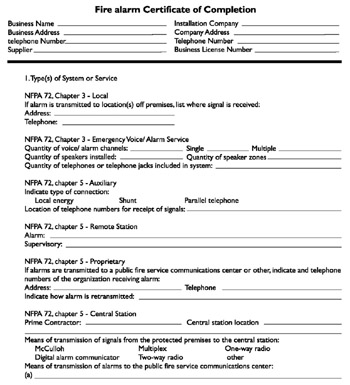
Figure 34-1: The Certificate of Completion prescribed by NFPA 72
Review
The prevention of false positives or false alarms should be one of the primary purposes of a regular maintenance and testing procedure. There are many causes for false alarms, including user errors, power or battery problems, misaligned or improperly placed sensors and contacts, sensors not configured for pets or children, malfunctioning detection devices, HVAC vents or air drafts that cause light objects to move, and setup configurations lost in the security panel. Most false alarms are caused by user errors and changes made to the home. Some municipalities require a home security system to be inspected and tested by a certified (licensed) technician no less than once a year, with some requiring semi-annual inspections and testing.
A security sensor or contact that is intermittently reporting false alarms may have power or continuity issues caused by cable or wire problems. A window or door contact that is even slightly misaligned may generate a false alarm even if the window or door is closed and locked. All doors and windows should be closed completely and locked before the alarm system is activated. Sensors and detectors incorrectly placed can also cause false alarms. Motion sensors should be configured to avoid alarm signals for small children and pets. The placement of objects in a secured room should take into consideration the location of HVAC vents or room fans.
When troubleshooting a home security system, you must first determine whether the problem is being caused by one of the four major areas of a security system: contacts, sensors, or detectors; the security system controller; wiring; or the interface to the telephone system.
A regular periodic program of preventive maintenance can assure the homeowners that their security system is properly functioning and reliable. The frequency of the preventive maintenance program should never be less than at least once annually, with quarterly or semi-annual programs at the discretion of the homeowner.
The advantages of periodic preventive maintenance on a home security system are: prevention of false alarms, fewer service or problem calls, desired changes implemented when needed; reliability of the system, manufacturer’s upgrades applied regularly, and potentials problems corrected before they cause the system to fail.
In compliance with NFPA 72 guidelines, a home security system must be tested at least once per year. If a local emergency services authority, such as the police or fire department, monitors the system, they may require the system to be recertified each year and a “Certificate of Completion” issued.
Questions
- What is the primary performance and maintenance issue with a home security system?
- Corroding window contacts
- False alarms
- Dead batteries
- System programming
- What is the cause of more than two-thirds of home security system false alarms?
- Faulty wiring
- Misaligned contacts
- System programming
- User error
- Which of the following could be the cause of window or door contact generating false positives?
- Misalignment
- Corrosion
- Change in the shape or fit of the door or window
- Damage to the contact
- All of the above
- Which one of the following is most likely the problem when a motion detector that is otherwise functioning properly does not sense someone entering the room where it is located?
- The lighting level is too low
- The opening door blocks the scanning field
- The sensor is set too high or too low
- Too many objects are in the room
- Which of the following should be included in the troubleshooting process for a security system controller?
- Reload the controller’s backup
- Apply all manufacturer’s upgrades
- Test the system
- Disconnect all zone devices before troubleshooting the system controller
- When troubleshooting NC contacts wired in series, what procedure should be used?
- Test all contacts in the series
- Disconnect all but the first contact and add the contacts back to the system one at a time
- Disconnect all but the last contact and add the contacts back to the system one at a time
- NC contacts should be wired in parallel
- Which of the following is a good troubleshooting technique for a suspected faulty contact or sensor?
- Disconnect the suspected device and retest the system
- Disconnect all but the suspected device and retest the system
- Replace the suspected device with a known-good device and retest
- Replace the suspected device immediately
- When performing a visual inspection of contacts and sensors, which of the following should you be looking for?
- Corrosion
- Cleanliness
- Alignment
- Wiring
- All of the above
- What is the national standard that governs the installation and testing of fire alarm systems?
- NEC 72
- IEEE 72
- NFPA 72
- EIA/TIA 72
- When troubleshooting an RJ-31X connection, which of the following steps should be performed?
- Check jack and plug for damage
- Check continuity of wiring to security system controller
- Check continuity of wiring to telephone system
- Cause a security event from the control panel and verify the interior line has been seized by the system
- All of the above
- None of the above
Answers
- B. False alarms can be embarrassing and costly for a homeowner.
- D. Improper training is likely the underlying reason behind the number of user errors resulting in false alarms.
- E. All of these are possible causes for any security device to generate a false positive.
- B. The opening door blocks the scanning field. Improper placement of a motion sensor can defeat its function.
- C. Before any other action is taken, the system should be retested completely to ensure that the reported problem is not caused by another underlying problem.
- B. Disconnect all but the first contact and add the contacts back to the system one at a time. However, if the devices are wired in parallel, they can be tested individually.
- C. Replace the suspected device with a known-good device and retest. Replacing a suspected device with a known-good device is a quick way of identifying or eliminating a device as a problem.
- E. All of these choices should be included when visually inspecting security devices.
- C. Many communities use this standard as the local standard as well.
- E. All of these steps should be included when troubleshooting an RJ-31X connection.
Part I - Home Technology Installation Basics
- Wire and Cable Basics
- Connector Types and Uses
- Wiring Installation Practices
- Codes, Standards, and Safety Practices
Part II - Structured Wiring
- Infrastructure Wiring Basics
- Planning a Structured Wiring Installation
- Rough-In Installation
- Trim-Out Installation
- Troubleshooting Structured Wiring
Part III - Home Computer Networks
- Computer Network Basics
- Computer Network Hardware
- Computer Network Software
- Designing and Installing a Computer Network
- Troubleshooting a Home Network
Part IV - Audio/Video Systems
- Distributed Audio System Basics
- Designing and Installing Distributed Audio Systems
- Distributed Video Basics
- Designing and Installing Distributed Video Systems
- Troubleshooting Audio Systems
- Troubleshooting Video Systems
Part V. Home Lighting Management Systems
- Home Lighting Basics
- Home Lighting Devices
- Designing a Home Lighting Control System
- Installing a Home Lighting Control System
- Troubleshooting and Maintaining Lighting Control Systems
Part VI - Telecommunications
- Home Communication System Basics
- Designing and Installing a Home Telephone System
- Troubleshooting a Home Communication System
Part VII - HVAC and Water Management
Part VIII - Security System Basics
- Security System Basics
- Designing a Home Security System
- Installing a Home Security System
- Troubleshooting and Maintaining a Home Security System
- Home Security Surveillance Systems
- Home Access Control Systems
Part IX - Home Technology Integration
- Defining Users Needs and Desires
- User Interfaces
- Home Automation Controllers
- Programming
- Integrating the Connected Home
- Other Home Technology Integration Devices
Part X - Appendices

EAN: N/A
Pages: 300
