Makefile, qmake, and Project Files
C++ applications are generally composed of many source files, header files, and external libraries. During the normal course of project development, source files and libraries get added, changed, or removed. During the testing/development phase, the project is recompiled and re-linked many times. To produce an executable, all changed source files must be recompiled, and the object files must all be re-linked.
Keeping track of all of the parts of such a project requires a mechanism that precisely specifies the input files involved, the tools needed to build, the intermediate targets and their dependencies, and the final executable target.
The most widely used utility for handling the job of building a project is make. It reads the details of the project specifications and the instructions for the compiler from a Makefile, which resembles a shell script but contains (at a minimum):
- Rules for building certain kinds of files (e.g., to get a .o file from a .cpp file, we must run gcc -c on the .cpp file)
- Targets that specify which executables (or libraries) must be built
- Dependencies that list which targets need to be rebuilt when certain files get changed
The make command by default loads the file named Makefile from your current working directory and performs the specified build steps (compiling and linking).
The immediate benefit of using make is that it recompiles only the files that need to be rebuilt, rather than blindly recompiling every source file every time. Figure 3.1 is a diagram that attempts to show the steps involved in building a Qt application. To learn more about make, we recommend the book The Linux Development Platform by Rafeeq Ur Rehman and Christopher Paul (Prentice Hall).
Figure 3.1. (q)make build steps
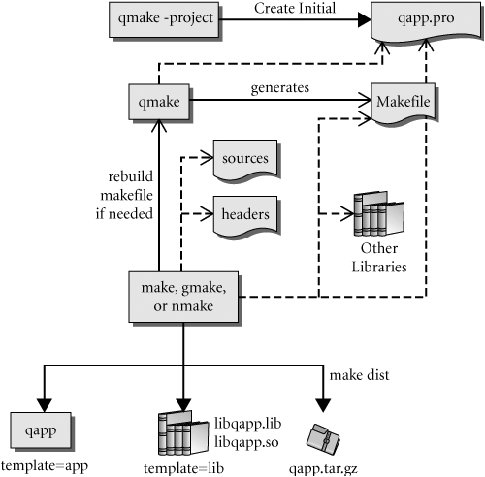
With Qt, it is not necessary to write Makefiles. Qt provides a tool called qmake to generate Makefiles for you. It is still necessary to somehow run make and understand its output. Most IDEs run make (or something similar) under the covers and either display or filter its output.
The following transcript shows which files get created at each step of the build process for Example 3.1.
src/qapp> ls -sF
total 296
 4 main.cpp
src/qapp> qmake -project
src/qapp> ls -sF
total 296
 4 main.cpp 4 qapp.pro
src/qapp> qmake
src/qapp> ls -sF
total 296
 4 main.cpp 4 qapp.pro 4 Makefile
src/qapp> make
g++ -c -pipe -g -Wall -W # compile step
 -D_REENTRANT -DQT_CORE_LIB -DQT_GUI_LIB -DQT_SHARED
 -I/usr/local/qt/mkspecs/linux-g++ -I.
 -I/usr/local/qt/include/QtGui -I/usr/local/qt/include/QtCore
 -I/usr/local/qt/include -I. -I. -I.
 -o main.o main.cpp
g++ -Wl,-rpath,/usr/local/qt/lib # link step
 -L/usr/local/qt/lib -L/usr/local/qt/lib -lQtGui_debug
 -L/usr/X11R6/lib -lpng -lXi -lXrender -lXinerama -lfreetype
 -lfontconfig -lXext -lX11 -lm -lQtCore_debug -lz -ldl -lpthread
 -o qapp main.o
src/qapp> ls -sF
total 420
 4 main.cpp 132 main.o 124 qapp*
 8 Makefile 4 qapp.pro
src/qapp>
Notice that we can see the arguments passed to the compiler when we run make. If any errors are encountered, we will see them too.
3.2.1. #include: Finding Header Files
There are three commonly used ways to #include a library header file:
#include
#include "headerFile"
#include "path/to/headerFile"
The angle brackets (< >) indicate that the preprocessor must look (sequentially) in the directories listed in the include path for the file.
A quoted filename indicates that the preprocessor should look for headerfile in the including file's directory first. A quoted path indicates that the preprocessor should check the path directory first. The path information can be absolute or relative (to the including file's directory). If no file is found at the specified location, the directories listed in the include path are searched for headerfile.
If versions of the file exist in more than one directory in the include path, the search will stop as soon as the first occurrence of the file has been found. If the file is not found in any of the directories of the search path, then the compiler will report an error.
For items in the C++ Standard Library, the compiler generally already knows where to find the header files. For other libraries, we can expand the search path by adding a -I/path/to/headerfile switch to the compiler.
If you use an IDE, there will be a Project->Settings->Preprocessor, or Project->Options->Libraries configuration menu that lets you specify additional include directories, which end up getting passed as -I switches to the compiler.
With qmake, as we will soon see, you can add INCLUDEPATH += dirname lines to the project file. These directories end up in the generated Makefile as INCPATH macros, which then get passed on to the compiler/preprocessor at build time.
 |
In general, it is a good idea to #include non-Qt header files after Qt header files. Since Qt does define many symbols, in the compiler as well as the preprocessor, this helps you avoid/find name clashes more easily. |
3.2.2. The make Command
Instead of running the command line compiler directly, we will start using make,[2] which greatly simplifies the build process when a project involves multiple source files and libraries.
[2] Depending on your development environment, this program goes under many other names, such as mingw32-make, nmake, gmake, or unsermake.
We have seen before that qmake (without arguments) reads a project file and builds a Makefile. Example 3.3 is a slightly abbreviated look at the Makefile for the previous qapp project.
Example 3.3. src/qapp/Makefile-abbreviated
# Excerpts from a makefile ####### Compiler, tools and options CC = gcc # executable for C compiler CXX = g++ # executable for c++ compiler LINK = g++ # executable for linker # flags that get passed to the compiler CFLAGS = -pipe -g -Wall -W -D_REENTRANT $(DEFINES) CXXFLAGS = -pipe -g -Wall -W -D_REENTRANT $(DEFINES) INCPATH = -I/usr/local/qt/mkspecs/default -I. -I$(QTDIR)/include/QtGui -I$(QTDIR)/include/QtCore -I$(QTDIR)/include # Linker flags LIBS = $(SUBLIBS) -L$(QTDIR)/lib -lQtCore_debug -lQtGui_debug -lpthread LFLAGS = -Wl,-rpath,$(QTDIR)/lib # macros for performing other operations as part of build steps: QMAKE = /usr/local/qt/bin/qmake ####### Files HEADERS = # If we had some, they'd be here. SOURCES = main.cpp OBJECTS = main.o [snip] QMAKE_TARGET = qapp DESTDIR = TARGET = qapp # default target to build first: all # to build "first" we must build "all" ####### Implicit rules .SUFFIXES: .c .o .cpp .cc .cxx .C .cpp.o: $(CXX) -c $(CXXFLAGS) $(INCPATH) -o $@ $< ## Possible targets to build all: Makefile $(TARGET) # this is how to build "all" $(TARGET): $(OBJECTS) $(OBJMOC) # this is how to build qapp $(LINK) $(LFLAGS) -o $(TARGET) $(OBJECTS) $(OBJMOC) $(OBJCOMP) $(LIBS) qmake: FORCE # "qmake" is a target too! @$(QMAKE) -o Makefile qapp.pro # what does it do? dist: # Another target @mkdir -p .tmp/qapp && $(COPY_FILE) --parents $(SOURCES) $(HEADERS) $(FORMS) $(DIST) .tmp/qapp/ && (cd 'dirname .tmp/qapp' && $(TAR) qapp.tar qapp && $(COMPRESS) qapp.tar) && $(MOVE) 'dirname .tmp/qapp'/qapp.tar.gz . && $(DEL_FILE) -r .tmp/qapp clean:compiler_clean # yet another target -$(DEL_FILE) $(OBJECTS) -$(DEL_FILE) *~ core *.core ####### Dependencies for implicit rules main.o: main.cpp |
The command make checks the dependencies and performs each build step specified in the Makefile. The name and location of the final result can be set with the project variables, TARGET and target.path. If TARGET is not specified, the name defaults to the name of the directory in which the project file is located. If target.path is not specified, the location defaults to the directory in which the project file is located.
3.2.3. Cleaning Up Files
make can clean up the generated files for you with the two targets clean and distclean. Observe how they are different from the following code:
src/qapp> make clean
rm -f main.o
rm -f *~ core *.core
src/qapp> ls
 Makefile main.cpp qapp qapp.pro

src/qapp> make distclean
rm -f qmake_image_collection.cpp
rm -f main.o
rm -f *~ core *.core
rm -f qapp
rm -f Makefile
src/qapp> ls
main.cpp qapp.pro
After a make distclean, the only files that remain are the source files that can go into a tarball for distribution.
 |
If you modify a project file since the last execution of make, the next invocation of make should rebuild the Makefile itself (via qmake) before re-running make on the newly generated Makefile. In other words, the Makefile is qmake-aware and can re-qmake itself. |
|
The command make dist will create a tarball (dirname.tar.gz) that contains all the source files that the project file knows about. |
As we add more source-code, header, or library modules for our project, we edit the .pro file and add the new items to the SOURCES, HEADERS, and LIBS lists. The same documentation standards that apply to C++ source code should be applied to project files (where comments begin with #).
We think of the project file as a map of our project, containing references to all files and locations required for building our application or library. Like other source code files, this is both human readable and machine readable. The .pro file is the first place to look when we encounter "not found" or "undefined" messages during the build process (especially at link time). For further details we recommend that you read Trolltech's guide to qmake.[3]
[3] http://trolltech.com/qmake-manual.html
Part I: Introduction to C++ and Qt 4
C++ Introduction
- C++ Introduction
- Overview of C++
- A Brief History of C++
- Setup: Open-Source Platforms
- Setup: Win32
- C++ First Example
- Input and Output
- Identifiers, Types, and Literals
- C++ Simple Types
- C++ Standard Library Strings
- Streams
- The Keyword const
- Pointers and Memory Access
- const* and *const
- Reference Variables
- Points of Departure
- Review Questions
Classes
- Classes
- Structs
- Class Definitions
- Member Access Specifiers
- Encapsulation
- Introduction to UML
- Friends of a Class
- Constructors
- Subobjects
- Destructors
- The Keyword static
- Copy Constructors and Assignment Operators
- Conversions
- const Member Functions
- Review Questions
Introduction to Qt
- Introduction to Qt
- Example Project: Using QApplication and QLabel
- Makefile, qmake, and Project Files
- Getting Help Online
- Style Guidelines and Naming Conventions
- The Qt Core Module
- Streams and Dates
- Points of Departure
- Review Questions
Lists
Functions
- Functions
- Function Declarations
- Overloading Functions
- Optional Arguments
- Operator Overloading
- Parameter Passing by Value
- Parameter Passing by Reference
- References to const
- Function Return Values
- Returning References from Functions
- Overloading on const-ness
- Inline Functions
- Inlining versus Macro Expansion
- Review Questions
Inheritance and Polymorphism
- Inheritance and Polymorphism
- Simple Derivation
- Derivation with Polymorphism
- Derivation from an Abstract Base Class
- Inheritance Design
- Overloading, Hiding, and Overriding
- Constructors, Destructors, and Copy Assignment Operators
- Processing Command-Line Arguments
- Points of Departure
- Review Questions
Part II: Higher-Level Programming
Libraries
- Libraries
- Code Containers
- Reusing Other Libraries
- Organizing Libraries: Dependency Management
- Installing Libraries: A Lab Exercise
- Frameworks and Components
- Review Questions
Introduction to Design Patterns
QObject
- QObject
- QObjects Child Managment
- Composite Pattern: Parents and Children
- QApplication and the Event Loop
- Q_OBJECT and moc: A Checklist
- Values and Objects
- tr() and Internationalization
- Point of Departure
- Review Questions
Generics and Containers
- Generics and Containers
- Generics and Templates
- Containers
- Managed Containers, Composites, and Aggregates
- Implicitly Shared Classes
- Generics, Algorithms, and Operators
- Serializer Pattern
- Sorted Map Example
- Review Questions
Qt GUI Widgets
- Qt GUI Widgets
- Widget Categories
- QMainWindow and QSettings
- Dialogs
- Images and Resources
- Layout of Widgets
- QActions, QMenus, and QMenuBars
- QActions, QToolbars, and QActionGroups
- Regions and QDockWidgets
- Views of a QStringList
- Points of Departure
- Review Questions
Concurrency
- Concurrency
- QProcess and Process Control
- Threads and QThread
- Summary: QProcess and QThread
- Review Questions
Validation and Regular Expressions
- Validation and Regular Expressions
- Validators
- Regular Expressions
- Regular Expression Validation
- Review Questions
Parsing XML
Meta Objects, Properties, and Reflective Programming
- Meta Objects, Properties, and Reflective Programming
- Anti-patterns
- QMetaObject: The MetaObject Pattern
- Type Identification and qobject_cast
- Q_PROPERTY Macro: Describing QObject Properties
- QVariant Class: Accessing Properties
- DataObject: An Extension of QObject
- Property Containers: PropsMap
- Review Questions
More Design Patterns
- More Design Patterns
- Creational Patterns
- Serializer Pattern Revisited
- The Façade Pattern
- Points of Departure
- Review Questions
Models and Views
- Models and Views
- M-V-C: What about the Controller?
- Dynamic Form Models
- Qt 4 Models and Views
- Table Models
- Tree Models
- Review Questions
Qt SQL Classes
Part III: C++ Language Reference
Types and Expressions
- Types and Expressions
- Operators
- Evaluation of Logical Expressions
- Enumerations
- Signed and Unsigned Integral Types
- Standard Expression Conversions
- Explicit Conversions
- Safer Typecasting Using ANSI C++ Typecasts
- Run-Time Type Identification (RTTI)
- Member Selection Operators
- Point of Departure
- Review Questions
Scope and Storage Class
- Scope and Storage Class
- Declarations and Definitions
- Identifier Scope
- Storage Class
- Namespaces
- Review Questions
Statements and Control Structures
Memory Access
- Memory Access
- Pointer Pathology
- Further Pointer Pathology with Heap Memory
- Memory Access Summary
- Introduction to Arrays
- Pointer Arithmetic
- Arrays, Functions, and Return Values
- Different Kinds of Arrays
- Valid Pointer Operations
- What Happens If new Fails?
Chapter Summary
Inheritance in Detail
- Inheritance in Detail
- Virtual Pointers and Virtual Tables
- Polymorphism and virtual Destructors
- Multiple Inheritance
- Point of Departure
- public, protected, and private Derivation
- Review Questions
Miscellaneous Topics
Part IV: Programming Assignments
MP3 Jukebox Assignments
- MP3 Jukebox Assignments
- Data Model: Mp3File
- Visitor: Generating Playlists
- Preference: An Enumerated Type
- Reusing id3lib
- PlayListModel Serialization
- Testing Mp3File Related Classes
- Simple Queries and Filters
- Mp3PlayerView
- Models and Views: PlayList
- Source Selector
- Persistent Settings
- Edit Form View for FileTagger
- Points of Departure
Part V: Appendices
MP3 Jukebox Assignments
- MP3 Jukebox Assignments
- Appendix A. C++ Reserved Keywords
- Appendix B. Standard Headers
- Appendix C. The Development Environment
- Section C.1. The Preprocessor: For #including Files
- Section C.2. Understanding the Linker
- Section C.3. Debugging
- Section C.4. Qt Assistant and Designer
- Section C.5. Open-Source IDEs and Development Tools
Bibliography
MP3 Jukebox Assignments

EAN: 2147483647
Pages: 268
