XML Schema Tools
A number of tools are at your disposal to create and validate XML Schema documents. You can find a large list of such tools at http://www.w3.org/XML/Schema#Tools. Although a large list is available, I will review only the two that are commonly used by developers-Microsoft's Visual Studio 2005 and Altova's XMLSpy.
Microsoft's Visual Studio 2005
Microsoft made strong efforts to incorporate XML development into its latest development environment. Microsoft's Visual Studio 2005 can do quite a bit more than XML development, but it allows you to create XML-based documents of many kinds easily, including XML Schema documents.
A XSD document type in Visual Studio enables you to visual create schema documents. You can also create hem directly in the code view as well. Figure 6-4 shows Visual Studio 2005 open with the design surface for the schema document.
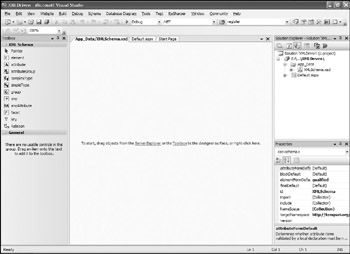
Figure 6-4
From the available Toolbox, you can drag and drop elements directly onto the design surface. The tool creates all the required code on your behalf. Figure 6-5 shows the screen when elements have been created on this design surface.
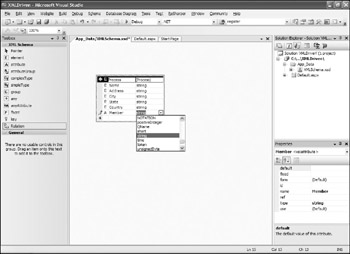
Figure 6-5
As you can see from the figure, you can select the datatypes from a drop-down list directly in the designer. Next, this chapter reviews Altova's XMLSpy.
Altova's XMLSpy
Altova's XMLSpy is a powerful tool recommended for any serious XML programmer. You will find that the XSD capabilities built into the tool allow you to perform pretty much any XSD task including creating schemas from scratch, from other XML documents, and more. Figure 6-6 shows how XMLSpy allows you to code the schema document directly.
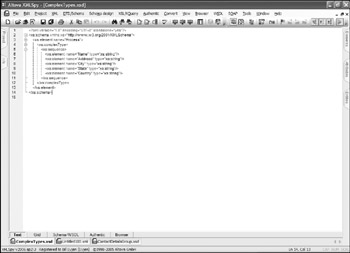
Figure 6-6
You can also design the schema visually and let XMLSpy create the schema code on your behalf. This is presented in Figure 6-7.
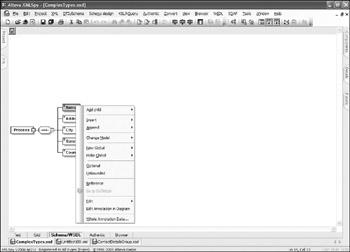
Figure 6-7

EAN: 2147483647
Pages: 215