Flylib.com

Books Software


19.4 Consolidating a 3-tier environment

19.4 Consolidating a 3- tier environment

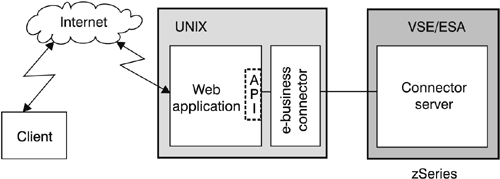
Integrated server environments are often implemented as 3-tier environments, for example, consisting of (1) Web browsers, (2) Web application servers, and (3) back-end servers. A common physical implementation of such a 3-tier environment is shown in Figure 19-12. The Web browsers run on workstations, the applications servers on UNIX servers, and the back-end server on a mainframe. The examples show VSE/ESA as the traditional mainframe operating system, but it could also be a z/OS system.

Figure 19-12. 3-tier server environment

graphics/19fig12.gif

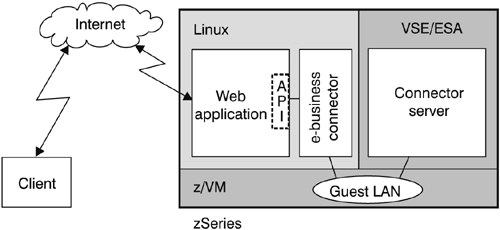
Linux on the mainframe allows you to implement a logical 3-tier environment on a physical 2-tier. Figure 19-13 shows how the physically distinct application server has been moved to a Linux image on the mainframe.

Figure 19-13. Physical 2-tier implementation for a logical 3-tier server environment

graphics/19fig13.gif

This consolidation can provide the benefits of hosting applications on the mainframe. The benefits possibly include cost savings due to reduced hardware acquisition and maintenance cost, simplified systems administration, and improved availability. For applications running on the mainframe, you can achieve a better operational integration into existing traditional mainframe application environments. For example, you can bring your Web applications closer to your data via virtual communication methods (HiperSockets or Guest LAN). Virtual communication can improve security and performance.

19.5 Enriching your mainframe environment with new applications

Adding a new application as a middle- tier to an existing mainframe environment can be an attractive proposition for a new business opportunity.

On the mainframe, it is easy to create an additional image for a new application. The mainframe's virtualization technology provides isolation that prevents the new operating system from interfering with the other operating systems on the machine.

Deploying a new application on Linux on the mainframe does not necessarily require additional hardware. The resources needed for starting a project can sometimes be covered by spare mainframe capacity. If a successful project's success requires more resources, its profitability can justify the purchase of the extra capacity.

As seen frequently in our discussion of StoreCompany, it uses this opportunity of easily adding additional images to great advantage for its online sales application and later for its business intelligence application.

19.6 Summary

The mainframe provides virtual inter-image communications that allow you to deploy integrated Linux server environments on a single mainframe machine. In this chapter, we have used mainly examples based on z/VM. For environments with a small number of images, many of the opportunities that we have described for z/VM can also be provided by LPARs and HiperSockets.

Connectors allow applications on Linux images to exploit resources on the traditional mainframe operating systems or vice versa. This means that it is possible to set up a heterogeneous server environment with a middle- tier based on Linux on the mainframe and a z/OS or VSE/ESA back-end.

Conversely, you can set up environments where applications on the traditional mainframe operating systems use Linux back-end servers.

You can implement a logical 3-tier application environment (non-zSeries clients , application servers, and back-end servers) within a physically consolidated 2-tier environment, where only the client is not on zSeries.

Linux on the mainframe can provide a fast deployment platform for new applications. While z/VM and LPAR provide isolation, connectors ease functional integration with an existing traditional mainframe environment.