The Life Cycle of a Thread
Now that you've seen how to give a thread something to do, we'll review some details that were glossed over in the previous section. In particular, we look at how to create and start a thread, some of the special things it can do while it's running, and how to stop it.
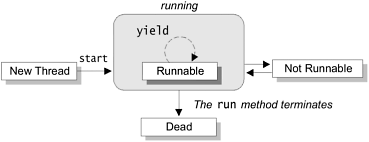
Figure 82 shows the states that a thread can be in during its life and illustrates which method calls cause a transition to another state. This figure is not a complete finite state diagram but rather an overview of the more interesting and common facets of a thread's life. The remainder of this section uses the Clock applet previously introduced to discuss a thread's life cycle in terms of its state.
Figure 82. Possible states of a thread.
Creating a Thread
The application in which an applet is running calls the applet's start method when the user visits the applet's page. The Clock applet creates a Thread, clockThread, in its start method with the code shown here in boldface:
public void start() {
 if (clockThread == null) {
 clockThread = new Thread(this, "Clock");
 clockThread.start();
 }
}
After the statement in boldface has been executed, clockThread is in the New Thread state. A thread in this state is merely an empty Thread object; no system resources have been allocated for it yet. When a thread is in this state, you can only start the thread. Calling any method besides start when a thread is in this state makes no sense and causes an IllegalThreadStateException. In fact, the runtime system throws an IllegalThreadStateException whenever a method is called on a thread and that thread's state does not allow for that method call.
Note that the Clock instance is the first argument to the thread constructor. The first argument to this thread constructor must implement the Runnable interface and becomes the thread's target. The clock thread gets its run method from its target Runnable objectin this case, the Clock instance. The second argument is just a name for the thread.
Starting a Thread
Now consider the next line of code in Clock's start method, shown here in boldface:
public void start() {
 if (clockThread == null) {
 clockThread = new Thread(this, "Clock");
 clockThread.start();
 }
}
The start method creates the system resources necessary to run the thread, schedules the thread to run, and calls the thread's run method. ClockThread's run method is the one defined in the Clock class.
After the start method has returned, the thread is "running." Yet it's somewhat more complex than that. As Figure 82 shows, a thread that has been started is in the Runnable state. Many computers have a single processor, thus making it impossible to run all "running" threads at the same time. The Java runtime environment must implement a scheduling scheme that shares the processor among all "running" threads. (See the section Understanding Thread Priority (page 286) for more information about scheduling.) So at any given time, a "running" thread may be waiting for its turn in the CPU.
Here's another look at Clock's run method:
public void run() {
 Thread myThread = Thread.currentThread();
 while (clockThread == myThread) {
 repaint();
 try {
 Thread.sleep(1000);
 } catch (InterruptedException e) {
 //the VM doesn't want us to sleep anymore,
 //so get back to work
 }
 }
}
Clock's run method loops while the condition clockThread == myThread is true. This exit condition is explained in more detail in the section Stopping a Thread (page 285). For now, however, know that it allows the thread, and thus the applet, to exit gracefully.
Within the loop, the applet repaints itself and then tells the thread to sleep for 1 second (1,000 milliseconds). An applet's repaint method ultimately calls the applet's paint method, which does the update of the applet's display area. The Clock paint method gets the current time, formats, and displays it:
public void paint(Graphics g) {
 //get the time and convert it to a date
 Calendar cal = Calendar.getInstance();
 Date date = cal.getTime();
 //format it and display it
 DateFormat dateFormatter = DateFormat.getTimeInstance();
 g.drawString(dateFormatter.format(date), 5, 10);
}
Making a Thread Not Runnable
A thread becomes Not Runnable when one of these events occurs:
- Its sleep method is invoked.
- The thread calls the wait method to wait for a specific condition to be satisfied.
- The thread is blocking on I/O.
The clockThread in the Clock applet becomes Not Runnable when the run method calls sleep on the current thread:
public void run() {
 Thread myThread = Thread.currentThread();
 while (clockThread == myThread) {
 repaint();
 try {
 Thread.sleep(1000);
 } catch (InterruptedException e) {
 //the VM doesn't want us to sleep anymore,
 //so get back to work
 }
 }
}
During the second that the clockThread is asleep, the thread does not run, even if the processor becomes available. After the second has elapsed, the thread becomes Runnable again; if the processor becomes available, the thread begins running again.
For each entrance into the Not Runnable state, a specific and distinct exit returns the thread to the Runnable state. An exit works only for its corresponding entrance. For example, if a thread has been put to sleep, the specified number of milliseconds must elapse before the thread becomes Runnable again. The following list describes the exit for every entrance into the Not Runnable state.
- If a thread has been put to sleep, the specified number of milliseconds must elapse.
- If a thread is waiting for a condition, another object must notify the waiting thread of a change in condition by calling notify or notifyAll. More information is available in the section Synchronizing Threads (page 291).
- If a thread is blocked on I/O, the I/O must complete.
Stopping a Thread
A program doesn't stop a thread like it stops an applet (by calling a method). Rather, a thread arranges for its own death by having a run method that terminates naturally. For example, the while loop in this run method is a finite loop: It will iterate 100 times and then exit:
public void run() {
 int i = 0;
 while (i < 100) {
 i++;
 System.out.println("i = " + i);
 }
}
A thread with this run method dies naturally when the loop completes and the run method exits.
Let's look at how the Clock applet thread arranges for its own death. You might want to use this technique with your applets. Recall Clock's run method:
public void run() {
 Thread myThread = Thread.currentThread();
 while (clockThread == myThread) {
 repaint();
 try {
 Thread.sleep(1000);
 } catch (InterruptedException e) {
 //the VM doesn't want us to sleep anymore,
 //so get back to work
 }
 }
}
The exit condition for this run method is the exit condition for the while loop because there is no code after the while loop:
while (clockThread == myThread) {
This condition indicates that the loop will exit when the currently executing thread is not equal to clockThread. When would this ever be the case?
When you leave the page, the application in which the applet is running calls the applet's stop method. This method then sets clockThread to null, thereby telling the main loop in the run method to terminate:
public void stop() { //applets' stop method
 clockThread = null;
}
If you revisit the page, the start method is called again and the clock starts up again with a new thread. Even if you stop and start the applet faster than one iteration of the loop, the clockThread thread will be different from myThread, and the loop will still terminate.
The isAlive Method
A final word about thread state: The API for the Thread class includes a method called isAlive. The isAlive method returns true if the thread has been started and not stopped. If the isAlive method returns false, you know that the thread either is a New Thread or is Dead. If the isAlive method returns true, you know that the thread is either Runnable or Not Runnable. You cannot differentiate between a New Thread and a Dead thread. Nor can you differentiate between a Runnable thread and a Not Runnable thread.
Getting Started
- About the Java Technology
- How Will Java Technology Change My Life?
- First Steps (Win32)
- First Steps (UNIX/Linux)
- First Steps (MacOS)
- A Closer Look at HelloWorld
- Questions and Exercises
- Code Samples
Object-Oriented Programming Concepts
- What Is an Object?
- What Is a Message?
- What Is a Class?
- What Is Inheritance?
- What Is an Interface?
- How Do These Concepts Translate into Code?
- Summary
- Questions and Exercises
- Code Samples
Language Basics
Object Basics and Simple Data Objects
Classes and Inheritance
Interfaces and Packages
Handling Errors Using Exceptions
- What Is an Exception?
- The Catch or Specify Requirement
- Catching and Handling Exceptions
- Specifying the Exceptions Thrown by a Method
- How to Throw Exceptions
- Runtime Exceptions The Controversy
- Advantages of Exceptions
- Summary of Exceptions
- Questions and Exercises
- Code Samples
Threads: Doing Two or More Tasks at Once
- What Is a Thread?
- Using the Timer and TimerTask Classes
- Customizing a Threads run Method
- The Life Cycle of a Thread
- Understanding Thread Priority
- Synchronizing Thread
- Grouping Threads
- Summary of Threads
- Questions and Exercises
- Code Samples
I/O: Reading and Writing
- Overview of I/O Streams
- Using the Streams
- Object Serialization
- Working with Random Access Files
- And the Rest…
- Summary of Reading and Writing
- Questions and Exercises
- Code Samples
User Interfaces That Swing
- Overview of the Swing API
- Your First Swing Program
- Example Two: SwingApplication
- Example Three: CelsiusConverter
- Example Four: LunarPhases
- Example Five: VoteDialog
- Layout Management
- Threads and Swing
- Visual Index to Swing Components
- Summary
- Questions and Exercises
- Code Samples
Appendix A. Common Problems and Their Solutions
- Appendix A. Common Problems and Their Solutions
- Getting Started Problems
- General Programming Problems
- Applet Problems
- User Interface Problems
Appendix B. Internet-Ready Applets
- Appendix B. Internet-Ready Applets
- Overview of Applets
- AWT Components
- Taking Advantage of the Applet API
- Practical Consideration of Writing Applets
- Finishing an Applet
- Swing-Based Applets
- Code Samples
Appendix C. Collections
- Appendix C. Collections
- Introduction
- Interfaces
- Implementations
- Algorithms
- Custom Implementations
- Interoperability
Appendix D. Deprecated Thread Methods
- Appendix D. Deprecated Thread Methods
- Why Is Thread.stop Deprecated?
- Why Are Thread.suspend and Thread.resume Deprecated?
- What about Thread.destroy?
- Why Is Runtime.runFinalizersOnExit Deprecated?
Appendix E. Reference

EAN: 2147483647
Pages: 125
