3.4. The MySQL Table Editor
MySQL Query Browser has a table editor facility that enables you to create tables or edit the definitions of existing tables. To access the MySQL Table Editor, right-click on a table name in the database browser and select Edit Table. The MySQL Table Editor also can be accessed from the MySQL Administrator program: Select the Catalogs section of the main window, select a database, and then right-click on a table
The MySQL Table Editor provides a graphic interface for manipulation of table definitions, as shown in Figure 3.2. Figure 3.2. MySQL Table Editor.
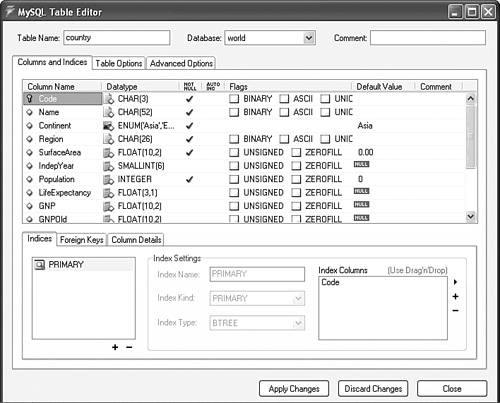
The MySQL Table Editor enables you to perform the following
The Options dialog has an Editors section that enables you to set MySQL Table Editor preferences. See Section 3.6, "The Options Dialog." |
3.5. Connection ManagementMySQL Query Browser provides a Connection dialog that enables you to connect to a MySQL server, and a connection editor that you can use to create profiles that store connection parameters for later use. This section describes how to use the Connection dialog and the connection editor. The discussion also applies to MySQL Administrator, which has the same connection management facilities.
A connection profile is a set of connection parameters to which you assign a name. You can recall profiles by
Profiles are stored in a file named mysqlx_user_connections.xml . The location of this file is the C:\Documents and Settings\ user_name \Application Data\MySQL directory on Windows and the ~/.mysqlgui directory on Unix. Profiles are stored as plain text in XML format, which means that profiles are portable and have good cross-platform compatibility. A file containing connection profiles can be given to other users on the same or different machines. This makes it easy to set up standard profiles and distribute them, a feature that can be useful in a classroom or training setting, or if you want to distribute standard profiles along with an application. The connections file is updated automatically when you use the Connection dialog or connection editor. Because the file is plain text, its contents can be edited by other programs as well, and the changes will be visible to the connection editor. 3.5.1. Using the Connection Dialog
MySQL Query Browser
Figure 3.3. Connection dialog.
To connect to a MySQL server by specifying connection parameters directly, fill in the appropriate fields beginning with the
Username
field and click the
OK
button. To connect using the parameters stored in a connection profile, select the profile from the
Connection
drop-down list and click the
OK
button. To access the connection editor, click the
...
button
3.5.2. Editing Connection ProfilesThe connection editor enables you to create, edit, and delete connection profiles. The connection editor also maintains a history of recent connections. You can access this editor from the Connection dialog or by selecting Options … from the Tools menu and selecting the Connections section of the Options dialog. In either case, the connection editor window is displayed, as shown in Figure 3.4. Figure 3.4. Connection Editor.
The Connections section has a browser for existing connection profiles. It also displays a history of previous connections that were made without using a connection profile. The other part of the Connections section has a tab for specifying general connection parameters and another for other options. To edit a profile, select it in the browser and then modify the fields displayed by the two tabs. You can also use the
Add New Connection
and
Delete
|