Leading change
INTRODUCTION
In this chapter we look at the leader’s role in the change process. The objectives of the chapter are to:
- enable leaders of change to explore the different roles they, and their colleagues need to play in a change process;
- identify how leaders of change can adapt their style and focus to the different phases of the change process;
- emphasize the importance of self-knowledge and inner resources in any leadership role.
The chapter is divided into six sections:
- visionary leadership;
- roles that leaders play;
- leadership styles and skills;
- different leadership for different phases of change;
- the importance of self-knowledge and inner resources;
- summary and conclusions.
It is important to first make the point that good leadership is well-rounded leadership. We believe that all four metaphors of organizations give rise to useful notions of leadership. Leaders go wrong when they become stuck in one metaphor, or in one way of doing things, and therefore appear one-dimensional in their range of styles and approaches.
To begin, we link leadership to the ideas presented in Chapter 3 on organizational change, by looking at the type of leadership that follows from approaching organizational change using each of the four key metaphors (see Table 4.1):
- the machine metaphor;
- the political system metaphor;
- the organism metaphor;
- The flux and transformation metaphor.
|
Metaphor |
Nature of change |
Leader’s role |
Type of leadership required |
Typical pitfalls for the leader |
|---|---|---|---|---|
|
Machine |
The designed end state can be worked towards. Resistance must be managed. Change needs to be planned and controlled. |
Chief designer and implementer of the changes |
Project management. Goal setting. Monitoring and controlling. |
Micro-management by leader means activity focuses on measuring, rather than experimenting or taking risks |
|
Political system |
Changes must be supported by a powerful person. Change needs a powerful coalition behind it. Winners and losers are important. |
Politician – powerful speaker and behind the scenes negotiator |
Visionary. Building a powerful coalition. Connecting agendas. |
Change leaders are seen as Machiavellian manipulators. Leaders cannot be trusted, so people comply rather than commit. People do the minimum. Leaders begin to follow their own agenda (cover their backs), rather than some higher purpose. |
|
Organism |
Change is adaptive. Individuals and groups need to be psychologically aware of the ‘felt need’ for change. End state can be defined and worked towards. |
Coach, counsellor and consultant, holding up the mirror |
Coaching and supporting |
The metaphor becomes an ideology. The change process becomes self-serving and achieves very little. There is a focus on reacting rather than initiating. Change happens, but too little too late. |
|
Flux and transformation |
Change cannot be managed, it emerges. Managers are part of the system, not outside the system. Conflict is useful. Managers enable good connections between people. |
Facilitator of emergent change |
Getting the governing principles right. Enabling connectivity. Amplifying issues. |
Leaders and others involved become confused and frustrated. The change effort becomes vague and directionless. There is no sense of progress to motivate future effort. |
Table 4.1 illustrates that the use of each metaphor brings both advantages and disadvantages for those wishing to be successful leaders of change.
The machine metaphor draws attention to clear goals and the need for structure, but overuse of this metaphor results in micromanagement of outcomes and too little risk taking. The political system metaphor adds the harsh reality of organizational life, and reminds us of the necessity for involving influential people when change is desired, but overuse can be seen as manipulation. The organism metaphor highlights the need for people to be involved, and to feel the need for change, but runs the risk of moving too slowly and too late. Finally the flux and transformation model is useful as a reminder that organizations and their people cannot be wholly controlled unless we rule by fear! Leaders must encourage discussion of conflicts and tensions to enable change to emerge, while avoiding the trap of being too vague and lacking direction.
We believe that successful change leadership is achieved by combining aspects of all four metaphors. This is evidenced by the models and approaches introduced in Chapter 3, which combine different metaphors to some degree (see Table 3.2).
COMBINING THE METAPHORS: REFLECTIVE COACHING SESSION
Once I realized that my boss was using a completely different organizational metaphor from myself, I began to see how we were clashing in our discussions about how to run projects and how to improve processes.
I prefer the machine metaphor. I like things to be pretty clear. In my area we have a well-defined structure with clear roles and objectives set for each person. The team runs like a well-oiled machine, with me in the engine room pulling levers and thinking about plans and processes.
On the other hand, my boss prefers a more fluid style of working. Objectives are flexible and revised daily, and the hierarchy means very little to him. If someone shows initiative and promise, he will go directly to that person and have a quite intense conversation to convey the importance of a particular initiative. It used to drive me crazy. I couldn’t keep control.
One day we had a chat about this using metaphor to discuss our differences. It was most illuminating, and we started to see the pros and cons of each approach. As a result I agreed to incorporate more flexibility in certain projects, and he agreed to stick with the plan rather than review and change other, more stable processes. We still clash from time to time, but it doesn’t cause quite so much irritation!
Global Services Manager, Oil Company – on use of metaphor to enhance understanding of other people’s viewpoints
Table 4.1 is also useful because it reveals a wide range of styles and skills required of leaders, depending on the metaphor in use:
- goal setting;
- monitoring and controlling;
- coaching and supporting;
- building vision;
- communicating vision;
- building coalitions;
- networking;
- negotiating;
- facilitating;
- dealing with conflict.
The difficulty with a list of skills this long is that is seems unattainable. In this chapter we try to help leaders to find a way through the various requirements of a leader to pinpoint the most important roles, skills, styles and areas of focus needed to make change happen.
VISIONARY LEADERSHIP
The first basic ingredient of leadership is a guiding vision. The leader has a clear idea of what he wants to do – professionally and personally – and the strength to persist in the face of setbacks, even failures. Unless you know where you are going, and why, you cannot possibly get there.
Warren Bennis (1994)
Visionary leadership has become something of a holy grail. It seems to be a rare commodity which is greatly sought after. Our recent research (see box) indicates that today’s business leaders place considerable value on visionary leadership as a tool for organizational change. But is visionary leadership really the answer?
In our change leadership sessions with private sector senior and middle managers in the UK we ask people to name significant leaders of change. The top four names mentioned over the period 1997–2002 were:
- Winston Churchill.
- Margaret Thatcher.
- Nelson Mandela.
- Adolf Hitler.
The top five characteristics that emerged through a typical discussion of these significant leaders were:
- Clear vision.
- Determination.
- Great speaker, great presence.
- Tough when needed.
- Able to stand alone.
Cameron Change Consultancy data 2002
Here we explore the views of the supporters of visionary leadership, and those who make the case against it.
Bennis on the characteristics of visionary leaders
Warren Bennis identified three basic ingredients of leadership:
- a guiding vision;
- passion;
- integrity.
He also developed a useful comparison of the differences between management and leadership (see Table 4.2) which unpacks some of the different qualities of a visionary leader.
|
A manager |
A leader |
|---|---|
|
Administers |
Innovates |
|
Is a copy |
Is an original |
|
Maintains |
Develops |
|
Focuses on systems and structure |
Focuses on people |
|
Relies on control |
Inspires trust |
|
Has a short-range view |
Has a long-range perspective |
|
Asks how and when |
Asks why |
|
Has his eye on the bottom line |
Has his eye on the horizon |
|
Imitates |
Originates |
|
Accepts the status quo |
Challenges the status quo |
|
Classic good soldier |
His own person |
|
Does things right |
Does the right thing |
|
Source: Bennis (1994) |
|
This comparison exercise separates management from leadership in a very clear way. This is useful for those wishing to take on more of a leadership role, although it is sometimes interpreted as slightly downplaying the important role of a good manager in organizational life. Most managers have to do both roles.
Kotter on what leaders really do
Kotter (1996) echoes the ideas of Bennis. He says, ‘we have raised a generation of very talented people to be managers, not leader/managers, and vision is not a component of effective management. The management equivalent to vision creation is planning.’ He says that leaders are different from managers. ‘They don’t make plans; they don’t solve problems; they don’t even organise people. What leaders really do is prepare organizations for change and help them cope as they struggle through it.’ He identifies three areas of focus for leaders and contrasts these with the typical focus of a manager:
- setting direction versus planning and budgeting;
- aligning people versus organizing and staffing;
- motivating people versus controlling and problem solving.
VISIONARY LEADERSHIP
We go to liberate, not to conquer.
We will not fly our flags in their country.
We are entering Iraq to free a people and the only flag which will be flown in that ancient land is their own.
Show respect for them.
There are some who are alive at this moment who will not be alive shortly.
Those who do not wish to go on that journey, we will not send.
As for the others, I expect you to rock their world.
Wipe them out if that is what they choose.
But if you are ferocious in battle remember to be magnanimous in victory.
Iraq is steeped in history.
It is the site of the Garden of Eden, of the Great Flood and the birthplace of Abraham.
Tread lightly there.
You will see things that no man could pay to see
– and you will have to go a long way to find a more decent, generous and upright people than the Iraqis.
You will be embarrassed by their hospitality even though they have nothing.
Don’t treat them as refugees for they are in their own country.
Their children will be poor, in years to come they will know that the light of liberation in their lives was brought by you.
Extract from speech widely hailed in the UK press as visionary. It was given by Lieutenant Colonel Tim Collins to around 800 men of the battlegroup of the 1st Battalion of the Royal Irish Regiment, at their Fort Blair Mayne camp in the Kuwaiti desert about 20 miles from the Iraqi border on Wednesday 19 March 2003. His intention was to prepare the men for the battle that lay ahead. Many of the men were young and the support from people back in the UK was patchy.
I HAVE A DREAM
I have a dream that one day this nation will rise up and live out the true meaning of its creed: ‘We hold these truths to be self-evident: that all men are created equal.’ I have a dream that one day on the red hills of Georgia the sons of former slaves and the sons of former slave owners will be able to sit down together at the table of brotherhood.
I have a dream that one day even the state of Mississippi, a state sweltering with the heat of injustice, sweltering with the heat of oppression, will be transformed into an oasis of freedom and justice.
I have a dream that my four little children will one day live in a nation where they will not be judged by the color of their skin but by the content of their character.
I have a dream today.
I have a dream that one day, down in Alabama, with its vicious racists, with its governor having his lips dripping with the words of interposition and nullification; one day right there in Alabama, little black boys and black girls will be able to join hands with little white boys and white girls as sisters and brothers.
I have a dream today.
I have a dream that one day every valley shall be exalted, every hill and mountain shall be made low, the rough places will be made plain, and the crooked places will be made straight, and the glory of the Lord shall be revealed, and all flesh shall see it together. This is our hope. This is the faith that I go back to the South with. With this faith we will be able to hew out of the mountain of despair a stone of hope. With this faith we will be able to transform the jangling discords of our nation into a beautiful symphony of brotherhood. With this faith we will be able to work together, to pray together, to struggle together, to go to jail together, to stand up for freedom together, knowing that we will be free one day.
Extract from speech by Martin Luther King, Jr. He was a driving force in the non-violent push for racial equality in the 1950s and the 1960s. This speech was given on 28 August 1963, on the steps of the Lincoln memorial. It mobilized supporters and acted as the catalyst for the 1964 Civil Rights Act.
Bass proof that visionary leadership works!
Bass (in Bryman, 1992) developed the notion of transformation leadership, which many managers find meaningful and helpful. He distinguished between transactional leadership and transformational leadership (see box), and identified through extensive research that charismatic and inspirational leadership were the components most likely to be associated with leadership success.
TRANSFORMATIONAL LEADERSHIP
Transformational leadership involves the leader raising the followers’ sense of purpose and levels of motivation. The aims of the leader and the followers combine into one purpose, and the leader raises the followers’ confidence and expectations of themselves. Transformational leadership comprises:
- charisma;
- inspiration;
- intellectual stimulation;
- individualized consideration.
Transactional leadership is simply an exchange in which the leaders hands over rewards when followers meet expectations.
- contingent reward;
- management by exception.
Source: Bryman (1992)
Gardner the need for leaders to embody a story
Howard Gardner’s (1996) influential research into the nature of successful leaders gave rise to some interesting lessons about visionary leadership. He chose eleven 20th century leaders who have really made a difference, and researched their lives and their work by reading their biographies and tracking down any speeches, letters, audiotapes and videotapes that were available.
He chose a mixture of different types of leader, combining business leaders, political leaders and those who influenced our thinking and behaviours without being in a position to lead directly. The list included among others Alfred Sloan, head of General Motors, Pope John XXIII, one of the most influential and popular popes of modern times, Martin Luther King, the advocate of African Americans, and Margaret Mead, a cultural anthropologist who deeply influenced our ideas about childhood, family life and society. (There have been attempts made to discredit her research, but she is still supported by many as being highly innovative and influential.)
Gardner’s findings indicated that those leaders who had really made a difference to the way others thought, felt and acted all appeared to have a central story or message. Stories not only provide background, but help the followers to picture the future. The story must connect with the audience’s needs and be embodied in the leader him or herself. Gardner makes the point that phonies are never in short supply, and the individual who does not embody or act out his or her messages will eventually be found out.
LEADERS’ STORIES
Margaret Thatcher
‘Britain has lost its way in defeatism and socialism. We must reclaim the leadership from ‘them’ (socialists, union trouble makers and the ‘wets’) and restore earlier grandeur.’
Margaret Mead
‘As human beings we can make wise decisions about our own lives by studying options that many other cultures pursue.’
Mahatma Gandhi
‘We in India are equal in status and worth to all other human beings. We should work cooperatively with our antagonists if possible, but be prepared to be confrontational if necessary.’
Leadership stories from Gardner (1996)
Heifetz and Laurie vision is not the answer
Heifetz and Laurie (1997) say that vision is not the answer. They say that the senior executive needs to alter his or her approach to match the needs of 21st century organizations. They say that what is needed is adaptive leadership. This is about challenging people, taking them out of their comfort zones, letting people feel external pressure and exposing conflict.
‘Followers want comfort and stability, and solutions from their leaders. But that’s babysitting. Real leaders ask hard questions and knock people out of their comfort zones. Then they manage the resulting distress.’ They believe the call for vision and inspiration is counter-productive and encourages dependency from employees.
There is a difference between the type of leadership needed to solve a routine technical problem and the type of leadership needed to enable complex organizational change. Leaders of change should concentrate on scanning the environment, and drawing people’s attention to the complex adaptive challenges that the organization needs to address, such as culture changes, or changes in core processes. This means not solving the problems for people, but giving the work back to them. It also means not protecting people from bad news and difficulty, but allowing them to feel the distress of things not working well. These ideas are quite a long way from the concept of transformational leadership mentioned above, which indicates that successful leaders are charismatic, visionary and inspirational.
Jean Lipman Blumen leaders need to make connections rather than build one vision
Jean Lipman-Blumen (2002) says that vision is no longer the answer. She encourages leaders to search for meaning and make connections, rather than build one vision. She notes that there is a growing sense that old forms of leadership are untenable in an increasingly global environment. She says that the sea change in the conditions of leadership imposed by the new global environment require new ways of thinking and working, which confront and deal constructively with both interdependence (overlapping visions, common problems) and diversity (distinctive character of individuals, groups and organizations).
Lipman-Blumen talks about connective leaders (see box) who perceive connections among diverse people, ideas and institutions even when the parties themselves do not. In the new ‘connective era’, she says that leaders will need to reach out and collaborate even with old adversaries. Mikhail Gorbachev is a good example of this in the political arena. Nelson Mandela is another.
Again, this approach is different from the suggestion that leaders need to develop and communicate clear vision in an inspiring way. Jean Lipman-Blumen encourages leaders to help others to make good connections, and to develop a sense of common purpose across boundaries, thus building commitment across a wide domain.
SIX IMPORTANT STRENGTHS FOR CONNECTIVE LEADERS
- Ethical political savvy. A combination of political know-how with strong ethics. Adroit and transparent use of others and themselves to achieve goals.
- Authenticity and accountability. Authenticity is achieved by dedicating yourself to the purpose of the group. Accountability is achieved by being willing to have every choice scrutinized.
- A politics of commonalities. Searching for commonalities and common ground, and building communities.
- Thinking long-term, acting short-term. Coaching and encouraging successors, and building for a long-term future despite the current demands of the day to day.
- Leadership through expectation. Scrupulously avoiding micro-managing. Setting high expectations and trusting people.
- A quest for meaning. Calling supporters to change the world for the better.
Source: Lipman-Blumen (2002)
Leadership for the 21st century less vision, more connection?
The world is changing. Organizations are more dispersed and less hierarchical. More information is more freely available. People want more from their jobs than they used to. Does this then change the role of the leader of change?
As we write this book, the US and UK governments are trying to persuade the rest of the world that war on Iraq was the only way to ensure a peaceful future. However, opinion polls within Europe and the United States indicate that increasing numbers of people are against armed conflict and no longer believe that this is a good way of resolving international issues. Perhaps things are different now. The increasingly globalized economy and access to news and information are perhaps encouraging people to form cooperative relationships with a measure of independence. Are people’s needs for strong leadership starting to shift? Perhaps clear, visionary, authoritative leadership is no longer working?
When we look inside organizations, the territory is also changing. John Kotter (1996) draws our attention to changes in organizational structures, systems and cultures (see Table 4.3). What does this mean for leading change? We think this means a shift from expectations of one visionary leader to the need for increased connectivity and overlapping agendas between different groups.
|
Structure |
Systems |
Culture |
Leadership of change |
|
|---|---|---|---|---|
|
20th century organizations |
• bureaucratic; • multileveled; • organized with the expectation that senior management will manage; • characterized by policies and procedures that create many complicated internal interdependencies. |
• depend on fewer performance information systems; • distribute performance information to executives only; • offer management training and support systems to senior people only. |
• inwardly focused; • centralized; • slow to make decisions; • political; • risk averse. |
Our thoughts: • directive; • visionary; • charismatic; • participative at top levels only. |
|
21st century organizations |
• nonbureaucratic, with fewer rules and employees; • limited to fewer levels; • organized with the expectation that management will lead, lower-level employees will manage; • characterized by policies and procedures that produce the minimal internal interdependence needed to serve customers. |
• depend on many performance information systems, providing data on customers especially; • distribute performance information widely; • offer management training and support systems to many people. |
• externally oriented; • empowering; • quick to make decisions; • open and candid; • more risk tolerant. |
Our thoughts: • scanning and interpreting environmental changes; • encouraging connectedness; • giving meaning and purpose. |
|
Source: adapted from Kotter (1996) |
||||
STOP AND THINK!
|
4.1 |
Name your top five contemporary leaders and say why you chose each one. Reflect on how important visionary leadership is to you. |
|
4.2 |
What are the most significant changes that have happened in the world since your childhood? Who was responsible for leading these? Did visionary leadership play a key role? |
|
4.3 |
Draw up a table identifying the pros and cons of:
|
|
4.4 |
Re-read Kotter’s (1996) comparison of 20th and 21st century organizational structures, systems and cultures. Then fill in your own ideas about leadership of change. |
ROLES THAT LEADERS PLAY
There are various views about the role a leader should play in the change process (see Table 4.1):
- The machine metaphor implies that the leader sits at the top of the organization, setting goals and driving them through to completion.
- The political system metaphor implies that the leader needs to become the figure-head of a powerful coalition which attracts followers by communicating a compelling and attractive vision, and through negotiation and bargaining.
- The organism metaphor says the leader’s primary role is that of coach, counsellor and consultant.
- The flux and transformation metaphor says the leader is a facilitator of emergent change.
How does the leader of a change process ensure that all the necessary roles are carried out? Should the leader try to perform all these roles personally, or select a specific role for him or herself and distribute supporting roles amongst his or her colleagues?
Senge dispersed leadership
Senge (Senge et al, 1999) has some fairly challenging ideas about this. He says that successful leadership of change does not have to come from the top of an organization. It comes from within the organization. He remarks that senior executives do not have as much power to change things as they would like to think.
He asks why we are struggling so much with changing our organizations, and he attacks our dependence on the ‘hero leader’. He claims it results in a vicious circle. The circle begins with a crisis, which leads to the search for a new CEO in whom all hopes are invested. The new CEO acts proactively and aggressively, and makes some dramatic short-term improvements such as cutting costs and improving productivity. Everyone then falls in line to please the new CEO, who does not suffer fools gladly. Employees comply rather than work hard to challenge the status quo, and a new crisis inevitably occurs. This vicious circle does not result in new thinking or organizational learning or renewal, or even growth, and in turn feeds our desire to find new hero-leaders. See Figure 4.1.
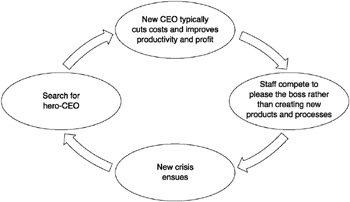
Figure 4.1: The search for a hero-CEO
Source: Senge et al (1999)
Senge offers some stark truths about organization change, which counteract the reliance on top-level vision set out by Bennis and Kotter.
- Little significant change can occur if it is driven from the top.
- CEO programmes rolled out from the top are a great way to foster cynicism and distract everyone from real efforts to change.
- Top management buy-in is a poor substitute for genuine commitment and learning capabilities at all levels in an organization.
You can see Senge’s point. How could one or two brave people at the top of an organization really be responsible for envisaging and tackling the enormous range of challenges that present themselves when fundamental change is attempted? He claims that we need to think about developing communities of interdependent leaders across organizations. Different types of leaders have different types of role. He identifies three important, interconnected types of leader: local line leaders, executive leaders and network leaders.
Local line leaders
These are the front-line managers who design the products and services and make the core processes work. Without the commitment of these people, no significant change will happen. These people are usually very focused on their own teams and customers. They rely on network leaders to link them with other parts of the organization, and on executive leaders to create the right infrastructure for good ideas to emerge and take root.
Executive leaders
These are management board members. Senge does not believe that all change starts here. Rather, he states that these leaders are responsible for three key things: designing the right innovation environment and the right infrastructure for assessment and reward, teaching and mentoring local line leaders, and serving as role models to demonstrate their commitment to values and purpose.
Network leaders
Senge makes the point that the really significant organizational challenges occur at the interfaces between project groups, functions and teams. Network leaders are people who work at these interfaces. They are guides, advisors, active helpers and accessors (helping groups of people to get resource from elsewhere), working in partnership with line leaders. They often have the insight to help local line leaders to move forward and make changes happen across the organization.
The interconnections are hard to achieve in reality. We have observed the following obstacles to achieving smooth interconnection between the different roles:
- Executive leaders are busy, hard-to-get-hold-of people who can become quite disconnected from their local line leaders.
- Executive leaders and local line leaders rarely meet face to face and communicate by e-mail, if at all.
- Network leaders, such as internal consultants or process facilitators, are often diverted from their leadership roles by requests either to perform expert tasks or to implement HR-led initiatives.
- Network leaders may be busy and effective, but are usually undervalued as leaders of change. They often have to battle to get recognized as important players in the organization.
Senge’s model recognizes the need for all three types of leader, and the need for connectivity between different parts of the organization if change is desired.
O Neill four key roles for successful change
Mary Beth O’Neill (2000) agrees with Senge’s idea of communities of leaders, and identifies four specific leadership roles necessary for successful and sustained change efforts in organizations. She uses Daryl Conner’s work on family therapy as her model for the change process, and identifies the important roles as sponsor, implementer, advocate and agent. See Table 4.4.
|
Role |
Description |
Hint |
|---|---|---|
|
Sponsor |
Has the authority to make the change happen. Has control of resources. |
Needs to have a clear vision for the change. Identify goals and measurable outcomes. |
|
Sustaining sponsor |
Sponsors change in own area, although top-level responsibility lies further up the hierarchy. |
Must be careful not to transmit cynicism |
|
Implementer |
Implements the change. Reports to sponsor. Responsible for giving live feedback to the sponsor on change progress. |
Needs to listen, enquire and clarify questions with the sponsor at the start of an initiative |
|
Change agent |
Facilitator of change. Helps sponsor and implementers stay aligned. Keeps sponsor on board. No direct authority over implementers. |
Acts as data gatherer, educator, advisor, meeting facilitator, coach |
|
Advocate |
Has an idea. Needs a sponsor to make it happen. Usually highly motivated. |
Must make idea appealing to sponsor |
|
Source: adapted from O’Neill (2000) |
||
Sponsor
The sponsor has the authority to make the change happen. He or she legitimizes and sanctions the change, and has line authority over the people who will implement the change and control of resources – such as time, money and people. There are also sustaining sponsors who are responsible for sponsoring change in their own area.
Good sponsors have a clear vision for the change. They identify goals and measurable outcomes for the initiative. Sustaining sponsors must be careful not to telegraph cynicism about the change to the team of implementers.
Implementer
Implementers are the people who must actually implement the change. They have direct line responsibilities to the sponsor. Their job is to provide the sponsor with live feedback from the change initiative. They can save the sponsor from tunnel vision, or from being surprised by obstacles that those closest to the change sometimes notice first.
Implementers are most effective when they listen, inquire and clarify their questions and concerns with the sponsor at the beginning of an initiative. This means they can commit to an effort rather than falsely complying early on and sabotaging later.
Change agent
A change agent is the facilitator of the change. He or she helps the sponsor and the implementers stay aligned with each other. The effectiveness of this role depends on the sponsor not abandoning the change agent to the implementers. The sponsor must not ‘drop the ball’. When this happens the change agent can over-function, making the system ineffective and unbalanced, and the change temporary.
The change agent acts as data gatherer, educator, advisor, meeting facilitator and coach. Most often he or she has no direct line authority over the implementers, and is therefore in a naturally occurring triangle among sponsor–implementer–agent.
Advocate
An advocate has an idea about how a change can happen but needs a sponsor for his or her idea. All change needs to be sponsored.
Advocates are often passionate and highly motivated to make the change happen. They must remember the key factor, which is to get a sponsor. Without this, advocates become frustrated and demoralized. Shrewd advocates promote ideas by showing their compatibility with issues near and dear to sponsors’ change projects and goals.
We have included Mary Beth O’Neill’s definitions of these roles because they provide a clear framework for those approaching organizational change, and illustrate the range of leadership roles necessary for change to occur. Our experience is that people at all levels in organizations find this framework useful for kicking off and sustaining change, and for judging how well the community of leaders is supporting the change process. This model seems to provide the necessary amount of clarity in today’s organizations, where hierarchy is unclear and jobs and projects overlap. There is often a need for a simple but flexible way of defining who does what in any process of change.
STOP AND THINK!
|
4.5 |
Use Mary Beth O’Neill’s four roles to analyse a change process in your organization. Who performed which role? How well were the roles performed? What contribution did the performance of these roles make to the level of success of the changes? |
LEADERSHIP STYLES AND SKILLS
Much has been written about leadership skills and leadership style. We have chosen the work of Goleman because we find it illuminating and useful when working with leaders at any stage in a change process. His work on leadership styles identifies a set of six styles for the leader to choose from in any situation and at any point in a change process. Leaders we have worked with find this very useful (see boxed examples).
This set of six styles is underpinned by Goleman’s work on emotional intelligence, which sets out the underlying competencies associated with successful leadership. This acts as a convenient checklist for those assessing their skills.
Goleman leadership that gets results
In his quest to discover the links between emotional intelligence and business results, Daniel Goleman (2000) developed a set of six distinct leadership styles through studying the performance of over 3,800 executives worldwide. These six leadership styles, arising from various different components of emotional intelligence, are used interchangeably by the best leaders. He encourages leaders to view the styles as six golf clubs, with each one being used in a different situation. Goleman also found that each style taken individually has a unique effect on organizational climate over time, some positive and some negative. This in turn has a major influence on business results.
Goleman links the competence of leaders directly to business results, but also identifies the situations in which each style is effective:
- Coercive style. Only to be used sparingly if a crisis arises. This is a useful style to employ if urgent changes are required now, but must be combined with other styles for positive results long term. Negative effects such as stress and mistrust result if this style is overused.
- Authoritative style. Useful when a turnaround is required and the leader is credible and enthusiastic. This is the ‘visionary’ leadership style. Goleman indicates that this style will only work if the leader is well respected by his or her people, and is genuinely enthusiastic about the change required. He does acknowledge the strongly positive effect of this approach, given the right prevailing conditions.
- Affiliative style. This style helps to repair broken relationships and establish trust. It can be useful when the going gets tough in a change process and people are struggling. However, it must be used with other styles to be effective in setting direction and creating progress.
- Democratic. This is an effective style to use when the team knows more about the situation than the leader does. They will be able to come up with ideas and create plans with the leader operating as facilitator. However it is not useful for inexperienced team members as they will go round in circles and fail to deliver.
- Pacesetting. This style can be used effectively with a highly motivated, competent team, but does not lead to positive results long term if used in isolation. Overuse of this style alone results in exhausted staff who feel directionless and unrewarded. The leader needs to switch out of this style to move into a change process rather than simply drive for more of the same.
- Coaching. This is an appropriate style to use if individuals need to acquire new skills or knowledge as part of changes being made.
THE COERCIVE-AFFILIATIVE MANAGER
I realize on reflection that I have been using just two leadership styles all my working life. I am 54, and this has been something of a revelation. I have been using the coercive style together with the affiliative style. It never occurred to me to do it any other way. I would tell the staff how things would be, give them a dressing down, and make up afterwards by talking about the football or asking about the family.
No one would make suggestions or use their initiative, and no one ever seemed to learn anything new. I was completely in charge of an efficient but stagnant site.
It wasn’t easy incorporating other styles, but once I had cracked the coaching style, things began to change. The staff began to see me as more accessible. Now my people trust me more, and they are prepared to take responsibility and to suggest things and to make changes. I use less energy to carry out my role, and can think more clearly about how best to lead.
General manager of a manufacturing plant
THE PACESETTING MANAGER
At first glance I thought I was using all six styles in the right measure. Then when I began to talk to my team about it, I realized that I was using the pacesetting style 85 per cent of the time. Even my attempts at being friendly (or affiliative) turned out to be pacesetting approaches. People described how a casual chat with me would end up feeling like an interrogation. People on the shop floor actively avoided me after a while. Or they spent ages preparing for an encounter with me.
Of course, all my star performers loved this style. They found it thrilling and stimulating. The others fell by the wayside as I had no time for coaching at all. My style became a self-fulfilling prophecy. The competent people did well, and those who needed to learn didn’t get the airtime from me that they needed, so they failed.
I’m not saying that this has completely changed. But now I do recognize when I need to coach and when I need to paceset. My actions are more aligned to my intentions, rather than being simply a question of habit.
Head teacher
See Table 4.5 for our summary of the six different styles and their uses.
|
Coercive |
Authoritative |
Affiliative |
Democratic |
Pace-setting |
Coaching |
|
|---|---|---|---|---|---|---|
|
Short defination |
Telling people what to do when |
Persuading and attracting people with an engaging vision |
Building relationships with people through use of positive feedback |
Asking the team what they think, and listening to this |
Raising the bar and asking for a bit more. Increasing the pace. |
Encouraging and supporting people to try new things. Developing their skills. |
|
When to use this style |
When there is a crisis |
When step change is required. When manager is both credible and enthusiastic. |
When relationships are broken |
When the team members have something to contribute |
When team members are highly motivated and highly competent |
When there is a skills gap |
|
Disadvantages of this style |
Encourages dependence. People stop thinking. |
Has a negative effect if manager is not credible |
Not productive if it is the only style used |
May lead nowhere if team is inexperienced |
Exhausting if used too much. Not appropriate when team members need help. |
If manager is not a good coach, or if individual is not motivated, this style will not work |
Goleman the importance of emotional intelligence for successful leaders
Underpinning Goleman’s six leadership style is his work on emotional intelligence (see Goleman, 1998). This is worth examining as it sets out all the competencies required to be a successful leader.
Goleman’s research into the necessity for emotional intelligence is convincing. First, his investigation into 181 different management competence models drawn from 121 organizations worldwide indicated that 67 per cent of the abilities deemed essential for management competence were emotional competencies. Further research carried out by Hay/McBer looked at data from 40 different corporations to determine the difference in terms of competencies between star performers and average performers. Again emotional competencies were found to be twice as important as skill-based or intellectual competencies.
EMOTIONAL COMPETENCIES FOR LEADERS
Self-awareness
Knowing one’s internal states, preferences, resources, and intuitions:
- Emotional awareness: recognizing one’s emotions and their effects.
- Accurate self-assessment: knowing one’s strengths and limits.
- Self-confidence: a strong sense of one’s self-worth and capabilities.
Self-management
Managing one’s internal states, impulses, and resources:
- Self-control: keeping disruptive emotions and impulses in check.
- Trustworthiness: maintaining standards of honesty and integrity.
- Conscientiousness: taking responsibility for personal performance.
- Adaptability: flexibility in handling change.
- Achievement orientation: striving to improve or meeting a standard of excellence.
- Initiative: readiness to act on opportunities.
Social awareness
Awareness of others’ feelings, needs, and concerns:
- Empathy: sensing others’ feelings and perspectives, and taking an active interest in their concerns.
- Organizational awareness: reading a group’s emotional currents and power relationships.
- Service orientation: anticipating, recognizing, and meeting customers’ needs.
Social skills
Adeptness at inducing desirable responses in others:
- Developing others: sensing others’ development needs and bolstering their abilities.
- Leadership: inspiring and guiding individuals and groups.
- Influence: wielding effective tactics for persuasion.
- Communication: listening openly and sending convincing messages.
- Change catalyst: initiating or managing change.
- Conflict management: negotiating and resolving disagreements.
- Building bonds: nurturing instrumental relationships.
- Teamwork and collaboration: working with others toward shared goals. Creating group synergy in pursuing collective goals.
Source: Goleman (1998), reproduced with permission of Bloomsbury, London
Goleman defined a comprehensive set of emotional competencies for leaders (see box). He grouped these competencies into four categories:
- self-awareness;
- self-management;
- social awareness;
- social skills.
Self-awareness, he says, is at the heart of emotional intelligence. To back this up, Goleman’s research shows that if self-awareness is not present in a leader, the chance of that person being competent in the other three categories is much reduced.
THE IMPORTANCE OF SELF-MANAGEMENT
The managers that we work with often have high drive levels and are also very intelligent. When this combination of characteristics is present in an individual, that individual often experiences a lot of frustration. Other people are either too slow, or too relaxed, or simply ‘not getting it’.
This was crystallized by a very dynamic and successful IT manager whom I worked with recently. When I went through her emotional intelligence feedback with her using HayGroup’s Emotional Competence Inventory, her self-management scores were low, especially in the area of self-control. I asked her how often she felt frustrated in her work. She paused for a moment and then with a sudden realization she said, ‘All the time.’ Up until that point, she had not realized that there was an issue. This had just become a way of life. Others were experiencing her as bad tempered, moody and occasionally bullying. Then we started to talk about strategies for dealing with this.
Esther Cameron, 2003
A brief scan of the competence set will confirm that self-awareness, self-management and social awareness are all competencies that are not necessarily observable. We call this inner leadership. Only the social skills category contains obvious observable behaviours. We call this outer leadership.
In our experience those involved in leading change have to develop especially strong inner leadership because of the emotions arising from their own drive to achieve, coupled with potential resistance from many levels, and the discomfort involved with letting go of old habits. It is a very emotional landscape!
Daniel Goleman says that it is vital that leaders develop emotional competencies. He says:
In the new stripped-down, every-job-counts business climate, these human realities will matter more than ever. Massive change is constant; technical innovations, global competition, and the pressures of institutional investors are ever-escalating forces for flux. As organizations shrink through waves of downsizing, those people who remain are more accountable – and more visible.
Whereas a bully, or a hypersensitive manager, might have gone unnoticed deep in many organizations 10 years ago, he or she is much more visible now.
STOP AND THINK!
|
4.6 |
Draw a pie chart that represents your own use of Goleman’s six leadership styles. Are you using them in the right proportion? If not, what do you plan to do differently and why? Try this exercise again, but this time use the framework to help someone else to focus on his or her leadership style. Write up the conversation, indicating what insights the exercise provoked. |
DIFFERENT LEADERSHIP FOR DIFFERENT PHASES OF CHANGE
In this section we examine the different phases of the change process, to identify the need for a leader to perform different skills or activities during each phase. We do this by using three different but complimentary models of the change process.
Cameron and Green inner and outer leadership
In our own experience of working with leaders on change processes, it is important to establish phases of change so that plans can be made and achievements recognized. This phasing also enables a leader to see the need for flexibility in leadership style, as the change moves from one phase into another phase. We have identified both the outer leadership and inner leadership requirements of a leader of change for each phase. See Table 4.6.
|
Phase of change |
Outer leadership – observable actions of the leader |
Inner leadership – what goes on inside the leader |
|---|---|---|
|
1. Establishing the need for change The leader illuminates a problem area through discussion |
Influencing, understanding, researching, presenting, listening |
Managing emotions, maintaining integrity, being courageous, being patient, knowing yourself, judging whether you really have the energy to do this |
|
2. Building the change team The leader brings the right people together and establishes momentum through teamwork. |
Chairing meetings, connecting agendas, facilitating discussion, building relationships, building teams, cutting through the politics |
Social and organizational awareness, self-awareness, managing emotions, adaptability, taking initiative, having the drive to achieve, maintaining energy despite knock-backs |
|
3. Creating vision and values The leader works with the group to build a picture of success. |
Initiating ideas, brainstorming, encouraging divergent and creative thinking, challenging others constructively, envisaging the future, facilitating agreement |
Strategic thinking, taking time to reflect, social awareness, drive to achieve, managing emotions |
|
4. Communicating and engaging The leader plays his or her role in communicating direction, giving it meaning, being clear about timescale and letting people know what part they will be playing. |
Persuading and engaging, presenting with passion, listening, being assertive, being creative with ways of communicating |
Patience, analysis of how to present to different audiences, managing emotions with regard to other people’s resistance, social awareness, adaptability, empathy |
|
5. Empowering others The leader entrusts those who have been involved in the creation of the new vision with key tasks. |
Clear target setting, good delegation, managing without micromanaging or abdicating, coaching |
Integrity, trust, patience, drive to achieve, steadiness of purpose, empathy |
|
6. Noticing improvements and energizing The leader stays interested in the process. This involves the ability to juggle lots of different projects and initiatives |
Playing the sponsorship role well, walking the talk, rewarding and sharing success, building on new ideas |
Steadiness of purpose, organizational and social awareness, empathy, managing emotions, drive to achieve |
|
7. Consolidating The leader encourages people to take stock of where they are, and reflect on how much has been achieved |
Reviewing objectively, celebrating success, giving positive feedback before moving on to what’s next |
Social awareness, empathy, drive to achieve, taking time to reflect, steadiness of purpose |
Kotter the importance of getting the early steps right
Kotter’s eight steps to transforming your organization (see Chapter 3) form a comprehensive guide to tackling the process of change. Kotter says that good leaders must get all eight steps right. However, he predicts that the process will be a great deal easier if groundwork is done well.
In Leading Change (1996), Kotter describes some of the actions a leader needs to take during all eight steps. In Table 4.7 we give some of Kotter’s suggestions for the first four steps, as they seem to necessitate the most direct action from the leader.
|
Kotter’s step |
Recommended actions |
|---|---|
|
1. Establishing a sense of urgency |
Push up the urgency level. Create a crisis by exposing issues rather than protecting people from them. Send more data to people about customer satisfaction, especially where weaknesses are demonstrated. Encourage more honest discussion of these issues. |
|
2. Creating the guiding coalition |
Include enough main line managers, enough relevant expertise, enough people with good credibility and reputation in the organization and enough ability to lead. Avoid big egos and snakes (who engender distrust). Talk a lot together, build trust and build a common goal. |
|
3. Developing a vision and strategy |
Vision building is a messy, difficult and sometimes emotionally charged exercise. Take time to do the process properly and expect it to take months. It is never achieved in a single meeting. |
|
4. Communicating the change vision |
Keep the communication simple and use metaphor and analogy. Creativity is necessary to ensure that many different forms of communication are used to repeat the message, including leading by example. Use two-way discussions and listen to the feedback. |
Rosabeth Moss Kanter learning how to persevere
Rosabeth Moss Kanter (2002) highlights the need for keeping going in the change process, even when it gets tough. She says that too often executives announce a plan, launch a task force and then simply hope that people find the answers. Kanter’s emphasis is different from Kotter’s. She says the difficulties will come after the change is begun.
Kanter says that leaders need to employ the following strategies to ensure that a change process is sustained beyond the first flourish:
- Tune into the environment. Create a network of listening posts to listen and learn from customers.
- Challenge the prevailing organizational wisdom. Promote kaleidoscopic thinking. Send people far afield, rotate jobs and create interdisciplinary project teams to get people to question their assumptions.
- Communicate a compelling aspiration. This is not just about communicating a picture of what could be, it is an appeal to better ourselves and become something more. The aspiration needs to be compelling as there are so many sources of resistance to overcome.
- Build coalitions. Kanter says that the coalition-building step, though obvious, is one of the most neglected steps in the change process. She says that change leaders need the involvement of people who have the resources, the knowledge and the political clout to make things happen.
- Transfer ownership to a working team. Once a coalition is formed, others should be brought on board to focus on implementation. Leaders need to stay involved to guarantee time and resources for implementers. The implementation team can then build its own identity and concentrate on the task.
- Learn to persevere. Kanter says that everything can look like a failure in the middle. If you stick with the process through the difficult times (see box), good things may emerge. The beginning is exciting and the end satisfying. It is the hard work in the middle that necessitates the leader’s perseverance.
- Make everyone a hero. Leaders need to remember to reward and recognize achievements. This skill is often underused in organizations, and it is often free! This part of the cycle is important to motivate people to give them the energy to tackle the next change process.
STICKY MOMENTS IN THE MIDDLE OF CHANGE AND HOW TO GET UNSTUCK:
- Forecasts fall short. Change leaders must be prepared to accept serious departures from plans, especially when they are doing something new and different.
- Roads curve. Expect the unexpected. Do not panic when the path of change takes a twist or a turn.
- Momentum slows. When the going gets tough it is important to review what has been achieved and what remains – and to revisit the mission.
- Critics emerge. Critics will emerge in the middle when they begin to realize the impact of proposed changes. Change leaders should respond to this, remove obstacles and move forward.
Source: Kanter (2002)
Bridges leading people through transition
William Bridges (1991) has very clear ideas about what leaders need to do to make change work. Bridges says that what often stops people from making new beginnings in a change process is that they have not yet let go of the past. He sees the leader as the person who helps to manage that transition. We see this as a particularly useful frame of thinking when an inevitable change such as a merger, acquisition, reorganization or site closure is underway.
In Chapter 3 we referred to his three phases of transition:
- ending;
- neutral zone;
- new beginning.
Leadership for the ending
Here is Bridges’ advice for how to manage the ending phase (or how to get them to let go):
- Study the change carefully and identify who is likely to lose what.
- Acknowledge these losses openly – it is not stirring up trouble. Sweeping losses under the carpet stirs up trouble.
- Allow people to grieve and publicly express your own sense of loss.
- Compensate people for their losses. This does not mean handouts! Compensate losses of status with a new type of status. Compensate loss of core competence with training in new areas.
- Give people accurate information again and again.
- Define what is over and what is not.
- Find ways to ‘mark the ending’ (see box).
- Honour rather than denigrate the past.
MARKING THE END
When a large public owned utility company in the UK split up into a myriad of small privatized units, there was a great sense of loss. Old teams and old friendships were breaking up. It was the end of an era. The organization held a wake, at which everyone moaned and complained and generally got things off their chest. There was much talk late into the night. The transition moved more smoothly after that event as people began to accept the reality and inevitability of the ending.
Leadership for the neutral zone
The neutral zone is an uncomfortable place to be. This is the time when for instance, the reorganization has been announced, but the new organization is not in place, or understood, or working. Anxiety levels go up and motivation goes down, and discord amongst the team can rise. This phase needs to be managed well, or it can lead to chaos. A selection of Bridges’ tips for this phase are listed below (he itemizes 21 in his book):
- Explain the neutral zone as an uncomfortable time which with careful attention can be turned to everyone’s advantage.
- Choose a new and more affirmative metaphor with which to describe it.
- Reinforce the metaphor with training programmes, policy changes and financial rewards for people to keep doing their jobs during the neutral zone.
- Create temporary policies, procedures, roles and reporting relationships to get you through the neutral zone.
- Set short-range goals and checkpoints.
- Set up a transition monitoring team to keep realistic feedback flowing upward during the time in the neutral zone.
- Encourage experimentation and risk taking. Be careful not to punish all failures.
- Encourage people to brainstorm many answers to the old problems – the ones that people say you just have to live with. Do this for your own problems too.
Leadership for the new beginning
Here are some of Bridges’ ideas for this phase:
- Distinguish in your own mind the difference between the start, which can happen on a planned schedule, and the beginning, which will not.
- Communicate the purpose of the change.
- Create an effective picture of the change and communicate it effectively.
- Create a plan for bringing people through the three phases of transition, and distinguish it from the change management plan.
- Help people to discover the part they will play in the new system.
- Build some occasions for quick success.
- Celebrate the new beginning and the conclusion of the time of transition.
STOP AND THINK!
|
4.7 |
Reflect on an organizational change in which you were involved. Did the ‘sticky moments’ suggested by Rosabeth Moss Kanter arise, and how were they dealt with? What could have been done differently by those leading the change? |
|
4.8 |
Imagine that the organization you work for as a line manager is about to be taken over by one of your key competitors. You have been told that everyone in your area will still have a job, but you will have to learn about the other organization’s way of doing business and drop many of the products and services you deliver now. Use the William Bridges’ tips to list some of the things you would need to start doing to enable the transition. |
THE IMPORTANCE OF SELF KNOWLEDGE AND INNER RESOURCES
Much is expected of a leader throughout a change process. It takes courage, a sense of purpose, the ability to manage your emotions, high integrity and a wide range of skills to lead change well. A great deal has been written about skills development, but what about self-knowledge and inner resources? How great a part does the inner life of the leader play in his or her ability to lead change, and how can this capacity be developed or improved?
We believe that this is the key to successful leadership; so does Daniel Goleman. See above to read about his research into leadership success which indicates that self-awareness forms the bedrock of the emotionally intelligent leader.
Bennis the role of self knowledge
Warren Bennis (1994) emphasizes the need to know yourself in order to become a good leader. He says that leaders must have self-knowledge if they want to be freed up sufficiently to think in new ways. Bennis claims that you make your life your own by understanding it, and become your own designer, rather than being designed by your own experience. He itemizes four lessons of self-knowledge. These are:
- One: be your own teacher. Leaders assume responsibility for their own learning, and treat it as a route to self-knowledge and self-expression. No one can teach them the lessons they need to learn. Stumbling blocks can be denial and blame.
- Two: accept responsibility and blame no one. Do not expect other people to take charge, or do things for you.
- Three: you can learn anything you want to learn. Leadership involves a kind of fearlessness, an optimism and a confidence.
- Four: true understanding comes from reflecting on your experience. Leaders make reflection part of their daily life. An honest look at the past prepares you for the future.
Bennis also notes the potential benefits of leaders recalling their childhoods honestly, reflecting on them, understanding them, and thereby overcoming the influence that childhood has on them. He quotes Erikson, the famed psychoanalyst, who says that there are eight stages of life each with an accompanying crisis (see Table 4.8). Erikson claims that the way in which we resolve the eight crises determines who we will be. He also notes that we may get stuck at a particular stage if we do not manage to solve the crisis satisfactorily. For instance many of us never overcome the inner struggle between initiative and guilt, and so we lack purpose.
|
Stage |
Crisis |
Resolution |
Conditions for optimal development |
|---|---|---|---|
|
Infancy (0–18 months) |
Trust vs mistrust |
Hope or withdrawal |
Mirroring Acceptance |
|
Early childhood (18 months–3 years) |
Autonomy vs shame and doubt |
Will or compulsion |
Security (routines and rituals) |
|
Play age (3–5 years) |
Initiative vs guilt |
Purpose or inhibition |
Clear boundaries Vision setting |
|
School age (8–12 years) |
Industry vs inferiority |
Competence or inertia |
Spectators Discipline |
|
Adolesence (12–28 years) |
Identity vs identity confusion |
Fidelity or repudiation |
Sampling Modelling |
|
Young adulthood (28–40 years) |
Intimacy vs isolation |
Love or exclusivity |
Maturity Identity |
|
Adulthood (40–55 years) |
Generativity vs stagnation |
Care or rejectivity |
Balance Mastery |
|
Maturity (55+) |
Integrity vs despair |
Wisdom or disdain |
Support Forgiveness |
|
Source: adapted from Erik Erikson in Bennis (1994) |
|||
As a leader you may need to overcome some of the habits you developed at an early age, which will be challenging but rewarding. Usually this process is accomplished via coaching, counseling or therapy depending on how deep you want or need to go.
Covey the need for principle centred leadership
Steve Covey is a writer and teacher who has had a tremendous effect on the psyche of UK and US managers. His book Principle-Centred Leadership (1992) was a New York Times bestseller for 220 weeks. His characteristics of principle-centred leaders (see box) and his seven habits (see below) are much quoted in management and leadership training courses. Again, his focus is on inner leadership, that is, on how to be rather than on what to do.
EIGHT CHARACTERISTICS OF PRINCIPLE-CENTERED LEADERS
- They are continually learning.
- They are service oriented.
- They radiate positive energy.
- They believe in other people.
- They lead balanced lives.
- They see life as an adventure.
- They are synergistic.
- They exercise for renewal on all four dimensions of human personality – physical, mental, emotional and spiritual.
Source: Covey (1992)
Covey’s organization runs workshops and programmes underpinned by a humanistic self-development approach. Unlike Bennis, he does not advocate revisiting your childhood to overcome difficulties, but encourages us to focus on visualizing a positive outcome and working with energy and enthusiasm towards it.
Covey’s seven habits (Covey, 1989) connect the leader’s outer habits with the inner capability, which he labels endowments:
- Habit 1: Be proactive. Know what needs to be done, and decide to do it. Do not be driven by circumstances. (Needs self-awareness and self-knowledge.)
- Habit 2: Begin with the end in mind. Have a clear sense of what you are trying to achieve in each year, month, day, moment. (Needs imagination and conscience.)
- Habit 3: Put first things first. This is about organizing how you spend your time in line with Habit 2. He talks about looking at level of urgency and level of importance of activities, and comments that we spend too much time responding to urgent issues. (Needs willpower.)
- Habit 4: Think win–win. Manage all interactions with the assumption that mutually beneficial solutions are possible. (Needs an abundance mentality.)
- Habit 5: Seek first to understand, then to be understood. Be prepared to clarify what other people are getting at before you put your point across. (Needs courage balanced with consideration.)
- Habit 6: Synergize. Value differences in people and work with others to create a sum that is greater than the parts. (Needs creativity.)
- Habit 7: Sharpen the saw. Avoid the futility of endless ‘busyness’. Make time to renew. Covey says, ‘Without this discipline, the body becomes weak, the mind mechanical, the emotions raw, the spirit insensitive, and the person selfish.’ (Needs continuous improvement or self-renewal.)
STOP AND THINK!
|
4.9 |
Identify the top five inner leadership strengths that you believe the headmaster or headmistress of an underperforming school needs to have. Use the ideas of Bennis and Covey in the section above, and consider also Goleman’s emotional competencies. Justify your choices. How could these areas be developed if they were lacking? |
|
4.10 |
Reflect on your own leadership using Covey’s seven habits. What are your strengths and weak areas? |
|
4.11 |
Imagine you have just been asked to lead a cultural change programme in a 10,000 strong organization based throughout Europe and the United States. The organization is a microelectronics company which has grown through acquisition and now wants to strengthen its unique culture as one organization emphasizing commercial applications, customer service and innovation. Using the ideas presented in this chapter, describe the approach you would take to leading this initiative and explain why. |
SUMMARY AND CONCLUSIONS
- Different metaphors of change lead to different assumptions about what good leaders do. We believe that the most effective ideas about change combine a number of metaphors, bringing the maximum benefits and avoiding the pitfalls of blinkered thinking.
- A popular notion of leadership is of the hero-leader who leads from the front with determination, great vision and independence of mind.
- Bennis places visionary leadership high on the agenda, and makes a point of distinguishing leadership from management. Kotter echoes this view.
- Studies that compared the effects of ‘transformational leadership’ with those of ‘transactional leadership’ at the end of the 20th century indicated that charismatic and inspirational leadership were the elements that led most reliably to team success.
- Howard Gardner’s research into the minds of significant 20th century leaders indicated that leaders who had great influence embodied stories and took care to connect well with their audiences.
- Heifetz and Laurie and Jean Lipman-Blumen all argue against the need for visionary leadership. Heifetz and Laurie advocate adaptive leadership which is about taking people out of their comfort zones, letting people feel external pressure and exposing conflict. Jean Lipman-Blumen instead emphasizes the need for leaders to ensure connectivity. She says leaders need to be able to perceive connections among diverse people, ideas and institutions even when the parties themselves do not.
- 21st-century organizations are different, and the pace of change is even faster. This has given rise to new ideas about where leaders need to put their energies. Perhaps this means less vision and more connectivity.
- Different metaphors of the change process imply different leadership roles. Senge advocates dispersed leadership, identifying three key types of leader in an organizational system. If these three roles are in place and are well connected, then change will happen naturally. Mary Beth O’Neill names four key leadership roles in any change process.
- Inner leadership is about what goes on inside the leader. Outer leadership is about what the leader does. Outer and inner leadership are both important for achieving organizational change.
- Daniel Goleman defines six leadership styles. A leader can select the right style for the right situation, taking into account the necessary conditions for success and long-term consequences. Goleman’s checklist of emotional intelligence competencies is useful for any leader wishing to be successful. These competencies include both inner and outer leadership elements.
- Kotter says that the hard work must be put in early in the change process, while Rosabeth Moss Kanter says the hardest part comes in the middle and that perseverance is key. Bridges identifies specific leadership tasks during endings, the neutral zone and beginnings.
- Bennis and Covey both place high value on the inner life of leaders. Bennis emphasizes the need for self-knowledge, whereas Covey lists a set of principles and guidelines to help leaders to develop positive thinking patterns.
Leadership is a fascinating subject. We all have different experiences and different views about what makes a good leader, and many of these views are ones we hold quite strongly. There are many apparent contradictions here. It is always intriguing to see how leaders with very different styles can both be equally successful. This observation can appear baffling to those wishing to make a rational assessment of what works in leadership and what does not work.
So how do we get to the truth about leaders? Do our heroes give us useful clues? The hero-leader is an enduring theme in discussions of leadership. Even the process of asking people to name their ‘top leaders’ encourages an individualist perspective, and automatically results in the naming of heroes. Perhaps this type of information is flawed, as it depends so much on the profile-raising skills of the leader, and his or her own personal brand. The facts concerning how these leaders demonstrated good leadership get lost in the general impression of success.
Leaders who offer a vision, or have a strong story, tend to be the most memorable. Their stories, or new ways of thinking, if taken on, may outlive the leader. Is this a sign of great leadership: when the story begins to live outside of the leader? There is also a strong sense that today’s followers need more than just a good story. They need a credible story that stands up to scrutiny.
On the other hand, those who doubt the viability of the role of visionary leadership suggest that leaders need to focus instead on connecting agendas and highlighting painful challenges. Our view is that all these things are necessary to create change, including the articulation of an attractive vision. Just read the words of Martin Luther-King again to feel the power of a well-articulated vision. Other things need to be in place too: the timing has to be right, and the vision has to be accepted by followers.
The leader of change has to be courageous and self-aware. He or she has to choose the right action at the right time, and to keep a steady eye on the ball. However, the leader cannot make change happen alone. A team needs to be in place, with well-thought-out roles, and committed people who are in for the duration, not just for the kick-off.
One thing is certain: the going will not be smooth.
Part I - The Underpinning Theory
Part II - The Applications

EAN: 2147483647
Pages: 96
- Structures, Processes and Relational Mechanisms for IT Governance
- Integration Strategies and Tactics for Information Technology Governance
- An Emerging Strategy for E-Business IT Governance
- Linking the IT Balanced Scorecard to the Business Objectives at a Major Canadian Financial Group
- The Evolution of IT Governance at NB Power
