Individual change
INTRODUCTION
This chapter draws together the key theories of how individuals go through change, using various models to explore this phenomenon. The aims of this chapter are to give managers and others experiencing or implementing change an understanding of the change process and how it impacts individuals, and strategies to use when helping people through change to ensure results are achieved.
This chapter covers the following topics, each of which takes a different perspective on individual change:
- Learning and the process of change – in what ways can models of learning help us understand individual change?
- The behavioural approach to change – how can we change people’s behaviour?
- The cognitive approach to change – how change can be made attractive to people and how people can achieve the results that they want.
- The psychodynamic approach to change – what’s actually going on for people.
- The humanistic psychology approach to change – how can people maximize the benefits of change?
- Personality and change – how do we differ in our responses to change?
- Managing change in self and others – if we can understand people’s internal experience and we know what changes need to happen, what is the best way to effect change?
As the box points out, a key point for managers of change is to understand the distinction between the changes being managed in the external world and the concurrent psychological transitions that are experienced internally by people (including managers themselves).
FOOD FOR THOUGHT
It was the ancient Greek philosopher, Heraclitus, who maintained that you never step into the same river twice. Of course most people interpret that statement as indicating that the river – that is, the external world – never stays the same, is always changing: constant flux, in Heraclitus’s words again. However there is another way of interpreting what he said. Perhaps the ‘you’ who steps into the river today is not the same ‘you’ who will step into the river tomorrow. This interpretation – which might open up a whole can of existential and philosophical worms – is much more to do with the inner world of experience than with the external world of facts and figures.
Immediately therefore we have two ways of looking at and responding to change: the changes that happen in the outside world and those changes that take place in the internal world. Often though, it is the internal reaction to external change that proves the most fruitful area of discovery, and it is often in this area that we find the reasons external changes succeed or fail.
In order to demonstrate this, we will draw on four approaches to change. These are the behavioural, the cognitive, the psychodynamic and the humanistic psychological approaches, as shown in Figure 1.1.
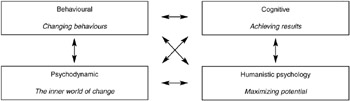
Figure 1.1: Four approaches to individual change
We will also look at Edgar Schein’s analysis of the need to reduce the anxiety surrounding the change by creating psychological safety. This is further illuminated by discussion of the various psychodynamics that come into play when individuals are faced with change, loss and renewal.
Finally we will explore tools and techniques that can be used to make the transition somewhat smoother and somewhat quicker. This will include a summary of how the Myers Briggs Type Indicator, which is used to develop personal and interpersonal awareness, can illuminate the managerial challenges at each stage of the individual change process. But first we will begin our exploration though by looking at how individuals learn.
LEARNING AND THE PROCESS OF CHANGE
Buchanan and Huczynski (1985) define learning as ‘the process of acquiring knowledge through experience which leads to a change in behaviour’. Learning is not just an acquisition of knowledge, but the application of it through doing something different in the world.
Many of the change scenarios that you find yourself in require you to learn something new, or to adjust to a new way of operating, or to unlearn something. Obviously this is not always the case – a company takes over your company but retains the brand name, the management team and it is ‘business as usual’ – but often in the smallest of changes you need to learn something new: your new boss’s likes and dislikes, for example.
A useful way of beginning to understand what happens when we go through change is to take a look at what happens when we first start to learn something new. Let us take an example of driving your new car for the first time. For many people the joy of a new car is tempered by the nervousness of driving it for the first time. Getting into the driving seat of your old car is an automatic response, as is doing the normal checks, turning the key and driving off. However, with a new car all the buttons and control panels might be in different positions. One can go through the process of locating them either through trial and error, or perhaps religiously reading through the driver’s manual first. But that is only the beginning, because you know that when you are actually driving any manner of things might occur that will require an instantaneous response: sounding the horn, flashing your lights, putting the hazard lights on or activating the windscreen wipers.
All these things you would have done automatically but now you need to think about them. Thinking not only requires time, it also requires a ‘psychological space’ which it is not easy to create when driving along at your normal speed. Added to this is the nervousness you may have about it being a brand new car and therefore needing that little bit more attention so as to avoid any scrapes to the bodywork.
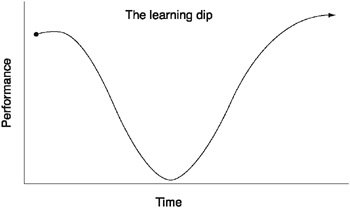
Figure 1.2: The learning dip
As you go through this process, an external assessment of your performance would no doubt confirm a reduction in your efficiency and effectiveness for a period of time. And if one were to map your internal state your confidence levels would most likely dip as well. Obviously this anxiety falls off over time. This is based on your capacity to assimilate new information, the frequency and regularity with which you have changed cars, and how often you drive.
Conscious and unconscious competence and incompetence
Another way of looking at what happens when you learn something new is to view it from a Gestalt perspective. The Gestalt psychologists suggested that people have a worldview that entails some things being in the foreground and other things being in the background of their consciousness.
To illustrate this, the room where I am writing this looks out on to a gravel path which leads into a cottage garden sparkling with the sun shining on the frost-covered shrubs. Before I chose to look up, the garden was tucked back into the recesses of my consciousness. (I doubt whether it was even in yours.) By focusing attention on it I brought it into the foreground of my consciousness. Likewise all the colours in the garden are of equal note, until someone mentions white and I immediately start to notice the snowdrops, the white narcissi and the white pansies. They have come into my foreground.
Now in those examples it does not really matter what is fully conscious or not. However in the example of driving a new car for the first time something else is happening. Assuming that I am an experienced driver, many of the aspects of driving, for me, are unconscious. All of these aspects I hopefully carry out competently. So perhaps I can drive for many miles on a motorway, safe in the knowledge that a lot of the activities I am performing I am actually doing unconsciously. We might say I am unconsciously competent. However, as soon as I am in the new situation of an unfamiliar car I realize that many of the things I took for granted I cannot now do as well as before. I have become conscious of my incompetence. Through some trial and error and some practice and some experience I manage – quite consciously – to become competent again. But it has required focus and attention. All these tasks have been in the fore-front of my world and my consciousness. It will only be after a further period of time that they recede to the background and I become unconsciously competent again(Figure 1.3).
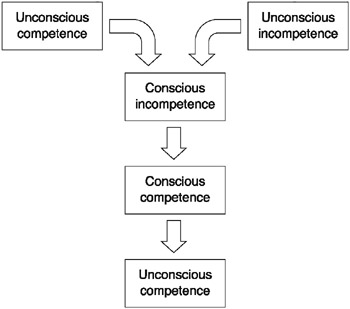
Figure 1.3: Unconscious competence
Of course there is another cycle: not the one of starting at unconscious competence, but one of starting at unconscious incompetence! This is where you do not know what you do not know, and the only way of realizing is by making a mistake (and reflecting upon it), or when someone kind enough and brave enough tells you. From self-reflection or from others’ feedback your unconscious incompetence becomes conscious, and you are able to begin the cycle of learning.
Kolb s learning cycle
David Kolb (1984) developed a model of experiential learning, which unpacked how learning occurs, and what stages a typical individual goes through in order to learn. It shows that we learn through a process of doing and thinking. (See Figure 1.4.) Following on from the earlier definition of learning as ‘the process of acquiring knowledge through experience which leads to a change in behaviour’, Kolb saw this as a cycle through which the individual has a concrete experience. The individual actually does something, reflects upon his or her specific experience, makes some sense of the experience by drawing some general conclusions, and plans to do things different in the future. Kolb would argue that true learning could not take place without someone going through all stages of the cycle.
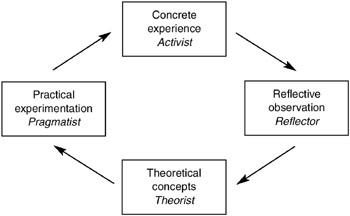
Figure 1.4: Kolb's learning cycle
In addition, research by Kolb suggested that different individuals have different sets of preferences or styles in the way they learn. Some of us are quite activist in our approach to learning. We want to experience what it is that we need to learn. We want to dive into the swimming pool and see what happens (immerse ourselves in the task). Some of us would like to think about it first! We like to reflect, perhaps on others’ experience before we take action. The theorists might like to see how the act of swimming relates to other forms of sporting activity, or investigate how other mammals take the plunge. The pragmatists amongst us have a desire to relate what is happening to their own circumstances. They are interested in how the act of swimming will help them to achieve their goals.
Not only do we all have a learning preference but also the theory suggests that we can get stuck within our preference.
FOOD FOR THOUGHT
If you were writing a book on change and wanted to maximize the learning for all of your readers perhaps you would need to:
- encourage experimentation (activist);
- ensure there were ample ways of engendering reflection through questioning (reflector);
- ensure the various models were well researched (theorist);
- illustrate your ideas with case studies and show the relevance of what you are saying by giving useful tools, techniques and applications (pragmatist).
So activists may go from one experience to the next one, not thinking to review how the last one went or planning what they would do differently. The reflector may spend inordinate amounts of time conducting project and performance reviews, but not necessarily embedding any learning into the next project. The theorist can spend a lot of time making connections and seeing the bigger picture by putting the current situation into a wider context, but they may not actually get around to doing anything. Pragmatists may be so intent on ensuring that it is relevant to their job that they can easily dismiss something that does not at first appear that useful.
STOP AND THINK!
|
1.1 |
A new piece of software arrives in the office or in your home. How do you go about learning about it?
|
THE BEHAVIOURAL APPROACH TO CHANGE
The behavioural approach to change, as the name implies, very much focuses on how one individual can change another individual’s behaviour using reward and punishment, to achieve intended results. If the intended results are not being achieved then an analysis of the individual’s behaviour will lead to an understanding of what is contributing to success and what is contributing to non-achievement. In order to elicit the preferred behaviour the individual must be encouraged to behave that way, and discouraged from behaving any other way. This approach has its advantages and disadvantages.
For example, an organization is undergoing a planned programme of culture change, moving from being an inwardly focused bureaucratic organization to a flatter and more responsive customer oriented organization. Customer facing and back office staff will all need to change the way they behave towards customers and towards each other to achieve this change. A behavioural approach to change will focus on changing the behaviour of staff and managers. The objective will be behaviour change, and there will not necessarily be any attention given to improving processes, improving relationships or increasing involvement in goal setting. There will be no interest taken in how individuals specifically experience that change.
This whole field is underpinned by the work of a number of practitioners. The names of Pavlov and Skinner are perhaps the most famous. Ivan Pavlov noticed while researching the digestive system of dogs that when his dogs were connected to his experimental apparatus and offered food they began to salivate. He also observed that, over time, the dogs started to salivate when the researcher opened the door to bring in the food. The dogs had learnt that there was a link between the door opening and being fed. This is now referred to as classical conditioning.
CLASSICAL CONDITIONING
Unconditioned stimulus (food) leads to an unconditioned response (salivation).
If neutral stimulus (door opening) and unconditioned stimulus (food) are associated, neutral stimulus (now a conditioned stimulus) leads to unconditioned response (now a conditioned response).
Pavlov (1928)
Further experimental research led others to realize that cats could learn how to escape from a box through positive effects (rewards) and negative effects (punishments). Skinner (1953) extended this research into operant conditioning, looking at the effects of behaviours, not just at the behaviours themselves. His experiments with rats led him to observe that they soon learnt that an accidental operation of a lever led to there being food provided. The reward of the food then led to the rats repeating the behaviour.
Using the notion of rewards and punishments, four possible situations arise, as demonstrated in Table 1.1.
|
Actions |
Positive |
Negative |
|---|---|---|
|
Addition |
Positive reinforcement Pleasurable and increases probability of repeat behaviour |
Punishment Unpleasant (for example, an electric shock) leading to decrease in repeat behaviour |
|
Subtraction |
Extinction Avoidance of an unpleasant stimulus increases the likelihood of repeat behaviour |
Negative reinforcement Removal of a pleasant stimulus decreases the likelihood of repeat behaviour |
STOP AND THINK!
|
1.2 |
What rewards and what punishments operate in your organization? How effective are they in bringing about change? |
So in what ways may behaviourism help us with individuals going through change? In any project of planned behaviour change a number of steps will be required:
- Step 1: The identification of the behaviours that impact performance.
- Step 2: The measurement of those behaviours. How much are these behaviours currently in use?
- Step 3: A functional analysis of the behaviours – that is, the identification of the component parts that make up each behaviour.
- Step 4: The generation of a strategy of intervention – what rewards and punishments should be linked to the behaviours that impact performance.
- Step 5: An evaluation of the effectiveness of the intervention strategy.
Reinforcement strategies
When generating reward strategies at Step 4 above, the following possibilities should be borne in mind:
Financial reinforcement
Traditionally financial reinforcement is the most explicit of the reinforcement mechanisms used in organizations today, particularly in sales oriented cultures. The use of bonus payments, prizes and other tangible rewards is common. To be effective the financial reinforcement needs to be clearly, closely and visibly linked to the behaviours and performance that the organization requires.
A reward to an outbound call centre employee for a specific number of appointments made on behalf of the sales force would be an example of a reinforcement closely linked to a specified behaviour. A more sophisticated system might link the reward to not only the number of appointments but also the quality of the subsequent meeting and also the quality of the customer interaction.
An organization-wide performance bonus unrelated to an individual’s contribution to that performance would be an example of a poorly linked reinforcement.
Non-financial reinforcement
Non-financial reinforcement tends to take the form of feedback given to an individual about performance on specific tasks. The more specific the feedback is, the more impactful the reinforcement can be. This feedback can take both positive and negative forms. This might well depend on the organizational culture and the managerial style of the boss. This feedback perhaps could take the form of a coaching conversation, where specific effective behaviours are encouraged, and specific ineffective behaviours are discouraged and alternatives generated.
Social reinforcement
Social reinforcement takes the form of interpersonal actions: that is, communications of either a positive or negative nature. Praise, compliments, general recognition, perhaps greater (or lesser) attention can all act as a positive reinforcement for particular behaviours and outcomes. Similarly social reinforcement could also take the form of ‘naming and shaming’ for ineffective performance.
Social reinforcement is not only useful for performance issues, but can be extremely useful when an organizational culture change is underway. Group approval or disapproval can be a determining factor in defining what behaviours are acceptable or unacceptable within the culture. New starters in an organization often spend quite some time working out which behaviours attract which reactions from bosses and colleagues.
Motivation and behaviour
The pure behaviourist view of the world, prevalent in industry up to the 1960s, led to difficulties with motivating people to exhibit the ‘right’ behaviours. This in turn led researchers to investigate what management styles worked and did not work.
In 1960 Douglas McGregor published his book The Human Side of Enterprise. In it he described his Theory X and Theory Y, which looked at underlying management assumptions about an organization’s workforce, as demonstrated in Table 1.2.
|
Theory X assumptions |
Theory Y assumptions |
|---|---|
|
People dislike work They need controlling and direction They require security They are motivated by threats of punishment They avoid taking responsibility They lack ambition They do not use their imagination |
People regard work as natural and normal They respond to more than just control or coercion, for example recognition and encouragement They commit to the organization’s objectives in line with the rewards offered They seek some inner fulfilment from work Given the right environment people willingly accept responsibility and accountability People can be creative and innovative |
|
Source: McGregor (1960) |
|
Theory X was built on the assumption that workers are not inherently motivated to work, seeing it as a necessary evil and therefore needing close supervision. Theory Y stated that human beings generally have a need and a desire to work, and given the right environment are more than willing to contribute to the organization’s success. McGregor’s research appeared to show that those managers who exhibited Theory Y beliefs were more successful in eliciting good performance from their people.
Frederick Herzberg also investigated what motivated workers to give their best performance. He was an American clinical psychologist who suggested that workers have two sets of drives or motivators: a desire to avoid pain or deprivation (hygiene factors) and a desire to learn and develop (motivators). (See Table 1.3.) His work throughout the 1950s and 1960s suggested that many organizations provided the former but not the latter.
|
Hygiene factors |
Motivators |
|---|---|
|
Pay Company policy Quality of supervision/management Working relations Working conditions Status Security |
Achievement Recognition Responsibility Advancement Learning The type and nature of the work |
|
Source: adapted from Herzberg (1968) |
|
An important insight of his was that the hygiene factors did not motivate workers, but that their withdrawal would demotivate the workforce.
STOP AND THINK!
|
1.3 |
What are the underlying assumptions built into the behaviourist philosophy, and how do they compare to McGregor’s theories? |
|
1.4 |
In a change programme based on the behaviourist approach, what added insights would Herzberg’s ideas bring? |
|
1.5 |
If one of your team members is not good at giving presentations, how would you address this using behaviourist ideas? |
Summary of behavioural approach
If you were to approach change from a behaviourist perspective you are more likely to be acting on the assumption of McGregor’s Theory X: the only way to motivate and align workers to the change effort is through a combination of rewards and punishments. You would spend time and effort ensuring that the right reward strategy and performance management system was in place and was clearly linked to an individual’s behaviours. Herzberg’s ideas suggest that there is something more at play than reward and punishment when it comes to motivating people. That is not to say that the provision of Herzberg’s motivators cannot be used as some sort of reward for correct behaviour.
THE COGNITIVE APPROACH TO CHANGE
Cognitive psychology developed out of a frustration with the behaviourist approach. The behaviourists focused solely on observable behaviour. Cognitive psychologists were much more interested in learning about developing the capacity for language and a person’s capacity for problem solving. They were interested in things that happen within a person’s brain. These are the internal processes which behavioural psychology did not focus on.
Cognitive theory is founded on the premise that our emotions and our problems are a result of the way we think. Individuals react in the way that they do because of the way they appraise the situation they are in. By changing their thought processes, individuals can change the way they respond to situations.
People control their own destinies by believing in and acting on the values and beliefs that they hold.
R Quackenbush, Central Michigan University
Much groundbreaking work has been done by Albert Ellis on rational-emotive therapy (Ellis and Grieger, 1977) and Aaron Beck on cognitive therapy (1970). Ellis emphasized:
[T]he importance of 1) people’s conditioning themselves to feel disturbed (rather than being conditioned by parental and other external sources); 2) their biological as well as cultural tendencies to think ‘crookedly’ and to needlessly upset themselves; 3) their uniquely human tendencies to invent and create disturbing beliefs, as well as their tendencies to upset themselves about their disturbances; 4) their unusual capacity to change their cognitive, emotive and behavioural processes so that they can: a) choose to react differently from the way they usually do; b) refuse to upset themselves about almost anything that may occur, and c) train themselves so that they can semi-automatically remain minimally disturbed for the rest of their lives. (Ellis, in Henrik, 1980)
If you keep doing what you’re doing you’ll keep getting what you get.
Anon
Beck developed cognitive therapy based on ‘the underlying theoretical rationale that an individual’s affect (moods, emotions) and behaviour are largely determined by the way in which he construes the world; that is, how a person thinks determines how he feels and reacts’ (A John Rush, in Henrik, 1980).
Belief system theory emerged principally from the work of Rokeach through the 1960s and 1970s. He suggested that an individual’s self concept and set of deeply held values were both central to that person’s beliefs and were his or her primary determinant. Thus individuals’ values influence their beliefs, which in turn influence their attitudes. Individuals’ attitudes influence their feelings and their behaviour.
Out of these approaches has grown a way of looking at change within individuals in a very purposeful way. Essentially individuals need to look at the way they limit themselves through adhering to old ways of thinking, and replace that with new ways of being.
This approach is focused on the results that you want to achieve, although crucial to their achievement is ensuring that there is alignment throughout the cause and effect chain. The cognitive approach does not refer to the external stimuli and the responses to the stimuli. It is more concerned with what individuals plan to achieve and how they go about this.
Achieving results
Key questions in achieving results in an organizational context, as shown in Figure 1.5, are:
- Self concept and values: what are my core values and how do they dovetail with those of my organization?
- Beliefs and attitudes: what are my limiting beliefs and attitudes and with what do I replace them?
- Feelings: what is my most effective state of being to accomplish my goals and how do I access it?
- Behaviour: what specifically do I need to be doing to achieve my goals and what is my first step?
- Results: what specific outcomes do I want and what might get in the way?

Figure 1.5: Achieving results
Setting goals
The cognitive approach advocates the use of goals. The assumption is that the clearer the goal, the greater the likelihood of achievement. Consider the following case study. Graduates at Yale University in the United States were surveyed over a period of 20 years. Of those surveyed, 3 per cent were worth more than the other 97 per cent put together. There were no correlations with parental wealth, gender or ethnicity. The only difference between the 3 per cent and the 97 per cent was that the former had clearly articulated and written goals, and the latter grouping did not. (This is perhaps just an apocryphal story, as the details of this case study are much quoted on many ‘positive thinking’ Web sites but we have been unable to trace the research back to where it should have originated at Yale.)
However, research undertaken by one of the authors (Green, 2001) into what makes for an outstanding sales person suggests that in the two key areas of business focus and personal motivation, goals-setting looms large. The outstanding sales people had clearer and more challenging business targets that they set themselves. These were coupled with very clear personal goals as to what the sales person wanted to achieve personally with the rewards achieved by business success.
This is further backed up by research conducted by Richard Bandler and John Grinder (1979), creators of neuro-linguistic programming, who found that the more successful psychotherapists were those who were able to get their clients to define exactly what wellness looked like. This in turn led to the idea of a ‘well-formed outcome’ which enabled significantly better results to be achieved by those who set clear goals as opposed to those with vague goals. The goals themselves were also more ambitious.
Making sense of our results
The cognitive approach suggests we pay attention to the way in which we talk to ourselves about results. For example, after a particularly good performance one person might say things such as, ‘I knew I could do it, I’ll be able to do that again.’ Another person might say something like, ‘That was lucky, I doubt whether I’ll be able to repeat that.’ Likewise after a poor or ineffective performance our first person might say something like, ‘I could do that a lot better next time’, while the second person might say, ‘I thought as much, I knew that it would turn out like this.’
Once we have identified our usual way of talking to ourselves we can look at how these internal conversations with ourselves limit us, then consider changing the script.
FOOD FOR THOUGHT
Reflect upon a time when you did not achieve one of your results.
What did you say to yourself?
What was your limiting belief?
What is the opposite belief?
What would it be like to hold the new belief?
How might your behaviour change as a result?
What results would you achieve as a consequence?
Techniques for change
The cognitive approach has generated numerous techniques for changing the beliefs of people and thereby improving their performance. These include the following.
Positive listings
Simply list all the positive qualities you have, such as good feelings, good experiences, good results, areas of skills, knowledge and expertise. By accepting that these are all part of you, the individual, you can reinforce all these positive thoughts, feelings and perceptions, which then lead to enhanced beliefs.
Affirmations
An affirmation is a positive statement describing the way that you want to be. It is important that the statement is:
- Personal: ‘I am always enthusiastic when it comes to work!’ It is you who this is about, and it is as specific as you can make it.
- Present tense: ‘I am always enthusiastic when it comes to work!’ It is not in the future, it is right now.
- Positive: ‘I am always enthusiastic when it comes to work!’ It describes a positive attribute, not the absence of a negative attribute.
- Potent: ‘I am always enthusiastic when it comes to work!’ Use words that mean something to you.
Try writing your own affirmation. Put it on a card and read it out 10 times a day. As you do so, remember to imagine what you would feel, what you would see, what you would hear if it were true.
Visualizations
Visualizations are very similar to affirmations but focus on a positive, present mental image. Effective visualizations require you to enter a relaxed state where you imagine a specific example of the way you want to be. You imagine what you and others would see, what would be heard and what would be felt. Using all your senses you imagine yourself achieving the specific goal. You need to practise this on a regular basis.
Reframing
Reframing is a technique for reducing feelings and thoughts that impact negatively on performance. You get daunted when going in to see the senior management team? Currently you see them looming large, full of colour, vitality and menacing presence? Imagine them in the boardroom, but this time see them all in grey. Maybe shrink them in size, as you would a piece of clip art in a document that you are word processing. Turn down their volume so they sound quite quiet. Run through this several times and see what effect it has on your anxiety.
Pattern breaking
Pattern breaking is a technique of physically or symbolically taking attention away from a negative state and focusing it on a positive. Take the previous example of going into the boardroom to meet the senior management team (or it could be you as the senior manager going out to meet the staff and feeling a little awkward). You find you have slipped into being a bit nervous, and catch yourself. Put your hand in the shape of a fist to your mouth and give a deep cough, or at an appropriate moment clap your hands firmly together and say, ‘Right, what I was thinking was …’. Once you’ve done the distraction, you can say to yourself, ‘That wasn’t me. This is me right now.’
Detachment
This is a similar technique with the same aim. Imagine a time when you did not like who you were. Perhaps you were in the grip of a strong negative emotion. See yourself in that state, then imagine yourself stepping outside or away from your body, leaving all that negativity behind and becoming quite calm and detached and more rational. When you next catch yourself being in one of those moods, try stepping outside of yourself.
Anchoring and resource states
These are two techniques where you use a remembered positive experience from the past which has all the components of success. For example, remember a time in the past where you gave an excellent presentation. What did you see? What did you hear? What did you feel? Really enter into that experience, then pinch yourself and repeat a word that comes to mind. Rerun the experience and pinch yourself and say the word. Now try it the other way pinch yourself and say the word – and the experience should return. Before your next presentation, as you go into the room reconnect to the positive experience by pinching yourself and saying the word. Does it work? If it does not, simply try something else.
Rational analysis
Rational analysis is a cognitive technique par excellence. It is based on the notion that our beliefs are not necessarily rational: ‘I could never do that’ or ‘I’m always going to be like that’. Rational analysis suggests you write down all the reasons that is incorrect. You need to be specific and not generalize (for example, ‘I’m always doing that’ – always?). You need to set measurable criteria, objectively based, and you need to use your powers of logic. By continuously proving that this is an irrational belief you will eventually come to disbelieve it.
STOP AND THINK!
|
1.6 |
What might the main benefits be of a cognitive approach? |
|
1.7 |
What do you see as some of the limitations of this approach? |
Summary of cognitive approach
The cognitive approach builds on the behaviourist approach by putting behaviour into the context of beliefs, and focusing more firmly on outcomes. Many cognitive techniques are used in the field of management today, particularly in the coaching arena. This approach involves focusing on building a positive mental attitude and some stretching goals, backed up by a detailed look at what limiting beliefs produce behaviour that becomes self-defeating.
A drawback of the cognitive approach is the lack of recognition of the inner emotional world of the individual, and the positive and negative impact that this can have when attempting to manage change. Some obstacles to change need to be worked through, and cannot be made ‘OK’ by reframing or positive talk.
THE PSYCHODYNAMIC APPROACH TO CHANGE
The idea that humans go through a psychological process during change became evident due to research published by Elizabeth Kubler-Ross (1969). The word ‘psychodynamic’ is based on the idea that when facing change in the external world, an individual can experience a variety of internal psychological states. As with the behavioural and cognitive approaches to change, research into the psychodynamic approach began not in the arena of organizations, but for Kubler-Ross in the area of terminally ill patients. Later research showed that individuals going through changes within organizations can have very similar experiences, though perhaps less dramatic and less traumatic.
The Kubler Ross model
Kubler-Ross published her seminal work On Death and Dying in 1969. This described her work with terminally ill patients and the different psychological stages that they went through in coming to terms with their condition. Clearly this research was considered to have major implications for people experiencing other types of profound change.
Kubler-Ross realized that patients – given the necessary conditions – would typically go through five stages as they came to terms with their prognosis. The stages were denial, anger, bargaining, depression and finally acceptance.
Denial
People faced with such potentially catastrophic change would often not be able to accept the communication. They would deny it to themselves. That is, they would not actually take it in, but would become emotionally numb and have a sense of disbelief. Some would argue that this is the body’s way of allowing people to prepare themselves for what is to follow. On a more trivial scale, some of us have experienced the numbness and disbelief when our favourite sports team is defeated. There is little that we can do but in a sense ‘shut down’. We do not want to accept the news and expose ourselves to the heartache that that would bring.
Anger
When people allow themselves to acknowledge what is happening they enter the second stage, typically that of anger. They begin to ask themselves questions like, ‘Why me?’, ‘How could such a thing happen to someone like me? If only it had been someone else’, ‘Surely it’s the doctors who are to blame – perhaps they’ve misdiagnosed’ (back into denial). ‘Why didn’t they catch it in time?’
Anger and frustration can be focused externally, but for some of us it is ourselves we blame. Why did we not see it coming, give up smoking? ‘It’s always me who gets into trouble.’
In some ways we can see this process as a continuation of our not wanting to accept the change and of wanting to do something, anything, other than fully believe in it. Anger is yet another way of displacing our real feelings about the situation.
Bargaining
When they have exhausted themselves by attacking others (or themselves) people may still want to wrest back some control of the situation or of their fate. Kubler-Ross saw bargaining as a stage that people would enter now.
For those who themselves are dying, and also for those facing the death of a loved one, this stage can be typified by a conversation with themselves. Or if they are religious, this may be a conversation with God, which asks for an extension of time. ‘If I promise to be good from now on, if I accept some remorse for any ills I have committed, if I could just be allowed to live to see my daughter’s wedding, I’ll take back all the nasty things I said about that person if you’ll only let them live.’
Once again we can see this stage as a deflection of the true gravity of the situation. This is bargaining, perhaps verging on panic. The person is desperately looking around for something, anything, to remedy the situation. ‘If only I could get it fixed or sorted everything would be all right.’
Depression
When it becomes clear that no amount of bargaining is going to provide an escape from the situation, perhaps the true momentousness of it kicks in. How might we react? Kubler-Ross saw her patients enter a depression at this stage. By depression we mean a mourning or grieving for loss, because in this situation we will be losing all that we have ever had and all those we have ever known. We shall be losing our future, we shall be losing our very selves. We are at a stage where we are ready to give up on everything. We are grieving for the loss that we are about to endure.
For some, this depression can take the form of apathy or a sense of pointlessness. For others it can take the form of sadness, and for some a mixture of intense emotions and disassociated states.
Acceptance
Kubler-Ross saw many people move out of their depression and enter a fifth stage of acceptance. Perhaps we might add the word ‘quiet’ to acceptance, because this is not necessarily a happy stage, but it is a stage where people can in some ways come to terms with the reality of their situation and the inevitability of what is happening to them. People have a sense of being fully in touch with their feeling about the situation, their hopes and fears, their anxieties. They are prepared.
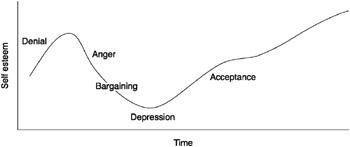
Figure 1.6: The process of change and adjustment
Source: based on Kubler-Ross (1969)
Further clinical and management researchers have added to Kubler-Ross’s five stages, in particular Adams, Hayes and Hopson (1976) as follows and as illustrated in Figure 1.7:
- Relief: ‘At least I now know what’s happening now, I had my suspicions, I wasn’t just being paranoid.’
- Shock and/or surprise: really a subset of denial but characterized by a sense of disbelief.
- Denial: total non-acceptance of the change and maybe ‘proving’ to oneself that it is not happening and hoping that it will go away.
- Anger: experiencing anger and frustration but really in an unaware sort of way, that is, taking no responsibility for your emotions.
- Bargaining: the attempt to avoid the inevitable.
- Depression: hitting the lows and responding (or being unresponsive) with apathy or sadness.
- Acceptance: the reality of the situation is accepted.
- Experimentation: after having been very inward looking with acceptance, the idea arrives that perhaps there are things ‘out there’. ‘Perhaps some of these changes might be worth at least thinking about. Perhaps I might just ask to see the job description of that new job.’
- Discovery: as you enter this new world that has changed there may be the discovery that things are not as bad as you imagined. Perhaps the company was telling the truth when it said there would be new opportunities and a better way of working.
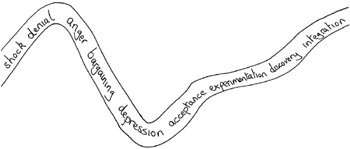
Figure 1.7: Adams, Hayes and Hopson's (1976) change curve
Virginia Satir model
Virginia Satir, a family therapist, developed her model (Satir et al, 1991) after observing individuals and families experience a wide range of changes. Her model not only has a number of stages but also highlights two key events that disturb or move an individual’s experience along: the foreign element and the transforming idea (Figure 1.8).
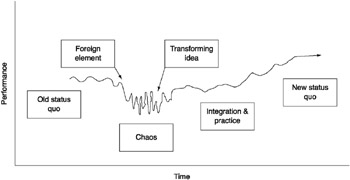
Figure 1.8: Satir's model
She describes the initial state as one of maintaining the status quo. We have all experienced periods within our lives – at home or at work – where day to day events continue today as they have done in previous days, and no doubt will be the same tomorrow. It may be that the organization you are working in is in a mature industry with well established working practices which need little or no alteration. This is a state in which if you carry on doing what you are doing, you will continue to get what you are getting. The situation is one of relative equilibrium where all parts of the system are in relative harmony. That is not to say, of course, that there is no dissatisfaction. It is just that no one is effecting change.
This changes when something new enters the system. Satir calls it a ‘foreign element’ in the sense that a factor previously not present is introduced. As with the examples from the two previous models it might be the onset of an illness, or in the world of work, a new chief executive with ideas about restructuring. Whatever the nature of this foreign element, it has an effect.
A period of chaos ensues. Typically this is internal chaos. The world itself may continue to function but the individual’s own perceived world might be turned upside down, or inside out. He or she may be in a state of disbelief – denial or emotional numbness – at first, not knowing what to think or feel or how to act. Individuals may resist the notion that things are going to be different. Indeed they may actually try to redouble their efforts to ensure that the status quo continues as long as possible, even to the extent of sabotaging the new ideas that are forthcoming. Their support networks, which before had seemed so solid, might now not be trusted to help and support the individual. They may not know who to trust or where to go for help.
During this period of chaos, we see elements of anger and disorganization permeating the individual’s world. Feelings of dread, panic and despair are followed by periods of apathy and a sense of pointlessness. At moments like this it may well seem like St John of the Cross’s Dark Night of the Soul (2003) when all hope has vanished.
But it is often when things have reached their very worst that from somewhere – usually from within the very depths of the person – the germ of an idea or an insight occurs. In terms of the Kubler-Ross model the individual is coming to terms with the reality of the situation and experiencing acknowledgement and acceptance. He or she has seen the light, or at least a glimmer of hope. An immense amount of work may still need to be done, but the individual has generated this transforming idea, which spreads some light on to the situation, and perhaps shows him or her a way out of the predicament.
Once this transforming idea has taken root, the individual can begin the journey of integration. Thus this period of integration requires the new world order to be assimilated into the individual’s own world.
Imagine a restructuring has taken place at your place of work. You have gone through many a sleepless night worrying what job you may end up in, or whether you will have a role at the end of the change. The jobs on offer do not appeal at all to you at first (‘Why didn’t they ask me for my views when they formulated the new roles?’ ‘If they think I’m applying for that they have another think coming!’). However as the chief executive’s thinking is made clearer through better communications, you grudgingly accept that perhaps he did have a point in addressing the complacency within the firm. Then perhaps one day you wake up and feel that maybe you might just have a look at that job description for the job in Operations. You have never worked in that area before and you have heard a few good things about the woman in charge.
You begin to accept the idea of a new role and ‘try it on for size’. Perhaps at first you are just playing along, but soon it becomes more experimentation and more of an exploration. As time moves on the restructure is bedded into the organization, roles and responsibilities clarified, new objectives and ways of working specified and results achieved. A new status quo is born. The scars are still there perhaps but they are not hurting so much.
Gerald Weinberg (1997), in his masterly book on change, but with a title that might not appeal to everyone (Quality Software Management, Volume 4: Anticipating Change) draws heavily on the Satir model and maps on to it the critical points that can under-mine or support the change process. (See Figure 1.9.) Weinberg shows that if the change is not planned well enough, or if the receivers of change consciously or unconsciously decide to resist, the change effort will falter.
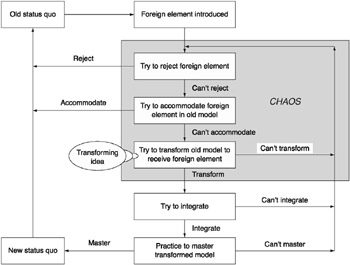
Figure 1.9: Critical points in the change process
Source: Weinberg (1997)
Reprinted by permission of Dorset House Publishing. All rights reserved.
Summary of psychodynamic approach
The psychodynamic approach is useful for managers who want to understand the reactions of their staff during a change process and deal with them. These models allow managers to gain an understanding of why people react the way they do. It identifies what is going on in the inner world of their staff when they encounter change.
As with all models, the ones we have described simplify what can be quite a complex process. Individuals do not necessarily know that they are going through different phases. What they may experience is a range of different emotions (or lack of emotion), which may cluster together into different groupings which could be labelled one thing or another. Any observer, at the time, might see manifestations of these different emotions played out in the individual’s behaviour.
Research suggests that these different phases may well overlap, with the predominant emotion of one stage gradually diminishing over time as a predominant emotion of the next stage takes hold. For example the deep sense of loss and associated despondency, while subsiding over time, might well swell up again and engulf the individual with grief, either for no apparent reason, or because of a particular anniversary, contact with a particular individual or an external event reported on the news.
Individuals will go through a process which, either in hindsight or from an observer’s point of view, will have a number of different phases which themselves are delineated in time and by different characteristics. However the stages themselves will not necessarily have clear beginnings or endings, and characteristics from one stage may appear in other stages.
Satir’s model incorporates the idea of a defining event – the transforming idea – that can be seen to change, or be the beginning of the change for, an individual. It may well be an insight, or waking up one morning and sensing that a cloud had been lifted. From that point on there is a qualitative difference in the person undergoing change. He or she can see the light at the end of the tunnel, or have a sense that there is a future direction.
Key learnings here are that everyone to some extent goes through the highs and lows of the transitions curve, although perhaps in different times and in different ways. It is not only perfectly natural and normal but actually an essential part of being human.
STOP AND THINK!
|
1.8 |
Think of a current or recent change in your organization.
|
THE HUMANISTIC PSYCHOLOGY APPROACH TO CHANGE
The humanistic psychological approach to change combines some of the insights from the previous three approaches while at the same time developing its own. It emerged as a movement in the United States during the 1950s and 1960s. The American Association of Humanistic Psychology describes it as ‘concerned with topics having little place in existing theories and systems: e.g. love, creativity, self, growth … self-actualization, higher values, being, becoming, responsibility, meaning … transcendental experience, peak experience, courage and related concepts’.
In this section we look at how the humanistic approach differs from the behavioural and cognitive approaches, list some of the key assumptions of this approach, and look at three important models within humanistic psychology.
Table 1.4 charts some of the similarities and differences between the psychoanalytic, behavioural, cognitive and humanistic approaches. Although taken from a book more concerned with counselling and psychotherapy, it illustrates where humanistic psychology stands in relation to the other approaches.
|
Theme |
Psychoanalytic |
Behaviourism |
Cognitive |
Humanistic |
|---|---|---|---|---|
|
Psychodynamic approach – looking for what is behind surface behaviour |
Yes |
No |
Yes |
Yes |
|
Action approach – looking at actual conduct of person, trying new things |
No |
Yes |
Yes |
Yes |
|
Acknowledgement of importance of sense-making, resistance, etc |
Yes |
No |
No |
Yes |
|
Use of imagery, creativity |
No |
Yes |
Yes |
Yes |
|
Use in groups as well as individual |
Yes |
No |
No |
Yes |
|
Emphasis on whole person |
No |
No |
No |
Yes |
|
Emphasis on gratification, joy, individuation |
No |
No |
No |
Yes |
|
Adoption of medical model of mental illness |
Yes |
Yes |
Yes |
No |
|
Felt experience of the practitioner important as a tool for change |
Yes |
No |
No |
Yes |
|
Mechanistic approach to client |
No |
Yes |
Yes |
No |
|
Open to new paradigm research methods |
No |
No |
Yes |
Yes |
|
Source: adapted from Rowan (1983) |
||||
Humanistic psychology has a number of key areas of focus:
- The importance of subjective awareness as experienced by the individual.
- The importance of taking responsibility for one’s situations – or at least the assumption that whatever the situation there will be an element of choice in how you think, how you feel and how you act.
- The significance of the person as a whole entity (a holistic approach) in the sense that as humans we are not just what we think or what we feel, we are not just our behaviours. We exist within a social and cultural context.
In juxtaposition with Freud’s view of the aim of therapy as moving the individual from a state of neurotic anxiety to ordinary unhappiness, humanistic psychology has ‘unlimited aims … our prime aim is to enable the person to get in touch with their real self’ (Rowan, 1983).
Maslow and the hierarchy of needs
Maslow did not follow the path of earlier psychologists by looking for signs of ill health and dis-ease. He researched what makes men and women creative, compassionate, spontaneous and able to live their lives to the full. He therefore studied the lives of men and women who had exhibited these traits during their lives, and in so doing came to his theory of motivation, calling it a hierarchy of needs. (See Figure 1.10.)
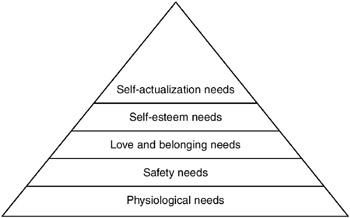
Figure 1.10: Maslow's hierarchy of needs
Source: Maslow (1970)
Maslow believed that human beings have an inbuilt desire to grow and develop and move towards something he called self-actualization. However in order to develop self-actualization an individual has to overcome or satisfy a number of other needs first.
One of Maslow’s insights was that until the lower level needs were met an individual would not progress or be interested in the needs higher up the pyramid. He saw the first four levels of needs as ‘deficiency’ needs. By that he meant that it was the absence of satisfaction that led to the individual being motivated to achieve something.
Physiological needs are requirements such as food, water, shelter and sexual release. Clearly when they are lacking the individual will experience physiological symptoms such as hunger, thirst, discomfort and frustration.
Safety needs are those that are concerned with the level of threat and desire for a sense of security. Although safety needs for some might be concerned with actual physical safety, Maslow saw that for many in the western world the need was based more around the idea of psychological safety. We might experience this level of need when faced with redundancy.
Love and belonging needs are more interpersonal. This involves the need for affection and affiliation on an emotionally intimate scale. It is important here to note that Maslow introduces a sense of reciprocity into the equation. A sense of belonging can rarely be achieved unless an individual gives as well as receives. People have to invest something of themselves in the situation or with the person or group. Even though it is higher in the hierarchy than physical or safety needs, the desire for love and belonging is similar in that it motivates people when they feel its absence.
Self-esteem needs are met in two ways. They are met through the satisfaction individuals get when they achieve competence or mastery in doing something. They are also met through receiving recognition for their achievement.
Maslow postulated one final need – the need for self-actualization. He described it as ‘the desire to become more and more what one is, to become everything that one is capable of becoming’. He observed that people continued to search for something else once all their other needs were being satisfied. Individuals try to become the person they believe or feel that they are capable of becoming. It is a difficult concept to put into words. Perhaps it is a longing for something to emerge from the depths of your being.
Before his death, Rabbi Zusya said, ‘In the coming world, they will not ask me, “Why were you not Moses?” They will ask me, “Why were you not Zusya?”’
Martin Buber, 1961, Tales of the Hasidim
Self-actualization can take many forms, depending on the individual. These variations may include the quest for knowledge, understanding, peace, self-fulfilment, meaning in life, or beauty … but the need for beauty is neither higher nor lower than the other needs at the top of the pyramid. Self-actualization needs aren’t hierarchically ordered.
(Griffin, 1991)
Rogers and the path to personal growth
Carl Rogers is one of the founders of the humanistic movement. He has written extensively on the stages through which people travel on their journey towards ‘becoming a person’. Rogers’ work was predominately based on his observations in the field of psychotherapy. However he was increasingly interested in how people learn, how they exercise power and how they behave within organizations.
Rogers is an important researcher and writer for consultants, as his ‘client-centred approach’ to growth and development provides clues and cues as to how we as change agents might bring about growth and development with individuals within organizations. Rogers (1967) highlighted three crucial conditions for this to occur:
- Genuineness and congruence: to be aware of your own feelings, to be real, to be authentic. Rogers’ research showed that the more genuine and congruent the change agent is in the relationship, the greater the probability of change in the personality of the client.
- Unconditional positive regard: a genuine willingness to allow the client’s process to continue, and an acceptance of whatever feelings are going on inside the client. Whatever feeling the client is experiencing, be it anger, fear, hatred, then that is all right. It is saying that underneath all this the person is all right.
- Empathic understanding: in Rogers’ words, ‘ it is only as I understand the feelings and thoughts which seem so horrible to you, or so weak, or so sentimental, or so bizarre – it is only as I see them as you see them, and accept them and you, that you feel really free to explore all the hidden roots and frightening crannies of your inner and often buried experience.’
Rogers continues, ‘in trying to grasp and conceptualize the process of change … I gradually developed this concept of a process, discriminating seven stages in it’. The following are the consistently recurring qualities at each stage as described by Rogers (1967):
- One:
- an unwillingness to communicate about self, only externals;
- no desire for change;
- feelings neither recognized nor owned;
- problems neither recognized nor perceived.
- Two:
- expressions begin to flow;
- feelings may be shown but not owned;
- problems perceived but seen as external;
- no sense of personal responsibility;
- experience more in terms of the past not the present.
- Three:
- a little talk about the self, but only as an object;
- expression of feelings, but in the past;
- non-acceptance of feelings; seen as bad, shameful, abnormal;
- recognition of contradictions;
- personal choice seen as ineffective.
- Four:
- more intense past feelings;
- occasional expression of current feelings;
- distrust and fear of direct expression of feelings;
- a little acceptance of feelings;
- possible current experiencing;
- some discovery of personal constructs;
- some feelings of self-responsibility in problems;
- close relationships seen as dangerous;
- some small risk-taking.
- Five:
- feelings freely expressed in the present;
- surprise and fright at emerging feelings;
- increasing ownership of feelings;
- increasing self-responsibility;
- clear facing up to contradictions and incongruence.
- Six:
- previously stuck feelings experienced in the here and now;
- the self seen as less of an object, more of a feeling;
- some physiological loosening;
- some psychological loosening – that is, new ways of seeing the world and the self;
- incongruence between experience and awareness reduced.
- Seven:
- new feelings experienced and accepted in the present;
- basic trust in the process;
- self becomes confidently felt in the process;
- personal constructs reformulated but much less rigid;
- strong feelings of choice and self-responsibility.
There are a number of key concepts that emerge from Rogers’ work which are important when managing change within organizations at an individual level:
- The creation of a facilitating environment, through authenticity, positive regard and empathic understanding, enabling growth and development to occur.
- Given this facilitating environment and the correct stance of the change agent, clients will be able to surface and work through any negative feelings they may have about the change.
- Given this facilitating environment and the correct stance of the change agent, there will be a movement from rigidity to more fluidity in the client’s approach to thinking and feeling. This allows more creativity and risk-taking to occur.
- Given this facilitating environment and the correct stance of the change agent, clients will move towards accepting a greater degree of self-responsibility for their situation, enabling them to have more options from which to choose.
Gestalt approach to individual and organizational change
Gestalt therapy originated with Fritz Perls, who was interested in the here and now. Perls believed that a person’s difficulties today arise because of the way he or she is acting today, here and now. In Perls’s words:
[T]he goal … must be to give him the means with which he can solve his present problems and any that may arise tomorrow or next year. The tool is self-support, and this he achieves by dealing with himself and his problems with all the means presently at his command, right now. If he can be truly aware at every instant of himself and his actions on whatever level – fantasy, verbal or physical – he can see how he is producing his difficulties, he can see what his present difficulties are, and he can help himself to solve them in the present, in the here and now.
(Perls, 1976)
A consultant using a Gestalt approach has the primary aim of showing clients that they interrupt themselves in achieving what they want. Gestalt is experiential, not just based on talking, and there is an emphasis on doing, acting and feeling. Gestaltists use a cycle of experience to map how individuals and groups enact their desires, but more often than not how they block themselves from completing the cycle as shown in Figure 1.11.
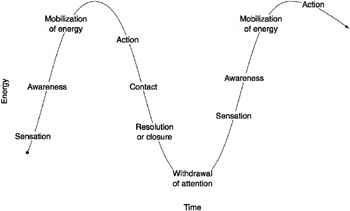
Figure 1.11: The Gestalt cycle
A favourite saying of Fritz Perls was to ‘get out of your mind and come to your senses’. Gestalt always begins with what one is experiencing in the here and now. Experiencing has as its basis what one is sensing. ‘Sensing determines the nature of awareness’ (Perls, Hefferline and Goodman, 1951).
What we sense outside of ourselves or within leads to awareness. Awareness comes when we alight or focus upon what we are experiencing. Nevis (1998) describes it as ‘the spontaneous sensing of what arises or becomes figural, and it involves direct, immediate experience’. He gives a comprehensive list of the many things that we can be aware of at any one moment, including the following:
- What we sense: sights, sounds, textures, tastes, smells, kinaesthetic stimulations and so on.
- What we verbalize and visualize: thinking, planning, remembering, imagining and so on.
- What we feel: happiness, sadness, fearfulness, wonder, anger, pride, empathy, indifference, compassion, anxiety and so on.
- What we value: inclinations, judgements, conclusions, prejudices and so on.
- How we interact: participation patterns, communication styles, energy levels, norms and so on.
Although your awareness can only ever be in the present, this awareness can include memory of the past, anticipation of the future, inner experience and awareness of others and the environment.
Mobilization of energy occurs as awareness is focused on a specific facet. Imagine you have to give a piece of negative feedback to a colleague. As you focus on this challenge by bringing it into the foreground, you might start to feel butterflies in your stomach, or sweaty palms. This is like using a searchlight to illuminate a specific thing and bring it into full awareness. In Nevis’s terminology this brings about an ‘energized concern’.
This energy then needs to be released typically by doing something, by taking action, by making contact in and with the outside world. You give the feedback.
Closure might come when the colleague thanks you for the feedback and compliments you on the clarity and level of insight. Or perhaps you have an argument and agree to disagree. You will then experience a reduction in your energy, and will complete the cycle by having come to a resolution, with the object of attention fading into the background once more. The issue of the colleague’s performance becomes less important.
For real change to have occurred (either internally or out in the world) the full Gestalt cycle will need to have been experienced.
Nevis shows how the Gestalt cycle maps on to stages in managerial decision making:
Awareness
Data generation, Seeking information, Sharing information, Reviewing past performance, Environmental scanning
Energy/action
Attempts to mobilize energy and interest in ideas or proposals, Supporting ideas presented by others, Identifying and experiencing differences and conflicts of competing interests or views, Supporting own position, Seeking maximum participation
Contact
Joining in a common objective, Common recognition of problem definition, Indications of understanding, not necessarily agreement, Choosing a course of possible future action
Resolution/closure
Testing, checking for common understanding, Reviewing what’s occurred, Acknowledgement of what’s been accomplished and what remains to be done, Identifying the meaning of the discussion, Generalizing from what’s been learned, Beginning to develop implementation and action plans
Withdrawal
Pausing to let things ‘sink in’
Reducing energy and interest in the issue
Turning to other tasks or problems
Ending the meeting.
STOP AND THINK!
|
1.9 |
Use the Gestalt curve to describe how a manager moves from a concern about the team’s performance to launching and executing a change initiative. |
Summary of humanistic psychology approach
For the manager, the world of humanistic psychology opens up some interesting possibilities and challenges. For years we have been told that the world of organizations is one that is ruled by the rational mind. Recent studies such as Daniel Goleman’s (1998) on emotional intelligence and management competence (see Chapter 4) suggest that what makes for more effective managers is their degree of emotional self-awareness and ability to engage with others on an emotional level. Humanistic psychology would not only agree, but would go one step further in stating that without being fully present emotionally in the situation you cannot be fully effective, and you will not be able to maximize your learning, or anyone else’s learning.
PERSONALITY AND CHANGE
We have looked at different approaches to change, and suggested that individuals do not always experience these changes in a consistent or uniform way. However we have not asked whether people are different, and if so, whether their difference affects the way they experience change.
We have found in working with individuals and teams through change that it is useful to identify and openly discuss people’s personality types. This information helps people to understand their responses to change. It also helps people to see why other people are different from them, and to be aware of how that may lead to either harmony or conflict.
The most effective tool for identifying personality type is the Myers Briggs Type Indicator (MBTI). This is a personality inventory developed by Katherine Briggs and her daughter Isabel Myers. The MBTI is based on the work of the Swiss analytical psychologist Carl Jung. The MBTI identifies eight different personality ‘preferences’ that we all use at different times – but each individual will have a preference for one particular combination over the others.
These eight preferences can be paired as set out below.
Where individuals draw their energy
Extraversion is a preference for drawing energy from the external world, tasks and things, whereas Introversion is a preference for drawing energy from the internal world of one’s thoughts and feelings.
What individuals pay attention to and how they receive data and information
Sensing is concerned with the five senses and what is and has been whereas Intuition is concerned with possibilities and patterns and what might be.
How an individual makes decisions
Thinking is about making decisions in an objective, logical way based on concepts of right and wrong whereas Feeling is about making decisions in a more personal values-driven and empathic way.
What sort of lifestyle an individual enjoys
Judging is a preference for living in a more structured and organized world which is more orderly and predictable, whereas Perceiving is a preference for living in a more flexible or spontaneous world where options are kept open and decisions not made until absolutely necessary.
So for example, a person who has a preference for Introversion, Intuition, Thinking and Judging (an INTJ, in the jargon) will have certain characteristics. Likewise an individual with a preference for Extroversion, Sensing, Feeling and Perceiving (ESFP) will have quite different characteristics.
The MBTI has been researched and validated for over 50 years now, and people rarely move permanently from their preferred ‘home’ type. That is not to say that Extroverts cannot spend time reflecting and being on their own, nor Introverts spend time in large groups discussing a broad range of issues. What it means is that if you are a particular type you have particular preferences and are different from other people of different types. This means that when it comes to change, people with different preferences react differently to change, both when they initiate it and when they are on the receiving end of it.
We can group the MBTI types into four categories for ease of analysis. One group of people will be cautious and careful about change – the Thoughtful Realists (those who are introverted sensing types). A second group will generate concepts that represent how things should be – the Thoughtful Innovators (introverted intuitives). A third group will have the energy and enthusiasm to get things done – the Action Oriented Realists (extraverted sensing). Meanwhile the fourth group – the Action Oriented Innovators (extraverted intuitives) – will be wanting to move into new areas and soon! (See Table 1.5.)
|
MBTI type by Quadrant |
IS Thoughtful Realist |
IN Thoughtful Innovator |
|---|---|---|
|
What they are most concerned with |
Practicalities |
Thoughts, ideas, concepts |
|
How they learn |
Pragmatically and by reading and observing |
Conceptually by reading, listening and making connections |
|
Where they focus their change efforts |
Deciding what should be kept and what needs changing |
Generating new ideas and theories |
|
Motto |
“If it isn’t broke don’t fix it” |
“Let’s think ahead” |
|
MBTI type by Quadrant |
ES Action Oriented Realist |
EN Action Oriented Innovator |
|
What they are most concerned with |
Actions |
New ways of doing things |
|
How they learn |
Actively and by experimentation |
Creatively and with others |
|
Where they focus their change efforts |
Making things better |
Putting new ideas into practice |
|
Motto |
“Let’s just do it” |
“Let’s change it” |
STOP AND THINK!
|
1.10 |
Use the Myers Briggs quadrants to identify your reactions to change.
|
MANAGING CHANGE IN SELF AND OTHERS
We now look at some of the factors that arise when you as a manager are required to manage change within your organization. We will:
- Discuss individual and group propensity for change.
- Introduce the work of Edgar Schein and his suggestions for managing change.
- Describe some of the ways that change can be thwarted.
- Identify how managers or change agents can help others to change.
RESPONSES TO CHANGE
Those who let it happen.
Those who make it happen.
Those who wonder what happened.
Anon
Propensity for change
We have isolated five factors, as shown in Figure 1.12, that have an influence on an individual’s response to change. As a manager of change you will need to pay attention to these five areas if you wish to achieve positive responses to change.
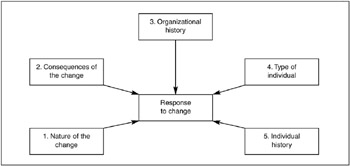
Figure 1.12: Five factors in responding to change
- The nature of the change varies. Changes can be externally imposed or internally generated. They can be evolutionary or revolutionary in nature. They can be routine or one-off. They can be mundane or transformative. They can be about expansion or contraction. Different types of change can provoke different attitudes and different behaviours.
- The consequences of the change are significant. For whose benefit are the changes seen to be (employees, customers, the community, the shareholders, the board)? Who will be the winners and who will be the losers?
- The organizational history matters too. This means the track record of how the organization has handled change in the past (or how the acquiring organization is perceived), what the prevailing culture is, what the capacity of the organization is in terms of management expertise and resources to manage change effectively, and what the future, beyond the change, is seen to hold.
- The personality type of the individual is a major determining factor in how she or he responds to change. The Myers Briggs type of the individual (reviewed earlier) can give us an indication of how an individual will respond to change. People’s motivating forces are also important – for example, are they motivated by power, status, money or affiliation and inclusion?
- The history of an individual can also give us clues as to how he or she might respond. By history we mean previous exposure and responses to change, levels of knowledge, skills and experience the individual has, areas of stability in his or her life and stage in his or her career. For example an individual who has previously experienced redundancy might re-experience the original trauma and upheaval regardless of how well the current one is handled. Or he or she may have acquired sufficient resilience and determination from the previous experience to be able to take this one in his or her stride.
Schein s model of transformative change
Edgar Schein has been a leading researcher and practitioner in the fields of individual, organizational and cultural change over the last 20 years. His seminal works have included Process Consultation and Organizational Culture and Leadership.
SCHEIN’S MODEL
Stage One
Unfreezing: Creating the motivation to change:
- Disconfirmation.
- Creation of survival anxiety or guilt.
- Creation of psychological safety to overcome learning anxiety.
Stage Two
Learning new concepts and new meanings for old concepts:
- Imitation of and identification with role models.
- Scanning for solutions and trial-and-error learning.
Stage Three
Refreezing: Internalizing new concepts and meanings:
- Incorporation into self-concept and identity.
- Incorporation into ongoing relationships.
Schein sees change as occurring in three stages:
- Unfreezing: creating the motivation to change.
- Learning new concepts and new meanings from old concepts.
- Internalizing new concepts and meanings.
During the initial unfreezing stage people need to unlearn certain things before they can focus fully on new learning.
Schein says that there are two forces at play within every individual undergoing change. The first force is learning anxiety. This is the anxiety associated with learning something new. Will I fail? Will I be exposed? The second, competing force is survival anxiety. This concerns the pressure to change. What if I don’t change? Will I get left behind? These anxieties can take many forms. Schein lists four of the associated fears:
- Fear of temporary incompetence: the conscious appreciation of one’s lack of competence to deal with the new situation.
- Fear of punishment for incompetence: the apprehension that you will somehow lose out or be punished when this incompetence is discovered or assessed.
- Fear of loss of personal identity: the inner turmoil when your habitual ways of thinking and feeling are no longer required, or when your sense of self is defined by a role or position that is no longer recognized by the organization.
- Fear of loss of group membership: in the same way that your identity can be defined by your role, for some it can be profoundly affected by the network of affiliations you have in the workplace. In the same way that the stable equilibrium of a team or group membership can foster states of health, instability caused by shifting team roles or the disintegration of a particular group can have an extremely disturbing effect.
What gets in the way of change resistance to change
Leaders and managers of change sometimes cannot understand why individuals and groups of individuals do not wholeheartedly embrace changes that are being introduced. They often label this ‘resistance to change’.
Schein suggests that there are two principles for transformative change to work: first, survival anxiety must be greater than learning anxiety, and second, learning anxiety must be reduced rather than increasing survival anxiety. Used in connection with Lewin’s force field (see Chapter 3), we see that survival anxiety is a driving force and learning anxiety is a restraining force. Rather than attempting to increase the individual or group’s sense of survival anxiety, Schein suggests reducing the individual’s learning anxiety. Remember also that the restraining forces may well have some validity.
How do you reduce learning anxiety? You do it by increasing the learner’s sense of psychological safety through a number of interventions. Schein lists a few:
- a compelling vision of the future;
- formal training;
- involvement of the learner;
- informal training of relevant family groups/teams;
- practice fields, coaches, feedback;
- positive role models;
- support groups;
- consistent systems and structures;
- imitation and identification versus scanning and trial and error.
STOP AND THINK!
|
1.11 |
Think of a recent skill that you had to learn in order to keep up with external changes. This could be installing a new piece of software, or learning about how a new organization works.
|
How managers and change agents help others to change
We have listed in Table 1.6 some of the interventions that an organization and its management could carry out to facilitate the change process. We have categorized them into the four approaches described earlier in this chapter.
|
Behavioural |
Cognitive |
|
Performance management Reward policies Values translated into behaviours Management competencies Skills training Management style Performance coaching 360 degree feedback |
Management by objectives Business planning and performance frameworks Results based coaching Beliefs, attitudes and cultural interventions Visioning |
|
Understanding change dynamics Counselling people through change Surfacing hidden issues Addressing emotions Treating employees and managers as adults |
Living the values Developing the learning organization Addressing the hierarchy of needs Addressing emotions Fostering communication and consultation |
|
Psychodynamic |
Humanistic |
From the behavioural perspective a manager must ensure that reward policies and performance management is aligned with the changes taking place. For example if the change is intended to improve the quality of output, then the company should not reward quantity of output. Kerr (1995) lists several traps that organizations fall into:
|
We hope for: |
But reward: |
|---|---|
|
Teamwork and collaboration |
The best team members |
|
Innovative thinking and risk-taking |
Proven methods and no mistakes |
|
Development of people skills |
Technical achievements |
|
Employee involvement and empowerment |
Tight control over operations |
|
High achievement |
Another year’s effort |
Managers and staff need to know in detail what they are expected to do and how they are expected to perform. Behaviour needs to be defined, especially when many organizations today are promoting ‘the company way’.
From the cognitive perspective a manager needs to employ strategies that link organizational goals, individual goals and motivation. This will create both alignment and motivation. An additional strategy is to provide ongoing coaching through the change process to reframe obstacles and resistances.
The psychodynamic perspective suggests adapting one’s managerial approach and style to the emotional state of the change implementers. This is about treating people as adults and having mature conversations with them. The psychodynamic approach enables managers to see the benefits of looking beneath the surface of what is going on, and uncovering thoughts that are not being articulated and feelings that are not being expressed. Working through these feelings can release energy for the change effort rather than manifesting as resistance to change.
Drawing on the transitions curve we can plot suitable interventions throughout the process. (See Figure 1.13.)
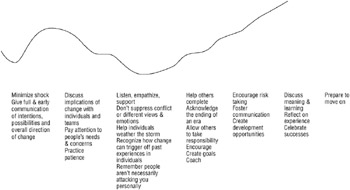
Figure 1.13: Management interventions through the change process
The humanistic psychology perspective builds on the psychodynamic ethos by believing that people are inherently capable of responding to change, but require enabling structures and strategies so to do. Healthy levels of open communication, and a positive regard for individuals and their potential contribution to the organization’s goals, contribute to creating an environment where individuals can grow and develop.
SUMMARY AND CONCLUSIONS
- Learning to do something new usually involves a temporary dip in performance.
- When learning something new, we focus on it and become very conscious of our performance. Once we have learnt something we become far less conscious of our performance. We are then unconsciously competent. This continues until something goes wrong, or there is a new challenge.
- There are four key schools of thought when considering individual change:
- The behaviourist approach is about changing the behaviours of others through reward and punishment. This leads to behavioural analysis and use of reward strategies.
- The cognitive approach is about achieving results through positive reframing. Associated techniques are goal setting and coaching to achieve results.
- The psychodynamic approach is about understanding and relating to the inner world of change. This is especially significant when people are going through highly affecting change.
- The humanistic psychology approach is about believing in development and growth, and maximizing potential. The emphasis is on healthy development, healthy authentic relationships and healthy organizations.
- Personality type has a significant effect on an individual’s ability to initiate or adapt to change.
- The individual’s history, the organization’s history, the type of change and the consequence of the change are also key factors in an individual’s response to change.
- Schein identified two competing anxieties in individual change: survival anxiety versus learning anxiety. Survival anxiety has to be greater than learning anxiety if a change is to happen. He advocated the need for managers to reduce people’s learning anxiety rather than increase their survival anxiety.
- Each of the four approaches above leads to a set of guidelines for managers:
- Behavioural: get your reward strategies right.
- Cognitive: link goals to motivation.
- Psychodynamic: treat people as individuals and understand their emotional states as well as your own!
- Humanistic: be authentic and believe that people want to grow and develop.
Part I - The Underpinning Theory
Part II - The Applications

EAN: 2147483647
Pages: 96
