Flylib.com

Books Software


Setting the Language


Setting the Language

You can also set the language. This ensures that foreign words as well as your native language are spell-checked and hyphenated using the proper dictionary. (Sorry, but changing the language doesn't translate the text.)

Tip

If you have [No Language] selected, InDesign can't substitute typographer's quotes ("curly" quotes) for the ordinary typewriter quotes ("dumb" quotes).


To set the language:

1.

Selectthe text that you want to set the language for.

2.

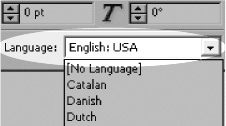
Choose the language from the pop-up menu in the Character palette .

The Language menu lets you set the language used for spelling checks as well as for typographer quotes .

Electronic Styling: Myths and Realities

As you set type using programs such as InDesign, people may tell you never to style fonts electronically . So if you use the Roman version of a font (such as Minion), you should never press the keyboard shortcut for italic. You should only choose the actual typeface (Minion Italic) from the font menu.

This rule emerged because some typefaces do not have an italic or bold version. The styling shows on the screen, but it doesn't print. Techno or Zapf Dingbats are examples of fonts that shouldn't be styled electronically. When people see their printed samples, they're disappointed that there is no bold or italic appearance.

Fortunately, InDesign prevents you from making errors like that. If you apply the shortcut for italic, InDesign applies the actual italic version. If there is no version, InDesign does not change the font. So there is no harm styling electronically using InDesign.

I've also heard people advise to avoid all caps, subscript, small caps, and other electronic styles on type. In most cases, there is nothing wrong with applying those styles, and InDesign allows you to apply those electronic styles to text.

In some cases you'll have better results with a small-caps version of a font than with the electronic style for small caps. However, a special small-caps font offers a subtle effect that few people will recognize. ( For an excellent discussion on how to use electronic small caps, see The Non-Designer's Type Book, by Robin Williams, published by Peachpit Press .)

I personally hate the electronic styling for Vertical and Horizontal Scale. They distort the type horribly. The Skew command is even worse ! However, I do accept that there might be times (grotesque Halloween cards?) where those distortions are acceptable.


Applying Paragraph Formatting

Paragraph formatting refers to the attributes that are applied to the paragraph as a whole. For instance, you cannot have half of the paragraph centered and the other half on the left size of the page. The alignment must be applied to the whole paragraph. InDesign paragraph formatting is applied using the Paragraph palette.

Tip

As you work with text frames , the Control palette changes to display many of the text controls found in the Character palette. This makes it possible to style text using just the Control palette. See "Using the Control Palette for Text" at the end of this chapter for information on using it to style text.


To work with the Paragraph palette:

1.

If the Paragraph palette is not visible, choose Window > Type & Tables > Paragraph or Type > Paragraph . This opens the Paragraph palette .

The Paragraph palette controls attributes that are applied to the whole paragraph .

or

Click the Paragraph palette tab to move it to the front of a set of tabbed palettes.

2.

To display all the paragraph formatting controls, choose Show Options from the Paragraph palette pop-up menu.

Tip

The Paragraph palette menu also contains additional controls for formatting text . ( See Chapter 16, "Typography Controls," for more on working with the Paragraph palette menu .)

The Paragraph palette menu contains additional controls for paragraph attributes .

Tip

The following techniques are useful when applying paragraph attributes:

  • To apply attributes to a single paragraph, click to place an insertion point within the paragraph.

  • To apply attributes to more than one paragraph, select a portion of the first and last paragraphs and the paragraphs in between.