Flylib.com

Books Software


Pay Close Attention to UDDI

Pay Close Attention to UDDI

There is a school of thought that believes Web services will really start to take off when public UDDI directories/registries become more widespread. Essentially, once these directories are in place, enterprises will be able to find a wealth of object-oriented applications that can be automatically integrated with enterprise applications to provide enterprises with additional functionality. These Web services applications would be made available for a fee (which is how some of the Web services applications makers would make money), or in some cases for free.

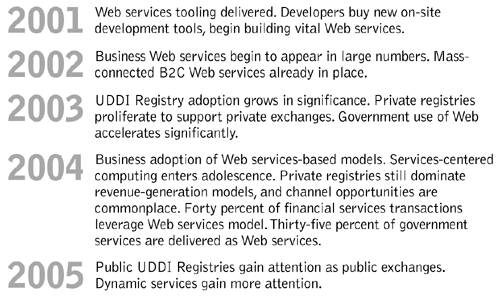
As shown in Figure 7-1, Gartner Group (a highly respected research and analysis firm) estimates that Web services will really start to take off in 2005 as public UDDI directories emerge and mature.

Figure 7-1. When Will Your Organization Need to Adopt Web Services?

Source: "Web Services: Software as Service Comes Alive," Daryl Plummer, October 2001. Used by Permission.
graphics/07fig01.jpg

Chapter Summary

When should your organization adopt Web services? The answer depends largely on two factors: (1) the skill set of your programmers (particularly in the areas of object programming and messaging architecture), and (2) your organization's need ( open new markets, reduce development costs, etc.).

As illustrated in earlier chapters, hundreds of organizations are currently using Web services to perform a variety of tasks . Visit www.Xmethods.com, as well as Microsoft and IBM Web sites, for examples of customers and applications that have currently been developed.

Much activity to date in terms of Web services development has been focused on B2B transactions as well as on reducing application development costs.

From a B2B perspective the important point is that Web services are based on a message-passing store-and-forward architecture that lends itself nicely to conducting transactions between business partners . And writing XML and Web services applications is reported to be easier than using EDI (although EDI is more sophisticated, reliable, and secure at the present time).

With respect to reducing application development costs, many enterprises are starting to consolidate all of their application objects into internal registries. They hope to reduce development costs by encouraging application developers to make use of already existing application objects rather than constantly reinventing-the-wheel with redundant application objects.

Finally, many organizations are starting to recognize that Web services offer them the potential to open new markets, or to service existing markets in new and different ways.

When should your organization adopt Web services? Now —if your organization has a need to consolidate existing application objects, or can take advantage of Web services to reduce application development costs, or has found a way to open new markets. By 2005 —if your organization is looking to capitalize on a vast application database that will manifest itself in public UDDI directories of the future.


Part III: A Business Executive Buyer's Guide

Chapter 8.  What Vendor Selection Criteria Should Be Used?

Chapter 9.  Should We Adopt .NET or J2EE?

Chapter 10.  Vendor Comparison—Contrasting Various Product and Service Offerings

Chapter 11.  A Review of Where This Book Has Taken Us

Summary Observations and Conclusions


Chapter 8. What Vendor Selection Criteria Should Be Used?

In This Chapter

Key Insights

How Do You Build/Acquire Web Services Applications? Three Approaches

A Closer Look at the Application Server Marketplace

First-Pass Look at the Market Positioning of Some of the Application Server Competitors

Chapter Summary